Rangoli Meaning: Why Sacred Patterns Welcome Beauty and Blessing
Rangoli turns an ordinary threshold into a place of welcome, joining beauty, hospitality, impermanence, regional memory, and daily devotional attention.
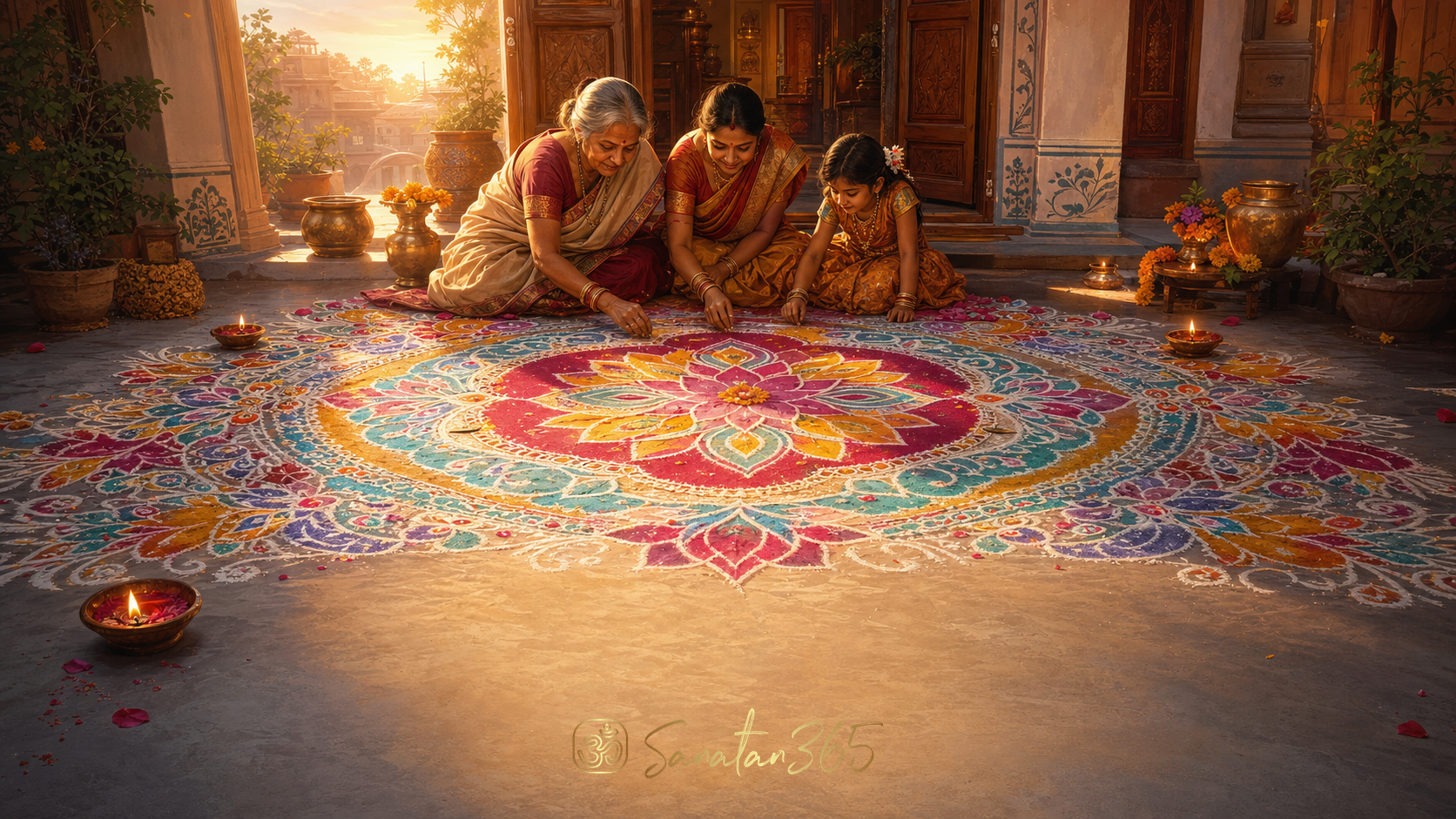
A doorway can be cleaned in minutes, yet a rangoli asks someone to pause, bend close to the earth, and make welcome visible. Rangoli meaning begins with this act: temporary patterns made at thresholds, courtyards, shrines, and festival spaces to invite auspiciousness, honour guests, and turn everyday ground into a field of attentive beauty.
Rangoli is not one fixed design or one universal ritual. It is a broad family of Indian floor-art traditions created with rice flour, stone or chalk powder, grains, flowers, natural colours, and, today, many modern materials. Names, methods, and meanings change by region. What remains remarkably consistent is the discipline of preparing a place with care.
What Is Rangoli Meaning in Hindu Tradition?
The word rangoli is commonly connected with colour and patterned lines. In practice, it describes designs drawn on the ground, especially near an entrance or sacred area. A rangoli may be geometric, floral, figurative, freehand, or built from a grid of dots. It may last an hour or several days.
Its meaning comes less from a single symbol dictionary than from the relationship between action, place, and occasion. The maker cleans the surface, selects materials, creates order from scattered powder, and offers that beauty without expecting permanence. The completed design can express mangala (मङ्गल, auspiciousness or well-being), hospitality, gratitude, protection, celebration, and devotion.
Hindu household practice often understands beauty as ethically active. A cared-for threshold tells a guest, neighbour, deity, or returning family member: this place has been prepared for your arrival. That is why rangoli belongs naturally beside lamps, flowers, water, and other gestures of welcome.
The Sahapedia overview of Indian floor-drawing traditions documents the extraordinary regional variety of these arts. That variety matters. Rangoli should not be reduced to a decorative festival craft detached from the communities that sustain it.
Key takeaway: Rangoli is temporary sacred threshold art whose deepest meaning is attentive welcome.
Why Is Rangoli Made at the Threshold?
The threshold is neither fully inside nor fully outside. It is where household life meets the street, where a guest becomes part of the home, and where daily movement repeatedly crosses a boundary. Marking that place gives ordinary arrival a sacred dimension.
Many families draw rangoli after sweeping and washing the entrance. Cleaning is practical, but it can also become shaucha (शौच, purity or disciplined cleanliness). The pattern that follows is not meant to conceal disorder. It is the visible completion of preparation.
During Diwali, rangoli is often associated with welcoming Goddess Lakshmi, who represents prosperity, beauty, and auspicious abundance. Yet not every rangoli is a Lakshmi rangoli, and customs differ widely. Designs may honour Ganesha, celebrate a wedding, mark a vrata, welcome guests, accompany a harvest observance, or simply renew the doorway each morning.
The practice also carries a social message. A carefully prepared entrance can make hospitality public before a word is spoken. It says that those who approach will be received with dignity. This echoes the ethic explored in Atithi Devo Bhava: welcome becomes sacred when it protects the guest's dignity rather than displaying the host's status.
Key takeaway: The threshold is decorated because it is a living boundary where cleanliness, welcome, and sacred attention meet.
What Do Rangoli Patterns and Materials Symbolize?
Common motifs include lotuses, vines, leaves, conch forms, lamps, footprints, birds, fish, circles, squares, stars, and repeating geometries. Their significance depends on context. A lotus may suggest purity and spiritual unfolding; a lamp may evoke knowledge; paired footprints may welcome a deity in one household and mark a festive entrance in another.
Geometry gives the design rhythm and balance. Repetition guides attention. Symmetry can suggest ordered relationship, while expanding patterns make a small threshold feel connected to a larger cosmos. These are contemplative possibilities, not rigid universal codes.
Materials matter too:
- Rice flour joins beauty with nourishment. In some daily traditions, tiny creatures may consume it, allowing household art to participate in generosity toward life.
- Stone or chalk powder creates crisp, durable lines suited to intricate designs.
- Flowers and leaves bring fragrance, season, and living colour.
- Turmeric and kumkum may add colours already associated with blessing and worship. Their careful use should follow family custom; readers can explore the distinct meaning of kumkum.
- Grains, pulses, and sand create texture, but edible materials should be used responsibly and never wasted merely for display.
Modern chemical colours can be bright, yet households should check ingredients, protect children and animals, avoid powders that irritate skin or lungs, and prevent runoff into drains and soil. Reverence includes care for bodies and the environment.
Key takeaway: Rangoli symbols gain meaning through occasion and community, while materials connect art to nourishment, season, and responsibility.
How Do Rangoli Traditions Vary Across India?
“Rangoli” is a useful umbrella term, but regional names preserve distinct practices.
- In Maharashtra and parts of western India, rangoli often uses fine powder and flowing freehand or geometric motifs at home entrances and festival spaces.
- In Tamil Nadu, kolam (கோலம், threshold pattern) is frequently drawn with rice flour through dot grids and continuous lines. Its daily discipline and mathematical elegance deserve recognition as a specific tradition, explored in Kolam meaning.
- In Karnataka, rangavalli traditions include dot-based and freehand designs used daily and on special occasions.
- In Andhra Pradesh and Telangana, muggu often transforms dot grids into extensive threshold patterns, especially during Sankranti.
- In Bengal, alpana commonly uses a liquid rice-paste medium and expressive white motifs for puja, vrata, and household ceremonies.
- In the Kumaon region of Uttarakhand, aipan uses white rice paste on a red-ochre ground for ritual diagrams connected with specific ceremonies and sacred seats.
These forms should not be treated as interchangeable fonts. Each carries local vocabulary, bodily technique, calendar, and inherited knowledge. Learning from a practitioner or reliable regional source is more respectful than copying a sacred diagram without knowing its purpose.
Diaspora families often adapt the practice to apartment corridors, weather, rental rules, and available materials. A removable board, flower arrangement, or small rice-flour design can preserve the intention without creating hazards or conflict. Adaptation has always been part of living tradition when it remains honest about its source.
Key takeaway: Regional floor arts share a family resemblance, but their distinct names, materials, and ritual contexts deserve careful respect.
How Can Beginners Make Rangoli Respectfully?
A beginner does not need to imitate a complex ceremonial diagram. A modest design made attentively is better than an elaborate pattern copied without context.
- Clean and dry a safe, visible area that will not become slippery.
- Ask whether the household or occasion has an established regional form.
- Choose non-toxic materials suitable for children, animals, wind, and cleanup.
- Begin with dots, a circle, petals, or a simple symmetrical border.
- Work from the centre outward, keeping breathing relaxed and movements steady.
- If adding a lamp, use a stable holder and maintain fire safety.
- Credit the regional tradition when sharing a learned design publicly.
- Remove the design respectfully when it fades, and dispose of materials responsibly.
Avoid placing sacred words, deity faces, or mantras where feet will cross them. Do not reproduce specialised yantras (यन्त्र, sacred geometric diagrams) as casual décor; such forms can have ritual contexts that require guidance. Similarly, festival competitions should celebrate skill without mocking simpler household work or turning living tradition into cultural costume.
Children can participate by sorting flowers, placing dots, or learning one family motif. The lesson is not perfection. It is patience, coordination, memory, and shared responsibility for the beauty of a home.
Key takeaway: Respectful rangoli begins with safety, cultural context, modest materials, and a willingness to learn.
Why Does Rangoli Teach Impermanence and Renewal?
Rangoli is made to disappear. Footsteps disturb it. Wind softens its edges. Rain carries colour away. The next day, the maker may sweep the remains and begin again.
That fragility is not a flaw. It places beauty beside anitya (अनित्य, impermanence). The value of the work does not depend on possession or preservation. Its discipline lies in offering full attention to something temporary.
Daily renewal also prevents sacred practice from becoming a museum object. The design must return through human hands. A grandmother's curve, a parent's grid, or a child's first uneven flower keeps knowledge embodied. Repetition creates continuity, while variation keeps it alive.
In a culture of permanent posts and instant duplication, rangoli offers a different measure. Make carefully. Share generously. Let go without resentment. Prepare the ground again. This is not withdrawal from life; it is a practical education in loving what cannot be held forever.
The threshold then becomes a teacher. Every crossing asks whether one brings care into the home and dignity into the world outside it. The pattern may vanish, but the habit of welcome can remain.
Key takeaway: Rangoli makes impermanence visible and turns renewal into a daily spiritual discipline.
Conclusion
Rangoli transforms ground into greeting. Across India's regional traditions, it gathers cleaning, geometry, colour, memory, hospitality, environmental care, and devotion into one temporary act. Its power is not that every pattern carries a secret universal code. Its power is that someone chooses to prepare a shared threshold beautifully.
Key takeaway: The true meaning of rangoli is beauty offered as welcome, renewed with humility, and released without attachment.
FAQ
What is the spiritual meaning of rangoli?
Rangoli commonly expresses auspiciousness, welcome, gratitude, protection, and devotional attention. Its exact meaning depends on the region, household, design, and occasion.
Why is rangoli made outside the front door?
The entrance is a boundary between home and the wider world. Preparing it with a rangoli marks welcome, cleanliness, and sacred attention for guests, family members, and, in some traditions, a deity.
Is rangoli only made during Diwali?
No. Diwali is strongly associated with rangoli, but many communities create related floor art daily and for weddings, pujas, harvest festivals, vratas, and other household observances.
What is the difference between rangoli, kolam, alpana, and aipan?
Rangoli is often used broadly, while kolam, alpana, and aipan name distinct regional traditions with their own materials, techniques, motifs, and ritual contexts. They should be learned and credited specifically.
Can beginners make rangoli without religious expertise?
Yes. Beginners can create a simple floral or geometric threshold pattern with safe materials. They should avoid copying specialised sacred diagrams or placing divine names and images where people may step on them.
About the author
Sanatan365 Editorial
Bringing Sanatan Dharma to modern seekers through authentic, scripture-grounded content.
Related in Practices
 Practices
Bhuta Shuddhi Meaning: Purifying the Five Elements Within
Bhuta Shuddhi means the purification of the five elements: earth, water, fire, air, and space. In Hindu yogic and Tantric traditions, it is…
 Practices
Likhita Japa: Meaning and Practice of Writing a Mantra
Likhita japa turns mantra repetition into a written devotional discipline. Learn its meaning, how it differs from spoken and mental japa, a…
 Practices
Surya Arghya Meaning: Why Water Is Offered to the Rising Sun
Learn the meaning of Surya Arghya, why devotees offer water to the rising sun, and how to approach this daily Hindu practice with gratitude…