Guruvayur Temple: Krishna, Sacred Presence, and Kerala Devotion
Guruvayur Temple in Kerala honors Guruvayurappan, the four-armed form of Krishna-Vishnu. Its sacred stories, Narayaneeyam tradition, and daily worship reveal a distinctive culture of devotion.
A temple can hold cosmic majesty and the intimacy of a beloved child in the same sacred image. Guruvayur Temple in Kerala does exactly that: it honors Guruvayurappan, Krishna worshipped in a four-armed Vishnu form, through a living rhythm of offerings, poetry, music, and pilgrimage. Understanding the temple means seeing how its image, origin story, and devotional literature belong together, rather than treating it simply as another destination to photograph.
Located in Guruvayur in Kerala's Thrissur district, this is a place where devotion has acquired a distinctive regional language without losing its connection to the wider Krishna tradition. Its significance becomes clearer through six questions: who is present, what the image expresses, how the sacred story is told, why poetry matters, how worship structures the day, and what a thoughtful visit asks of a pilgrim.
What Makes Guruvayur Temple a Center of Krishna Devotion?
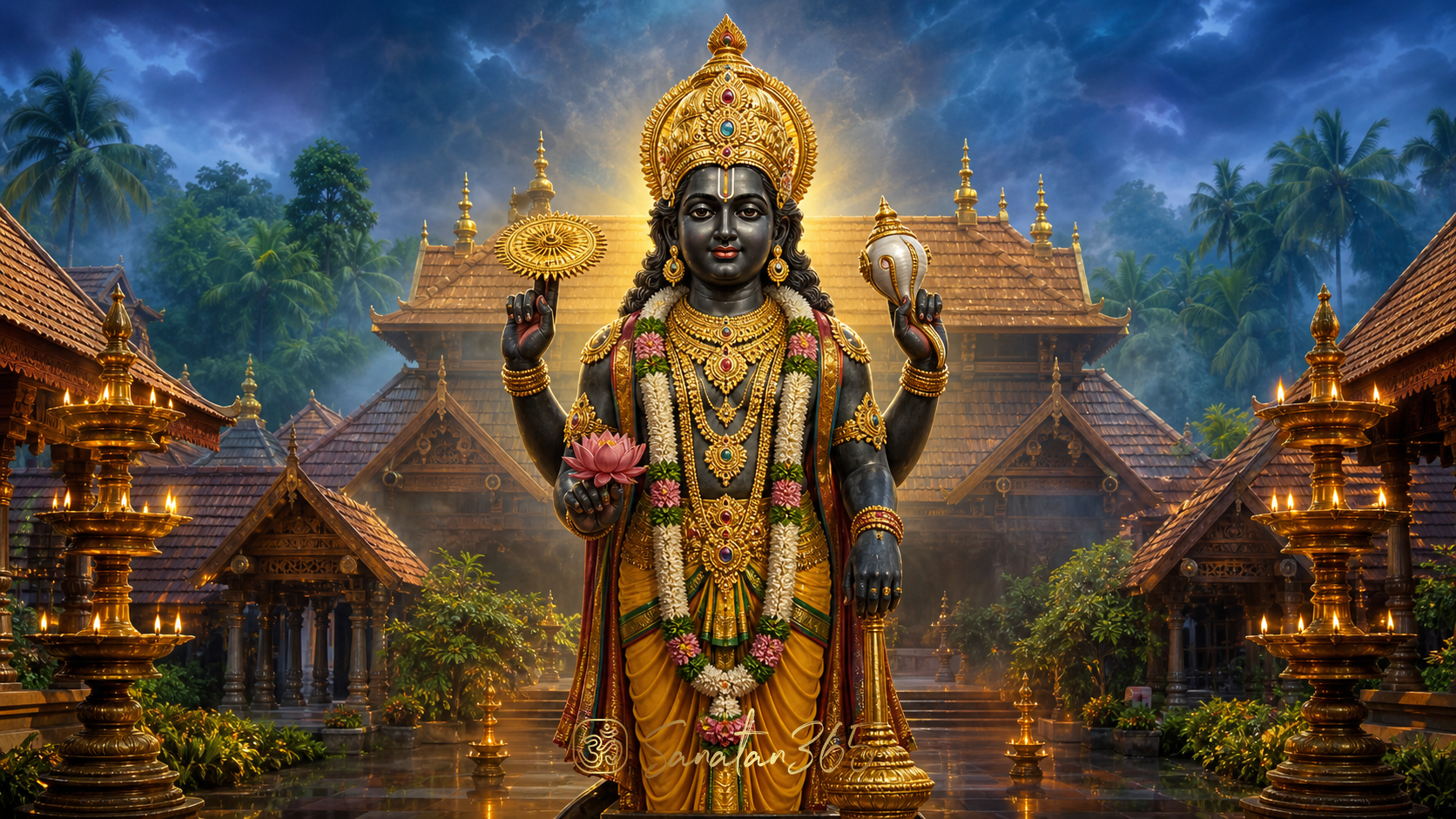
Guruvayurappan means the Lord of Guruvayur. Devotees approach him as Krishna, often with the affection associated with the divine child, while the principal sacred image bears the four arms familiar from Vishnu iconography. These are not competing identities that a visitor must choose between. They express related dimensions of the deity within the temple's devotional understanding.
Bhakti (भक्ति, loving devotion) supplies the connection. It allows grandeur to become personal: the sustainer of the universe is also the one addressed in song, remembered during household work, or approached with a quiet family prayer. The temple's appeal is therefore not limited to the scale of its buildings. It lies in the relationship maintained through repeated acts of attention.
Kerala Tourism's Guruvayoor temple account identifies it as a major Krishna pilgrimage center and describes its traditional Kerala architecture. That regional setting matters. Sloping roofs, enclosed worship spaces, lamps, and the temple's ceremonial environment create a different visual experience from the towering gateways often associated with Tamil temple towns.
A useful comparison is the Krishna tradition at Udupi. Both places center Krishna devotion, but their institutions, sacred narratives, and ritual arrangements should not be flattened into one interchangeable South Indian pattern. The distinctiveness of Guruvayur is part of its meaning, not a decorative variation on a generic temple.
Darshan (दर्शन, sacred seeing and being seen) helps explain what draws a pilgrim inward. The encounter is not understood merely as viewing a valuable object. It is an act of relationship in which the worshipper becomes attentive before the deity. A brief moment may carry weight because it has been prepared by waiting, remembrance, and a lifetime of hearing the divine name.
Key takeaway: Guruvayur joins Krishna's intimate devotional presence with the majesty of Vishnu in a specifically Kerala temple culture.
Why Does Guruvayurappan Have Four Arms?
The principal image holds the conch, discus, mace, and lotus, as described in ISKCON Educational Services' account of Guruvayur. These attributes make the Vishnu connection visible. A flute-bearing Krishna image may be more familiar from popular devotional art, but it should not be substituted for Guruvayurappan when describing the temple's central icon.
In Sanskrit, these emblems are shankha (शङ्ख, conch), chakra (चक्र, discus), gada (गदा, mace), and padma (पद्म, lotus). Their meanings are explored in different ways across texts and teaching traditions. A careful introductory reading can associate them with sacred proclamation, divine order, protective strength, and purity without pretending that each symbol has only one authorized interpretation.
The distinction between image and interpretation matters. The four attributes are recognizable iconographic features; the lessons drawn from them are a devotional reading. A writer should not turn an attractive modern explanation into a quotation from scripture or claim that every worshipper understands the symbols identically.
The wider symbolism of Vishnu's conch, discus, mace, and lotus provides useful background. At Guruvayur, however, those emblems are not an abstract diagram. They belong to a particular worshipped presence, surrounded by a particular community and history of remembrance.
Murti (मूर्ति, a sacred embodied form used in worship) is the appropriate term for that image. For devotees, its significance is not exhausted by material, craftsmanship, or age. The four-armed form offers a way of holding together protection and tenderness, power and accessibility. Krishna need not lose cosmic stature to be approached with affection.
This also explains why temple imagery deserves precision. A beautiful illustration of a pastoral Krishna scene may express genuine devotion, yet still fail to describe the specific central form at Guruvayur. Respectful art and accurate art should support each other.
Key takeaway: Guruvayurappan's four arms identify a Vishnu form of Krishna; devotional intimacy does not erase that iconographic specificity.
What Does the Guru and Vayu Origin Story Express?
The traditional narrative recorded by ISKCON Educational Services connects Guruvayur with Guru, understood here as Brihaspati, and Vayu, the wind deity. In the familiar sacred account, they bring and establish an image associated with Krishna's Dwaraka. The conjunction of their names explains Guruvayur within that traditional narrative.
This should be introduced as a sacred origin story, not presented as an archaeologically established transport record. Reverence does not require confusing kinds of evidence. A community's account of why a place is holy and a historian's account of when a surviving structure was built answer different questions.
The story links Kerala with the larger sacred geography of Krishna. The western coastal temple is not portrayed as spiritually isolated. It receives a presence whose associations reach beyond its immediate region. At the same time, that presence becomes rooted in local worship, local language, and the recurring life of the town.
One possible reflection is the partnership suggested by Guru and Vayu: guidance and movement, understanding and the carrying forward of a sacred responsibility. This is a reading offered for contemplation, not a claim that the legend has only that meaning. The story's devotional force exceeds a single moral extracted from it.
Pilgrims can preserve three useful distinctions:
- Traditional narrative: how devotees tell the coming of the sacred image.
- Documented history: what reliable records establish about people, institutions, buildings, and change.
- Personal reflection: what the story invites someone to consider in their own life.
Keeping these distinctions clear protects both faith and accuracy. There is no need to attach an unsupported numerical age to the temple to explain its importance. A living tradition can deserve careful attention without an exaggerated claim of antiquity.
For current temple information, the official Guruvayur Devaswom website is the appropriate starting point. Its institutional guidance should take precedence over copied travel summaries when a practical decision depends on present arrangements.
Key takeaway: The Guru-Vayu account expresses sacred continuity and belonging; it should be respected as tradition without being mislabeled historical proof.
How Did Narayaneeyam Shape Guruvayur Devotion?
Narayaneeyam (नारायणीयम्, a devotional work centered on Narayana, a name of Vishnu) is closely associated with Guruvayur and the Sanskrit poet Melpathur Narayana Bhattathiri. It condenses themes and narratives of the Bhagavata Purana (भागवत पुराण, a sacred text celebrating the Divine, especially Vishnu and Krishna) into a work of concentrated praise, as identified in the Vedanta Press catalogue for Swami Tapasyananda's translation.
The connection matters because a temple is sustained not only by architecture and ceremony, but also by words remembered beyond its walls. Poetry can bring a sacred place into the home. A passage heard repeatedly may shape how a devotee later sees the image, understands a festival, or speaks in prayer.
Narayana (नारायण, a divine name associated with Vishnu) and Krishna belong within that shared devotional world. The literary tradition moves across cosmic description, divine manifestations, and the intimacy of Krishna's presence. It does not require a reader to separate philosophical depth from affectionate praise.
For a newcomer, a measured way to approach the work is more useful than attempting an impressive quantity of recitation without understanding:
- Choose a short passage with a reliable translation.
- Identify the episode or divine quality it describes.
- Notice whether the passage narrates, praises, asks, or contemplates.
- Read slowly enough to understand what is being addressed.
- Return to the same passage before moving to another.
This is a reading suggestion, not a replacement for a teacher's recitation guidance or a prescribed temple practice. Pronunciation and interpretive details can be learned patiently from competent sources.
The wider significance is that devotional literature makes attention repeatable. Not every devotee can travel often, and not every visit permits prolonged stillness. A poem provides a form of return. The temple remains a concrete place, while remembrance continues elsewhere.
Care is also needed when repeating anecdotes about poets and saints. Devotional biographies may carry theological and moral meanings that cannot be treated as ordinary documentary claims. An introductory temple article need not repeat every dramatic story to communicate the depth of the literary tradition.
Key takeaway: Narayaneeyam helps extend Guruvayur's devotional life through poetry, listening, understanding, and repeated remembrance.
How Does Daily Worship Give the Temple Its Rhythm?
A living temple follows a sacred timetable, not simply a visitor's preferred itinerary. Puja (पूजा, ritual worship) includes offerings and acts of service to the deity. At Guruvayur, the daily succession of worship gives time a structure that a pilgrim enters rather than controls.
Kerala Tourism's account draws attention to the deepastambham, a pillar of lamps, and the nalambalam, the enclosing temple structure around the inner sacred area. Such features are more than picturesque details. Light, movement, enclosure, and the approach toward the sanctum help organize the experience of worship.
A lamp is visible for a moment, yet lighting it requires preparation and continued care. That simple observation offers a useful way to understand temple service. What appears effortless to a visitor depends on recurring work: cleaning, arranging offerings, maintaining order, and observing the requirements of the worship tradition.
The pilgrim sees only part of that labor. Recognizing it changes the attitude of a visit. Waiting becomes participation in a shared setting rather than merely a delay before a private experience. Courtesy toward staff and other devotees is not separate from reverence at the sanctum.
Prasad (प्रसाद, an offering received as divine grace) similarly shifts emphasis from acquisition to reception. It is not best understood as a souvenir whose value grows with the amount collected. Its meaning belongs to the relationship between offering, worship, and grateful receiving.
Festival periods bring additional rhythms, but a general article should not turn an old schedule into current booking advice. Opening arrangements, queues, services, and access instructions can change. The Devaswom's current notices are the proper authority for planning a particular day.
Key takeaway: Guruvayur's daily worship teaches that devotion is sustained through recurring service, shared discipline, and attention to more than one's own visit.
How Can a Pilgrim Approach Guruvayur Thoughtfully?
A meaningful visit begins before joining a queue. Learning the deity's form, reading a little of the temple's background, and checking current official instructions reduce avoidable confusion. Practical preparation supports attention; it need not compete with devotion.
A simple preparation list can help:
- Check the Devaswom's current dress, access, booking, and belongings guidance.
- Allow room for waiting and changes in the day's arrangements.
- Consider the needs of older relatives, children, and anyone requiring assistance.
- Follow staff instructions and local rules on photography and phones.
- Avoid purchasing services on the strength of unverifiable promises.
No offering, payment, or travel effort should be described as guaranteeing a particular worldly result. Devotion is not a transaction in which an external outcome can be purchased. A temple guide serves readers better by clarifying practice than by amplifying extraordinary promises.
For diaspora families or those unable to travel, reading about Guruvayur can still build cultural understanding. Learning the difference between the four-armed temple form and other Krishna images, listening to a translated devotional passage, or discussing the origin narrative can make a future visit more intelligible.
The central question is not how many rituals can be fitted into one morning. It is what kind of attention the visit encourages. Has the pilgrim learned to wait with greater courtesy, distinguish belief from unsupported claims, or recognize the work behind a shared sacred place? These are modest questions, but they give the experience a life beyond the queue.
Guruvayur's power as a devotional center lies in the meeting of a specific image, an inherited story, a literary voice, and daily service. None needs to be reduced to a slogan. Together they show how a temple becomes both a destination and a continuing relationship.
Key takeaway: A thoughtful pilgrimage combines practical preparation with accurate understanding, patient attention, and respect for the living community of worship.
FAQ
Where is Guruvayur Temple located?
Guruvayur Temple is in Guruvayur town in the Thrissur district of Kerala. Current travel and temple arrangements should be checked through official sources before a visit.
Is Guruvayurappan Krishna or Vishnu?
Guruvayurappan is worshipped as Krishna in a four-armed Vishnu form. The image holds the conch, discus, mace, and lotus, while devotional affection often centers on Krishna's intimate presence.
Why is the temple called Guruvayur?
The traditional explanation joins Guru, identified with Brihaspati, and Vayu, who are associated with bringing and establishing the sacred image. This is the temple's sacred origin narrative, not a substitute for historical evidence.
What connects Narayaneeyam with Guruvayur?
Melpathur Narayana Bhattathiri's Narayaneeyam is closely associated with devotion at Guruvayur. Its Sanskrit praise condenses Bhagavata themes and helps devotees approach the deity through poetry and remembrance.
Where should visitors check current temple rules?
Use the official Guruvayur Devaswom website and current temple notices for dress, access, booking, and service instructions. Older articles and forwarded messages may no longer reflect the arrangements in force.
About the author
Sanatan365 Editorial
Bringing Sanatan Dharma to modern seekers through authentic, scripture-grounded content.
Related in Temples
 Temples
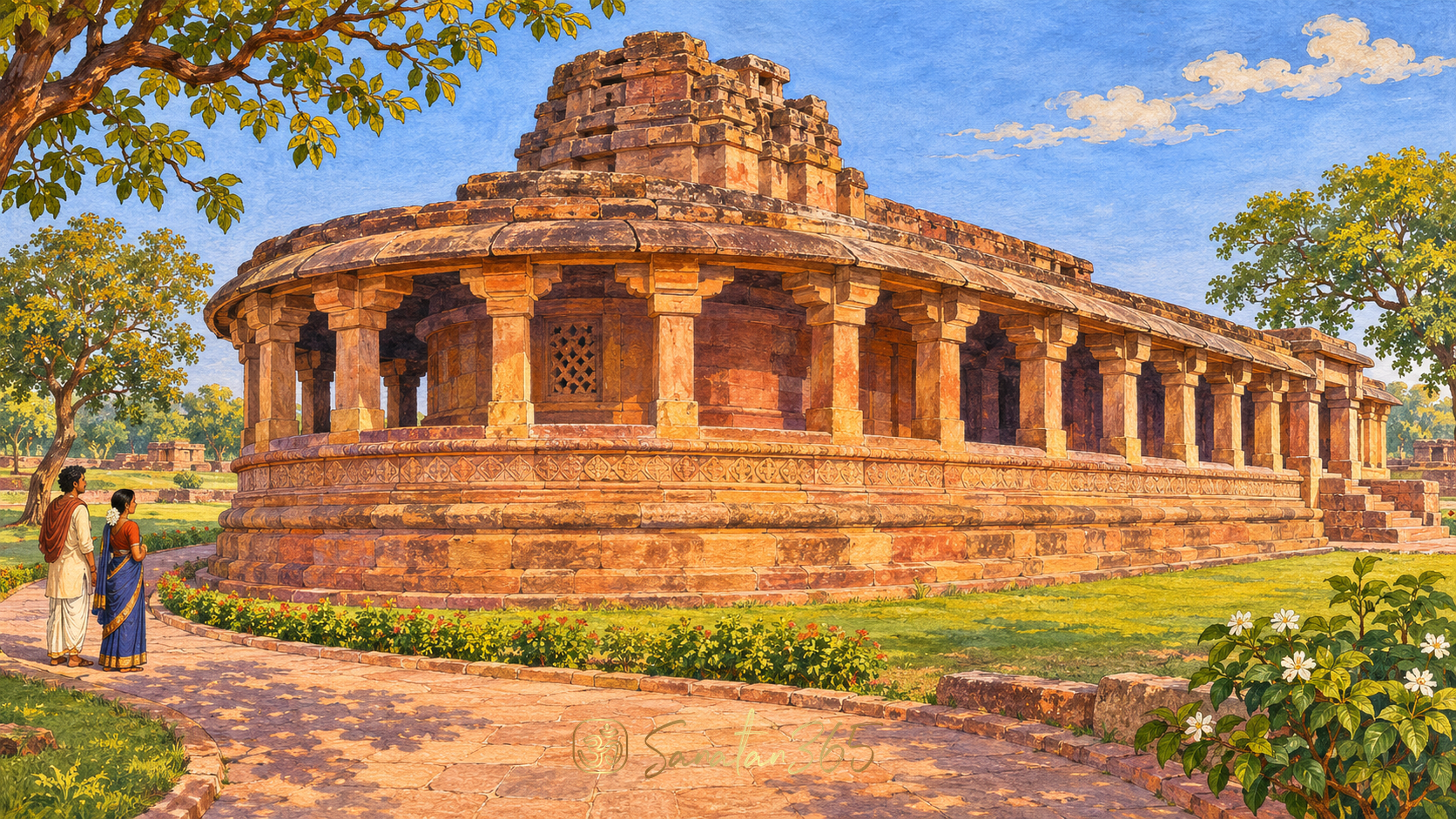
Aihole Durga Temple: Reading the Curved Stone Plan
Read Aihole’s Durga Temple through its rounded rear, raised plinth and pillared gallery, and see how a curved plan creates a sheltered rout…
 Temples
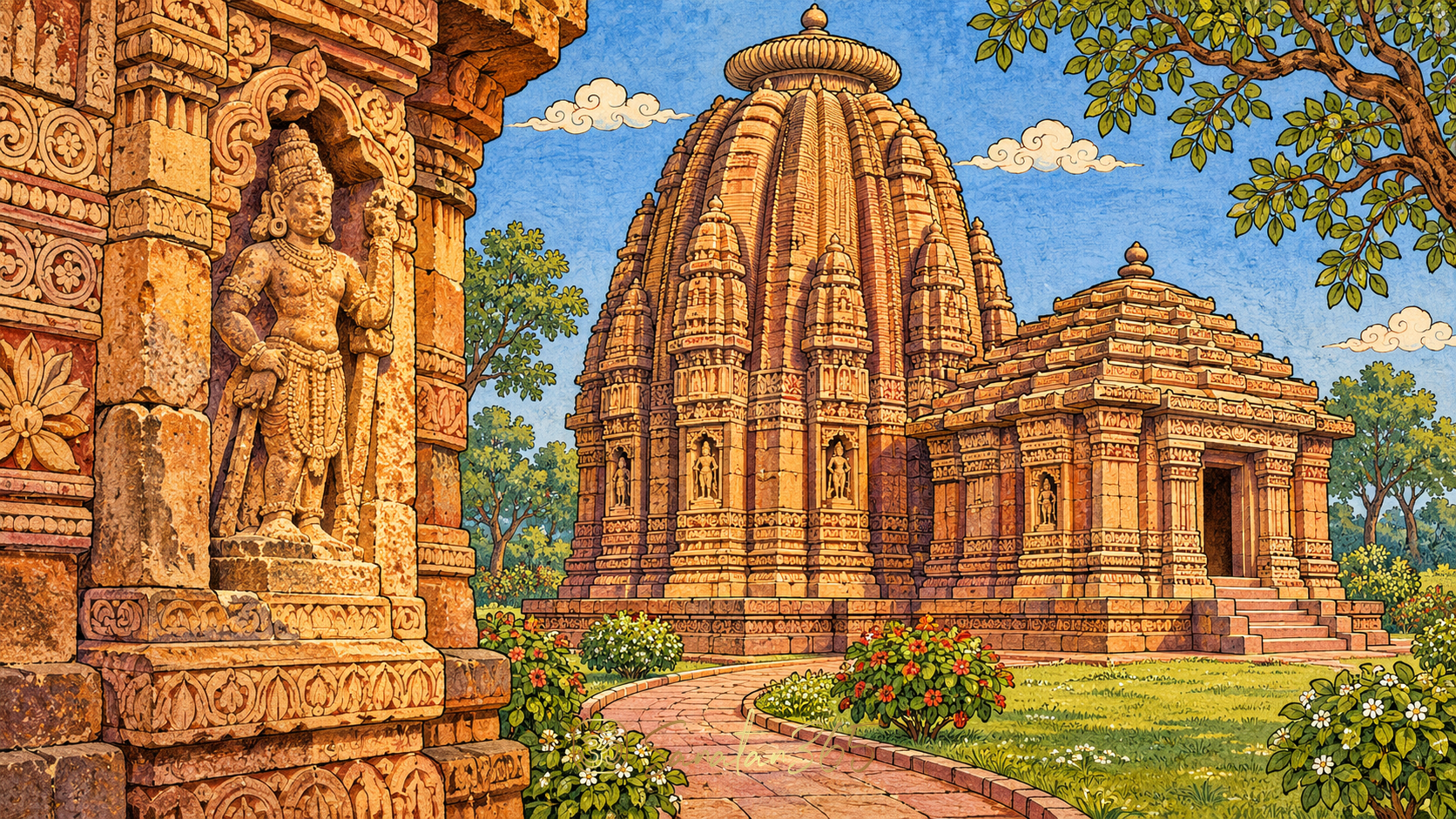
Rajarani Temple: How to Read Its Eight Guardians
Learn to read Rajarani Temple’s eight guardians, distinguish them from other figures, and understand what the carvings can tell us about th…
 Temples
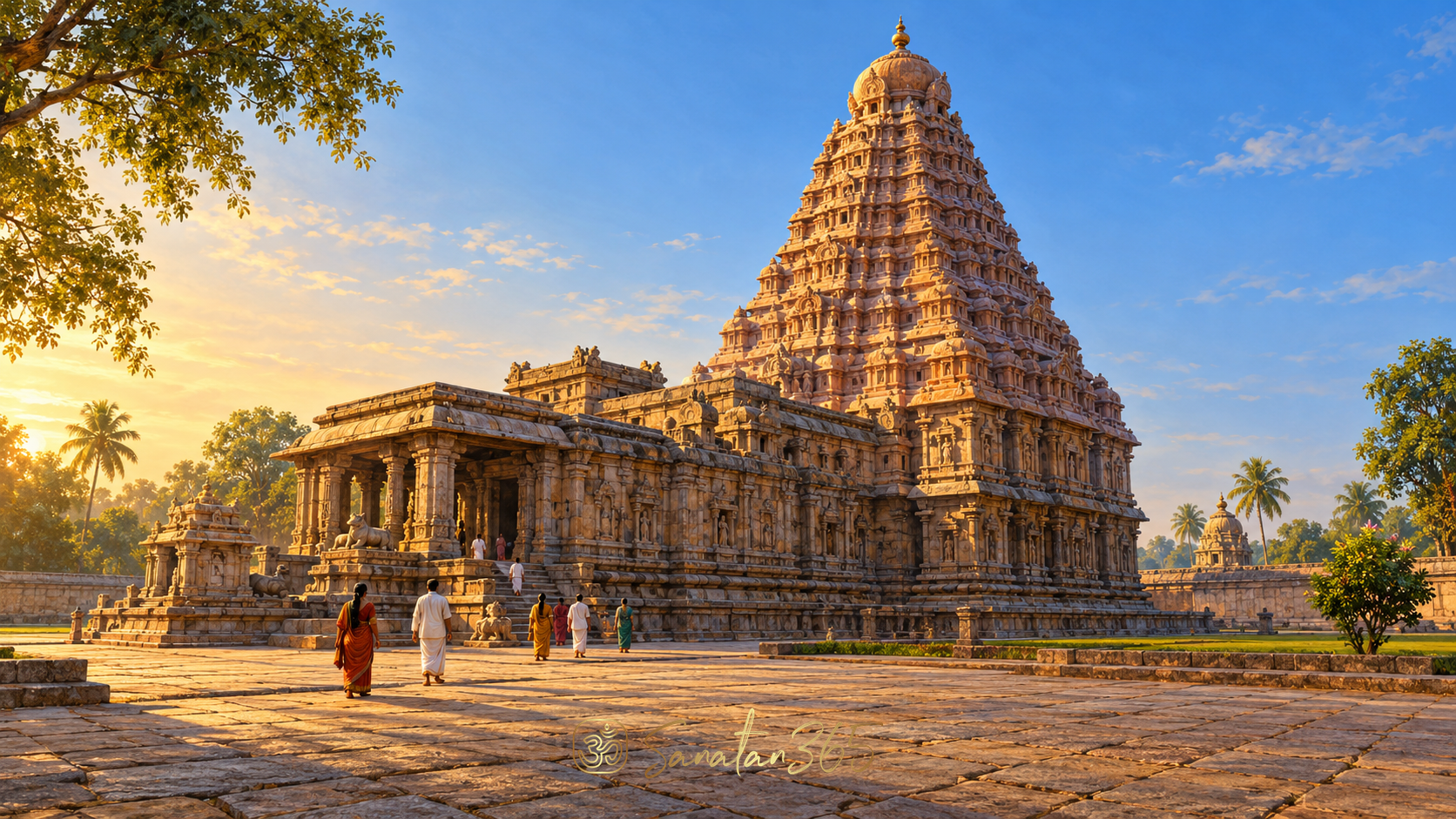
Gangaikonda Cholapuram Temple: Reading the Curve of Sacred Stone
How a curving Chola sanctum tower, carved surfaces and continuing Shiva worship invite a more attentive way of seeing Gangaikonda Cholapura…

