Hayagriva Meaning: Vishnu's Horse-Headed Form of Sacred Knowledge
Hayagriva is a horse-headed form of Lord Vishnu revered as the protector and restorer of sacred knowledge. His imagery joins intellectual clarity with humility, discipline, and devotion.
A deity with a horse's head may first appear mysterious. Yet Hayagriva's unusual form carries a precise spiritual message: knowledge is sacred only when it is recovered from confusion, protected from misuse, and offered in service.
Hayagriva meaning begins with Lord Vishnu as the guardian of wisdom. Hayagriva (हयग्रीव, haya-grīva, “horse-necked” or “horse-headed”) is a divine form revered especially in Vaishnava traditions. Stories differ across scriptures, but they converge on one truth: when the Vedas or the order of knowledge are threatened, the Divine restores them. Hayagriva therefore represents lucid intelligence, disciplined study, pure speech, memory, and the humility required to receive teaching.
Who is Hayagriva in Hindu tradition?
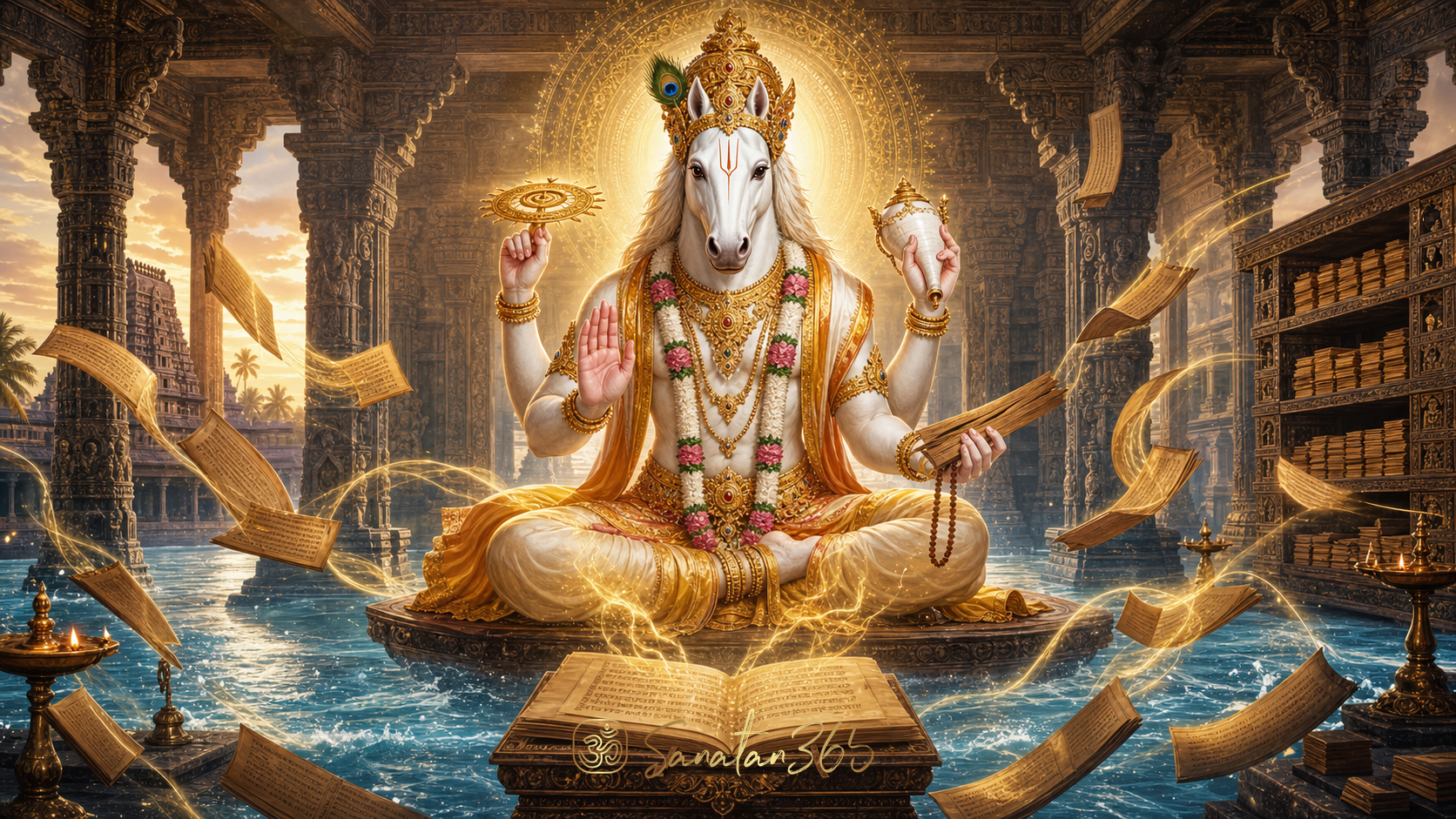
Hayagriva is understood in many Vaishnava traditions as a form of Lord Vishnu. He is commonly depicted with a radiant human body and a white horse's head. White suggests clarity and purity; Vishnu's familiar emblems, such as the shankha (शङ्ख, śaṅkha, conch) and chakra (चक्र, cakra, discus), identify the form with the cosmic Preserver. Some images also include a book, rosary, lotus, or gestures of teaching and blessing.
The name is descriptive rather than dismissive. Haya means horse, while grīva means neck. Hindu sacred art often uses a distinctive form to make a theological quality visible. Varaha's boar form expresses the strength to lift Earth from disorder; Garuda's winged form joins power to devoted service. Hayagriva's equine head points toward alertness, breath, articulate sound, and concentrated intelligence.
Hayagriva is not simply a symbol invented after the stories. Devotees approach him as a real manifestation of Vishnu's grace. At the same time, the icon invites reflection: learning does not belong to the ego. It is received, cultivated, guarded, and shared responsibly.
Regional traditions give this devotion particular depth. Hayagriva has a strong place in Sri Vaishnava life, where Vedanta Desika's Hayagriva Stotra praises the deity as the source of knowledge and eloquence. In Karnataka and Tamil Nadu, students and teachers may remember Hayagriva at the beginning of study. Assam's Hayagriva Madhava Temple at Hajo preserves another important regional expression, demonstrating that the form's reverence extends beyond one school or geography.
Key takeaway: Hayagriva is Vishnu present as the protector of knowledge, not knowledge reduced to personal achievement.
Why does Hayagriva have a horse's head?
No single symbolic explanation should be presented as the only universal one. Hindu iconography grows through scripture, theology, poetry, temple practice, and regional memory. Still, several meanings consistently help readers understand the horse-headed form.
First, the horse conveys wakeful energy. A horse can be powerful without being chaotic when trained and directed. In the same way, the mind becomes useful when attention, memory, and speech are disciplined. Intelligence without direction can scatter; intelligence aligned with dharma (धर्म, dharma, sustaining order and right responsibility) becomes a force for protection.
Second, the image connects knowledge with sound. The Vedas are śruti (श्रुति, “that which is heard”), transmitted through careful listening and recitation. The horse's resonant voice becomes, in devotional interpretation, a powerful image for sacred utterance. This does not mean every feature of a horse has a fixed code. It means the form makes the living power of recited knowledge memorable.
Third, Hayagriva joins strength and refinement. Learning can become pride, argument, or accumulation. Hayagriva's serene iconography corrects that tendency. The divine face is strong but composed; the weapons protect, while the book and teaching gestures illuminate. Knowledge must be defended from distortion, but it must also be given without arrogance.
This balance resembles the teaching of Vidura Niti, where wise counsel requires self-mastery as much as information. A person may know many facts yet remain unable to speak at the right time, listen carefully, or act for the common good. Hayagriva devotion places character beside cognition.
Key takeaway: The horse-headed form makes disciplined energy, sacred sound, clarity, and humble intelligence visible at once.
How do the scriptures tell Hayagriva's story?
Hayagriva narratives appear in more than one textual stream, and their details are not identical. Responsible reading respects these differences instead of forcing them into a single timeline.
One widely known Vaishnava pattern describes the Vedas being stolen or concealed in the cosmic waters. Vishnu assumes the Hayagriva form, defeats the forces of disorder, and restores sacred knowledge to Brahma so creation can proceed rightly. Versions vary regarding the adversaries' names and the sequence of events. The theological center, however, remains stable: knowledge essential to cosmic order is not allowed to disappear.
The Bhagavata Purana includes Hayashirsha or horse-headed references within accounts of divine manifestations, while the Mahabharata preserves praise of a horse-headed form associated with the recovery of the Vedas. Readers can consult public translations through the Internet Sacred Text Archive's Hindu texts collection, while keeping in mind that translations and numbering differ.
Another stream, especially in the Devi Bhagavata Purana, tells a more complex narrative involving Vishnu's head, a horse's head, and the defeat of an asura also named Hayagriva. Here the shared name can confuse newcomers: “Hayagriva” may refer to the divine Vishnu form or to an antagonist in a particular telling. Context matters. The deity worshipped as Hayagriva is Vishnu's radiant form of wisdom, not the hostile figure.
Such variation is normal within the Puranic world. A Purana does not function like a modern police report. Its narratives teach theology through layered memory, praise, cosmology, and sacred imagination. The aim is not to flatten differences but to ask what each version protects. Again and again, Hayagriva stands at the point where knowledge must be rescued from concealment and returned to rightful use.
The recovery of the Vedas also carries a modern ethical warning. Information can be hidden, monopolized, distorted, or separated from wisdom. Hayagriva's story does not endorse careless circulation of everything; sacred teaching requires context and qualified guidance. It does insist that knowledge serving dharma cannot remain captive to selfish power.
Key takeaway: Different scriptures tell the episode differently, but all place restoration of sacred knowledge at the heart of Hayagriva's significance.
What does Hayagriva teach about knowledge and humility?
Hayagriva devotion begins where modern achievement culture often ends. A grade, title, publication, or fluent answer may prove competence, but it does not by itself prove wisdom. Sacred learning asks what knowledge does to the learner.
Three disciplines follow from Hayagriva's image:
- Receive before claiming. Every student depends on teachers, language, family, texts, and communities of preservation. Gratitude prevents learning from becoming possession.
- Clarify before repeating. Sacred terms deserve accurate pronunciation, context, and meaning. Speed is not a substitute for understanding.
- Serve before displaying. Knowledge matures when it reduces confusion, protects dignity, and supports dharmic action.
Vedanta Desika, the influential Sri Vaishnava teacher, opens his Hayagriva Stotra by contemplating Hayagriva as pure knowledge and bliss. The hymn is devotional theology, not a promise of instant examination success. Its spirit is better understood as surrendering the obstacles of dullness, pride, and confused speech before beginning serious study. An overview of Vedanta Desika's place in the tradition is available through the Encyclopaedia Britannica entry on Vishishtadvaita, which situates the broader Sri Vaishnava philosophical lineage.
This approach can shape an ordinary study session. A learner may begin with a short prayer according to family tradition, set a clear intention, remove distractions, study one bounded section, and conclude by summarising it honestly. The devotional act does not replace reading, practice, sleep, or instruction. It sanctifies effort and reminds the student why effort matters.
For teachers, Hayagriva's lesson is equally demanding. Protecting knowledge includes protecting students from humiliation, false certainty, and careless claims. A teacher need not pretend to know everything. Saying “this requires verification” can be an act of reverence for truth.
Key takeaway: Hayagriva links intellectual brilliance to gratitude, accuracy, disciplined effort, and service.
How is Hayagriva worshipped across India?
Hayagriva worship varies by sampradaya (सम्प्रदाय, sampradāya, a transmitted spiritual lineage), region, temple, and household. No single ritual sequence should be treated as mandatory for everyone.
In Sri Vaishnava contexts, devotees may recite the Hayagriva Stotra, offer flowers, remember a teacher lineage, or seek blessings before study. Some families place books respectfully near the altar and avoid treating learning materials carelessly. Students may pray for medhā (मेधा, medhā, discerning intelligence) and smṛti (स्मृति, smṛti, memory) while committing to real work.
At temples, Hayagriva may be worshipped through standard Vaishnava forms of puja (पूजा, pūjā, reverential worship), including lamp, flowers, food offering, mantra, and darshan (दर्शन, darśana, sacred seeing). Hayagriva Jayanti observances may include special recitation and worship, but dates and customs can vary with the lunar calendar and local panchang. Devotees should follow their temple or family tradition rather than treating one online timetable as universal.
A simple, respectful home observance can include:
- Cleaning the study space and arranging books carefully.
- Lighting a lamp safely before an approved image or murti of Lord Hayagriva or Vishnu.
- Offering a flower, water, or fruit according to household custom.
- Reciting a familiar Vishnu prayer or Hayagriva verse learned from a reliable teacher.
- Beginning a focused period of study and ending with gratitude.
The offering may be modest. Bhagavad Gita 9.26 teaches that a leaf, flower, fruit, or water offered with devotion is accepted by the Divine. The principle is not display but sincerity. Readers interested in how sacred items support ordered attention can also explore the meaning of a puja thali.
Hayagriva is sometimes paired in popular devotion with Goddess Saraswati because both are associated with learning. They should not be collapsed into one another or ranked. Saraswati expresses wisdom, music, language, and refined learning through her own sacred form; Hayagriva is Vishnu's form associated with the protection and restoration of knowledge. Hindu tradition can honour both without insisting on superiority.
Key takeaway: Hayagriva worship turns study into a disciplined offering while respecting lineage, regional variation, and the distinct dignity of every divine form.
Hayagriva's horse-headed form is memorable because its lesson is exacting. Knowledge must be found, guarded, clarified, and returned to the world without vanity. The deity's radiance belongs not only in a temple or manuscript but also in the quiet decision to learn carefully, speak truthfully, and use understanding for the good of others.
Key takeaway: To remember Hayagriva is to treat learning as sacred responsibility: clear in thought, humble in spirit, and generous in use.
FAQ
What is the meaning of Hayagriva?
Hayagriva means “horse-necked” or “horse-headed” in Sanskrit. In Vaishnava tradition, Hayagriva is a form of Lord Vishnu revered as the protector and restorer of sacred knowledge.
Is Hayagriva a form of Vishnu?
Yes. The worshipped deity Hayagriva is understood as a manifestation of Lord Vishnu. Some scriptures also mention an asura with the same name, so readers should distinguish the divine form from the antagonist in that particular narrative.
Why do students worship Hayagriva?
Students worship Hayagriva for clarity, memory, disciplined speech, and right understanding. The devotion supports sincere effort; it does not replace study, instruction, rest, or practice.
Are Hayagriva and Saraswati the same deity?
No. Both are associated with knowledge, but they are distinct divine forms with their own iconography and traditions. Hayagriva is a form of Vishnu, while Goddess Saraswati is revered as the goddess of wisdom, learning, music, and speech.
How can someone pray to Hayagriva at home?
A person may clean the study area, light a lamp safely, offer a flower or fruit, recite a prayer learned from a reliable tradition, and begin focused study with gratitude. Family and sampradaya customs should guide the details.
About the author
Sanatan365 Editorial
Bringing Sanatan Dharma to modern seekers through authentic, scripture-grounded content.
Related in Deities
 Deities
Indra Deva Meaning: The Vajra, Rain, and Responsible Power
Indra links the thunderbolt and released waters with a demanding question: what is strength for? Read his Vedic imagery and later lessons w…
 Deities
Agni Deva Meaning: Sacred Fire and the Divine Messenger
Meet Agni as the Vedic priest and messenger, read the first Rig Veda hymn, and understand sacred fire without reducing a living deity to a…
 Deities
Brahma Deva Meaning: Four Faces, Creation, and Sacred Knowledge
Understand Brahma, the Hindu creator deity, through his four faces, lotus imagery, sacred knowledge, and a careful distinction from Brahman…