King Nahusha’s Story: Power, Pride, and the Return to Wisdom
King Nahusha rose from righteous earthly rule to the throne of heaven, then fell when power outran humility. His Mahabharata story explores authority, arrogance, accountability, and the possibility of learning after failure.
Nahusha did not begin as a warning. He became one.
The King Nahusha story is unsettling because its central figure first appears worthy of trust. He is remembered as a powerful earthly ruler, connected to the lunar dynasty and praised for merit accumulated through disciplined conduct. When heaven needs a temporary sovereign, Nahusha is raised to Indra’s throne. Yet the authority that confirms his stature also exposes a weakness within it. Power grows faster than humility; honour becomes entitlement; and a king capable of ruling others loses the capacity to govern himself.
The Mahabharata does not leave Nahusha at the moment of collapse. In the forest, long after his fall, he meets Yudhishthira in the form of a great serpent. Their conversation turns punishment into inquiry. Nahusha must listen, question, remember, and finally understand. His story is therefore not only about pride. It is about why character must keep pace with authority, and why honest understanding can reopen a future after failure.
Key takeaway: Nahusha’s rise and fall show that power does not create character; it magnifies the character already being practised.
Who Was King Nahusha in the Mahabharata?
Nahusha is a royal ancestor in the lunar dynasty and the father of Yayati. The epic remembers him as a rajarshi (राजर्षि, a royal sage): a king whose authority was strengthened by sacrifice, discipline, and accumulated merit. This background matters. Nahusha is not introduced as a naturally cruel ruler who predictably receives punishment. He has earned respect.
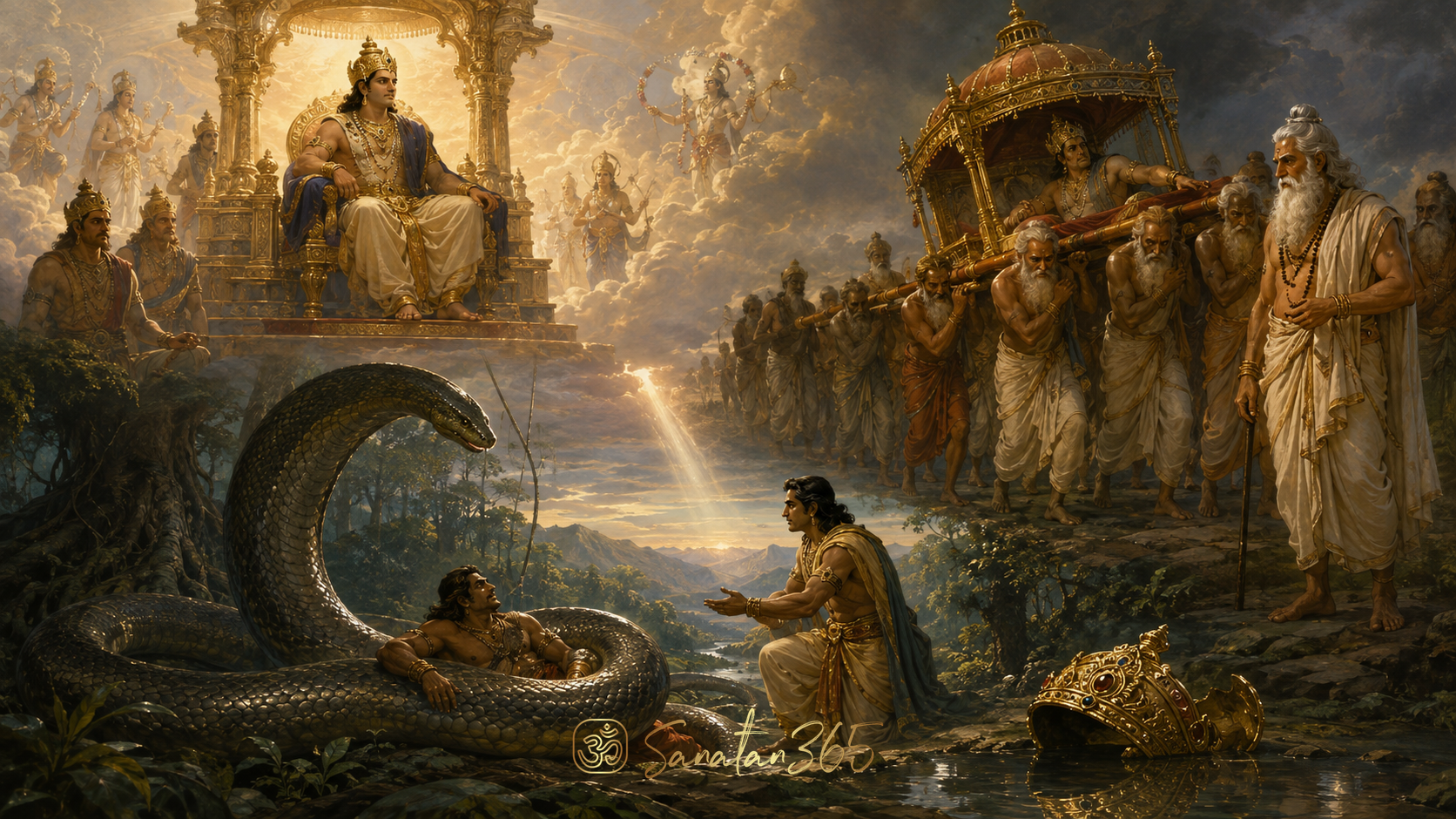
His story appears across related passages and later retellings, so details and emphasis can vary. The Mahabharata’s Vana Parva preserves the crucial forest episode in which a huge serpent captures Bhima and identifies itself as Nahusha. Yudhishthira arrives not with a stronger weapon, but with questions and answers about conduct, knowledge, and human worth. An English rendering of the Vana Parva presents the serpent explicitly as the royal sage Nahusha and records the ethical dialogue that follows (Internet Sacred Text Archive).
This framing makes Nahusha both ancestor and examiner. He belongs to the Pandavas’ lineage, yet he has become a danger to Bhima. He possesses memory and learning, yet remains bound by the consequences of misused power. The contradictions are deliberate: past merit does not make a person immune to later error.
Key takeaway: Nahusha’s earlier virtue makes his fall more instructive, because no reputation can replace continuing self-discipline.
Why Was Nahusha Chosen to Rule Heaven?
In the wider narrative tradition, Indra withdraws from his position after a grave act and the devas (देव, divine beings or deities) require someone to govern heaven. Nahusha is chosen because of his strength, merit, and royal capacity. The elevation is not random. Heaven recognizes qualities he has already cultivated on earth. The Mahabharata’s Anushasana Parva likewise remembers Nahusha as a royal sage who gained heaven’s sovereignty through good deeds and disciplined senses (Anushasana Parva, Section XCIX).
The throne of Indra should be understood here as both a divine office and an immense concentration of authority. Nahusha receives access to splendour, obedience, and status beyond ordinary kingship. At first, this can look like the fulfilment of a virtuous life. The story soon complicates that appearance.
Authority changes the moral environment around a person. Fewer people may speak plainly. Desire can disguise itself as privilege. Respect freely offered can become difficult to distinguish from compliance demanded. Nahusha’s earlier discipline had been formed under one set of conditions; his new office tests whether that discipline can survive abundance and deference.
This is why the ascent matters as much as the fall. The epic does not say that responsibility should never be entrusted to an accomplished person. It asks whether accomplishment has been joined to the humility, counsel, and restraint needed for a larger sphere of action.
Key takeaway: Nahusha was chosen because he had real merit, but greater office required an even greater capacity for restraint.
How Did Power Change King Nahusha?
Nahusha gradually becomes intoxicated by celestial sovereignty. In the Mahabharata narrative summarized from the Udyoga Parva, he desires Shachi, Indra’s wife, and makes the sages carry his palanquin; his arrogance and disrespect toward Agastya precipitate his fall (Wisdomlib’s Mahabharata summary). Translations and retellings vary in emphasis, but the moral movement is consistent: reverence toward the wise is replaced by the expectation that wisdom itself should serve his appetite.
The palanquin is a powerful image. A ruler is literally raised above those whose insight should help steady him. Instead of receiving the sages as moral guides, Nahusha treats them as instruments of royal convenience. The problem is not splendour alone; Hindu traditions contain many dignified images of sacred kingship. The problem is the conversion of persons into props for status and desire.
Pride also alters perception. Nahusha no longer reads hesitation as counsel or boundaries as protection. He interprets delay as disobedience. In popular narration, his impatient command “sarpa, sarpa” (often understood as “move, move”) becomes associated with his later serpent form, though readers should recognize that recensions and retellings explain the verbal connection differently.
The deeper pattern is clear without depending on a single dramatic phrase. When power removes friction, desire can start speaking in the voice of destiny: “I deserve this because I have arrived.” Nahusha’s failure begins when possession of an office becomes, in his mind, proof that every impulse of the officeholder is legitimate.
Key takeaway: Power changed Nahusha when he stopped treating people and limits as sources of moral guidance.
Why Was Nahusha Cursed to Become a Serpent?
The crisis reaches its height when Nahusha disrespects the sages carrying him and, in widely known versions, strikes or touches the sage Agastya with his foot. Agastya curses him to fall from heaven and live as a serpent. Later tellings sometimes add different participants or narrative details, but the symbolism remains forceful.
The fall reverses every feature of his pride. Nahusha had demanded elevation; he is brought to the ground. He had expected others to carry him; he must now move on his own body. He had used command to overpower; he becomes a being whose strength restrains Bhima but cannot release itself. Celestial visibility gives way to hidden life in the forest.
A curse in an epic should not be flattened into a mechanical formula of instant supernatural punishment. Within the story, it reveals the moral shape of an action. Nahusha has allowed appetite to coil around discernment. The serpent form makes that inward captivity visible.
Yet the curse is not simply annihilation. A condition for release remains. Nahusha will eventually meet a person capable of answering his questions and restoring right understanding. Consequence and possibility coexist.
Key takeaway: The serpent curse externalizes Nahusha’s moral bondage, but it also creates the setting in which reflection and release become possible.
What Happened When Nahusha Met Yudhishthira?
During the Pandavas’ forest exile, the serpent Nahusha captures Bhima. Physical might does not solve the crisis. Yudhishthira finds his brother and enters into dialogue with the serpent, who asks difficult questions about a Brahmana (ब्राह्मण, here a person recognized for sacred learning and virtuous qualities), knowledge, conduct, and liberation.
One of the episode’s most enduring teachings is that noble identity cannot be secured by birth-label alone. In the translated exchange, Yudhishthira identifies truthfulness, generosity, forgiveness, good conduct, compassion, and restraint as decisive qualities. The serpent presses him on the fact that such qualities may appear across social categories; Yudhishthira responds by centring conduct rather than empty designation (Vana Parva, Section CLXXIX). This passage requires careful reading within the epic’s historical world, but its ethical force is unmistakable: claimed status without corresponding qualities is spiritually hollow.
The conversation is especially fitting for Nahusha. He had once possessed the highest visible status and behaved beneath it. Now, stripped of that status, he hears a teaching that human worth must be made visible in qualities and action.
Yudhishthira’s strength is not aggression. He stays composed while Bhima is in danger, answers thoughtfully, and does not humiliate the fallen king. Knowledge joined to steadiness succeeds where force cannot. Satisfied, Nahusha releases Bhima and is himself released from the curse.
Key takeaway: Yudhishthira frees both Bhima and Nahusha by showing that truth and character carry more weight than power or inherited labels.
What Does the King Nahusha Story Teach About Authority and Character?
First, authority requires practices that preserve reality. A leader needs people who can disagree, boundaries that cannot be purchased, and habits that survive praise. Nahusha’s mistake was not merely feeling proud; it was reorganizing the world so that his pride met no valid resistance.
Second, past goodness is not stored immunity. Merit can open a door, but it cannot walk through that door on a person’s behalf. Every new scale of responsibility produces a new test. A disciplined student, parent, manager, teacher, or public leader can still become careless when admiration grows. This differs from the King Shibi story, where royal authority is tested through protection and competing duties.
Third, the treatment of those with less immediate power is diagnostic. Nahusha’s celestial title cannot hide the indignity of using sages as carriers. Leadership is revealed in how a person responds when others are unable or unwilling to flatter them.
Fourth, intelligence without self-command is incomplete. Nahusha remains capable of asking penetrating questions in the forest, yet knowledge had not prevented his earlier fall. The episode distinguishes information from wisdom. Wisdom must govern desire at the moment when desire has the means to act.
A practical reading might use three questions:
- Who can tell me a truth I do not enjoy hearing?
- What appetite becomes louder when I receive more authority?
- Which daily discipline keeps other people from becoming instruments of my ambition?
These are not questions only for kings. Every household, workplace, institution, and community contains smaller thrones. The meaning of Arjava, sincerity and alignment between thought, speech, and conduct, offers a complementary practice for keeping those thrones accountable.
Key takeaway: Ethical authority depends on truthful counsel, restraint, and respect for persons, not merely on competence or position.
Can Nahusha’s Fall Also Be Read as a Story of Redemption?
Redemption does not mean pretending the fall never happened. Nahusha’s release comes after consequence, long memory, honest dialogue, and recognition. The story neither excuses his misuse of power nor defines him forever by its worst moment.
This balance is important. Some modern readings treat accountability and compassion as opposites. Nahusha’s story joins them. Agastya’s curse names a boundary and makes violation consequential. Yudhishthira’s wisdom creates a path beyond consequence once understanding has matured. Justice prevents cheap forgetting; wisdom prevents endless reduction of a person to failure.
Nahusha also has to receive truth from someone he once would have ranked below his celestial sovereignty. His return begins with humility: the former ruler of heaven asks, listens, and accepts correction. Release is not another conquest. It is the loosening of a false self-image. The nearby Trishanku story explores a different royal pursuit of heaven, making a useful comparison in how ambition meets sacred limits.
For a reader carrying regret, this offers sober hope. One cannot always undo harm or recover a former role. But it may still be possible to tell the truth, accept consequence, repair what can be repaired, and practise the qualities once neglected. A fall can become instruction when it is neither denied nor worshipped.
Key takeaway: Nahusha’s redemption begins when accountability becomes understanding and understanding reshapes identity.
FAQ
Who was King Nahusha?
Nahusha was a king of the lunar dynasty, father of Yayati, and ancestor of the Pandavas. Hindu epic tradition remembers him as a meritorious ruler who temporarily occupied Indra’s throne before pride led to his fall.
Why did Nahusha become a serpent?
He was cursed after misusing celestial authority and disrespecting the sages, especially Agastya in widely known versions. The serpent form symbolizes his fall from elevation and bondage to the consequences of pride.
How was Nahusha freed from the curse?
In the Mahabharata’s forest episode, Nahusha captures Bhima and questions Yudhishthira. Yudhishthira’s wise answers satisfy him, Bhima is released, and Nahusha is freed from the curse.
What did Yudhishthira teach Nahusha?
Their dialogue emphasizes truth, generosity, forgiveness, compassion, restraint, knowledge, and conduct. It challenges the idea that a noble label has value when noble qualities are absent.
Is every version of the Nahusha story identical?
No. Mahabharata recensions, Puranic references, translations, and later retellings can vary in details such as the curse and the celestial episode. The core arc of merit, elevation, pride, fall, dialogue, and release remains widely recognizable.
King Nahusha’s story ends where wise leadership should begin: with the knowledge that no throne is higher than dharma (धर्म, sustaining ethical and sacred order), and no fall is beyond instruction when truth is finally allowed to speak.
About the author
Sanatan365 Editorial
Bringing Sanatan Dharma to modern seekers through authentic, scripture-grounded content.
Related in Stories
 Stories
Trishanku Story: Ambition, Belonging, and the Wisdom of Limits
Explore the Ramayana story of Trishanku, Vishvamitra's extraordinary intervention, and what the image of a suspended heaven teaches about a…
 Stories
Mandodari in the Ramayana: Wise Counsel in Ravana's Court
Mandodari's story reveals the courage to speak dharma inside a powerful household, the limits of ignored counsel, and dignity amid grief.
 Stories
Anusuya Story: Devotion, Hospitality, and Quiet Strength
The story of Anusuya explores devoted partnership, sacred hospitality, discernment, and the quiet spiritual strength that protects dignity…