
Markandeya Story: How Devotion to Shiva Transformed the Fear of Death
The Markandeya story tells how a young sage met the certainty of death with devotion to Shiva, revealing courage, surrender, and the deeper meaning of immortality.
At sixteen, Markandeya was said to face a boundary no human strength could move: the appointed hour of his death.
The Markandeya story tells how a young sage responded not by fleeing time, but by embracing a Shiva linga and turning completely toward the Divine. In the best-known telling, Yama came to claim him, Shiva intervened, and Markandeya received enduring life. Yet the story's deepest gift is not a promise that devotion prevents physical death. It is a teaching about bhakti (भक्ति, loving devotion): when fear is placed before the Eternal, mortality no longer has the final word over how a person lives.
Key takeaway: Markandeya does not defeat fear by denying death; he meets it through unwavering refuge in Shiva.
What Is the Markandeya Story?
Markandeya (मार्कण्डेय, Mārkaṇḍeya) is remembered as a great rishi (ऋषि, seer or sage) associated with several streams of Hindu sacred literature. The famous childhood legend begins with his parents, the sage Mrikandu and his wife, who longed for a child. Through austerity and prayer, they received a difficult choice: a son of exceptional virtue whose life would be brief, or a less noble son who would live long. They chose the virtuous child.
Markandeya grew in wisdom and devotion, especially devotion to Lord Shiva. When he learned that his life was destined to end at sixteen, he did not spend his remaining time in bitterness. He intensified worship. On the appointed day, he sat beside a Shiva linga, entered prayer, and held fast to the sacred form.
Yama, the lord who upholds the order of death, arrived to fulfil his duty. In popular retellings, Yama cast his noose, and it encircled both Markandeya and the linga. Shiva then emerged in the form of Kalantaka (कालान्तक, ender or conqueror of Time) or Mrityunjaya (मृत्युञ्जय, victor over death), restraining Yama and protecting the devotee. Markandeya was blessed with exceptional longevity and is often remembered as a chiranjivi (चिरञ्जीवी, one who lives for an extraordinarily long sacred span).
This legend is preserved through layered Puranic, temple, oral, and regional traditions rather than one single modern biography. The Shiva Purana tradition is commonly associated with Markandeya's rescue, while the Bhagavata Purana, Canto 12 presents the sage as an accomplished devotee who later beholds the bewildering power of cosmic dissolution and divine maya. Together, these traditions portray not merely a child saved from danger, but a seer transformed by proximity to death and eternity.
Key takeaway: the Markandeya story presents virtue, devotion, mortality, and divine grace as one continuous spiritual teaching.
Why Did Markandeya Embrace the Shiva Linga?
The Shiva linga is not an accidental object in the story. Linga (लिङ्ग, sign or mark) points toward Shiva as the reality that cannot be confined to one ordinary form. By embracing it, Markandeya takes refuge in that which stands beyond birth and death while remaining present within the world.
He does not bargain for an easier fate. He does not ask another person to carry his fear. His gesture is immediate and embodied: the whole person clings to the Divine. This makes the story especially powerful for householders and young readers. Prayer here is not vague optimism. It is the act of choosing where attention, trust, and identity will rest when control disappears.
The scene also explains why Shiva is worshipped as Mrityunjaya. Shiva is associated with cremation grounds, ash, dissolution, meditation, and renewal. These symbols do not glorify death. They strip away the illusion that permanence can be secured through possessions, status, youth, or avoidance. Shiva's presence teaches that what changes must change, while consciousness anchored in the sacred can meet change without losing its center.
Tamil Shaiva temples and devotional art often depict Shiva as Kalantaka or Kalanthaka, the one who checks Kala, meaning time or death, for Markandeya's sake. Regional imagery varies, but the moral center remains stable: the devotee takes shelter in Shiva, and grace interrupts the rule of fear.
This does not make the linga a magical object that guarantees escape from illness or mortality. Hindu ritual is diminished when it is treated as a transaction. Markandeya's embrace matters because it expresses complete sharanagati (शरणागति, taking refuge or surrender), not because it offers a mechanical formula.
Key takeaway: embracing the Shiva linga represents placing the whole self within the reality that transcends time.
What Does the Markandeya Story Mean About Death?
The story works on several levels, and each corrects a common misunderstanding.
First, death is not portrayed as evil. Yama is a guardian of cosmic order, not a demon acting from personal cruelty. Every embodied life participates in time. The tension arises because divine grace reveals that human existence cannot be understood only as a countdown of years.
Second, a short life and a wasted life are not the same thing. Markandeya's parents choose quality of character over mere duration. The choice can feel severe, but it asks a timeless question: should life be measured only by length, or also by truth, devotion, and what the person becomes?
Third, courage does not require the absence of fear. Markandeya's courage is relational. He turns toward Shiva. This is different from stoicism performed for an audience. A devotee may tremble and still pray; may grieve and still remember; may seek medical care and still surrender the outcome. Bhakti does not erase human vulnerability. It gives vulnerability a sacred direction.
Fourth, immortality in Hindu thought has more than one meaning. It can refer in stories to extraordinary longevity, but the Upanishadic horizon goes deeper: the realization of the Atman (आत्मन्, innermost Self) that is not reduced to the changing body. The Markandeya legend should therefore not be used to guarantee that a mantra will prolong a specific person's life. Its wiser promise is that disciplined remembrance changes the seeker's relationship with mortality.
For families, this distinction is important. The story can comfort someone facing illness or bereavement without denying medical reality and without blaming those whose prayers do not produce the outcome they wanted. Grace is not measured only by survival. It may also appear as clarity, reconciliation, courage, loving care, or peace within uncertainty.
Key takeaway: the story transforms death from a forbidden subject into a teacher about how to live truthfully.
Is Markandeya Connected to the Mahamrityunjaya Mantra?
Popular devotional tradition strongly connects Markandeya with the Mahamrityunjaya Mantra (महामृत्युञ्जय मन्त्र, the great death-conquering mantra) addressed to Tryambaka, the three-eyed Lord. The mantra itself appears in the Rig Veda 7.59.12, an ancient source that predates later Puranic storytelling.
Tryambakaṃ yajāmahe sugandhiṃ puṣṭivardhanam urvārukam iva bandhanān mṛtyor mukṣīya mā'mṛtāt.
A careful sense of the verse is: “We worship the three-eyed One, fragrant and nourishing; as a ripe cucumber is released from its stem, may we be released from bondage to death, not from immortality.” Translations vary because Vedic Sanskrit is dense and layered.
The verse is often chanted for healing, protection, courage, and peace. It may accompany worship during illness, Shravan, Maha Shivaratri, or personal difficulty. But responsible practice avoids two extremes. The first is dismissing the mantra as only poetry. The second is advertising it as a guaranteed cure or a substitute for professional care. Mantra is sacred practice; it does not authorize medical promises.
Was this exact Vedic mantra spoken by the young Markandeya in every early version of the rescue story? Traditions differ, and popular retellings often combine the Vedic mantra with the Puranic legend. It is more accurate to say that Hindu devotional memory has closely joined Markandeya, Shiva as Mrityunjaya, and this mantra. That connection expresses theological meaning even when textual details vary across sources.
A simple practice may be to chant the mantra slowly 3, 9, 11, or 108 times according to capacity, after learning pronunciation from a trusted teacher. A beginner can also repeat “Om Namah Shivaya” with attention. Count matters less than reverence, steadiness, and ethical living.
Key takeaway: Markandeya and the Mahamrityunjaya Mantra meet in devotional tradition as teachings of release from fear, not guarantees against mortality.
What Can Modern Readers Learn from Sage Markandeya?
Markandeya's world is ancient, but the pressure he faces is recognizable. Modern life often tries to hide death while producing constant anxiety about health, youth, achievement, and time. The story offers a different discipline.
1. Choose depth over mere duration
His parents' choice is not a rule for literal decision-making. It is a mirror. A long calendar does not automatically create a meaningful life. Character, service, knowledge, and devotion give time its weight.
2. Practice before crisis
Markandeya can turn toward Shiva at the decisive hour because devotion has already shaped him. Crisis rarely creates a stable practice from nothing. Daily puja, mantra, scripture study, honest work, and compassionate relationships prepare the mind before difficulty arrives. Readers beginning a home rhythm may also find Nitya Puja Meaning: Daily Worship as a Living Hindu Practice useful.
3. Let fear become prayer and action
Spiritual surrender is not passivity. A person worried about health can pray and book the appointment. Someone grieving can chant and seek support. A family facing uncertainty can worship and make practical plans. Dharma joins inward refuge with responsible action.
4. Do not make suffering a spiritual competition
Markandeya's devotion should never be used to tell another person, “If your faith were stronger, the outcome would change.” Such claims are cruel and unsupported. The story invites courage; it does not license judgment.
5. Remember what cannot be possessed
Time eventually loosens every claim of ownership. Markandeya's embrace of the linga redirects identity from “what I control” toward “what I serve.” That shift can make ordinary life more generous, not less engaged.
6. Hold reverence and discernment together
Different regions and sampradayas may tell the story with different names, verses, or sequences. Respecting that plurality is part of Hindu literacy. The essential lesson does not require pretending that every retelling is textually identical.
Key takeaway: Markandeya teaches a courage built through daily practice, responsible action, and refuge beyond the ego.
How Can Families Share the Markandeya Story with Children?
The story can be told to children without making death frightening or presenting devotion as supernatural bargaining. The emphasis should match the child's age and questions.
For younger children, the heart of the story may be simple: Markandeya loved Shiva, remembered the Divine when he was afraid, and became known for courage and wisdom. The dramatic conflict with Yama can be softened. Shiva's protection can be explained as grace that made Markandeya fearless.
Older children may explore deeper questions:
- Why did Markandeya's parents value virtue?
- Is Yama an enemy, or does he perform a necessary duty?
- What is the difference between being fearless and never feeling fear?
- Why does Markandeya hold the linga instead of running?
- What daily practice helps a person remain steady?
A family activity can follow the story. Light a diya before a Shiva linga or image, chant “Om Namah Shivaya” eleven times, and let each person name one fear and one responsible action connected to it. Children should never be pressured to disclose private fears, and the exercise should remain gentle.
During Shravan, families may pair the story with water offering according to household tradition, temple darshan, charity, or reading about the symbolism of Shiva. Related context appears in Om Namah Shivaya Meaning: Shiva's Five-Syllable Mantra of Surrender and Adiyogi Shiva Meaning: Why Shiva Is Called the First Yogi.
Key takeaway: children receive the story best when courage, devotion, and compassion are emphasized over spectacle.
Conclusion
The Markandeya story endures because it brings a universal fear into a sacred relationship. A young sage learns that the right response to mortality is neither denial nor despair. He turns toward Shiva with his whole being.
The legend does not remove the mystery of why lives differ in length or why sincere people suffer. It offers something more honest: a way to meet time without surrendering to terror. Devotion gives courage; practice gives steadiness; discernment prevents superstition; grace opens life beyond the ego's measurements.
Single key takeaway: Markandeya's victory is not simply that death was delayed, but that fear could no longer separate the devotee from Shiva.
FAQ
Who was Sage Markandeya?
Sage Markandeya was a revered rishi in Hindu tradition, remembered as a devotee of Shiva and as a seer associated with Puranic literature. The famous Markandeya story describes Shiva protecting him when he faced destined death at sixteen.
Why did Shiva save Markandeya?
In the devotional legend, Shiva responds to Markandeya's unwavering refuge and protects him when Yama's noose touches the Shiva linga. The episode expresses divine grace and the power of bhakti, not a mechanical guarantee of physical immortality.
Is Markandeya one of the chiranjivis?
Many Hindu traditions describe Markandeya as a chiranjivi, meaning one blessed with extraordinary sacred longevity. Lists and interpretations of chiranjivis can vary among traditions.
Did Markandeya chant the Mahamrityunjaya Mantra?
Popular tradition closely connects Markandeya with the Mahamrityunjaya Mantra. The mantra itself appears in Rig Veda 7.59.12, while the rescue legend is told through later Puranic and regional traditions. Details differ across retellings.
What is the main lesson of the Markandeya story?
Its central lesson is that devotion can transform the fear of death. Markandeya responds to mortality with refuge in Shiva, disciplined prayer, and courage, showing that a meaningful life is measured by depth and dharma as well as duration.
About the author
Sanatan365 Editorial
Bringing Sanatan Dharma to modern seekers through authentic, scripture-grounded content.
Related in Stories
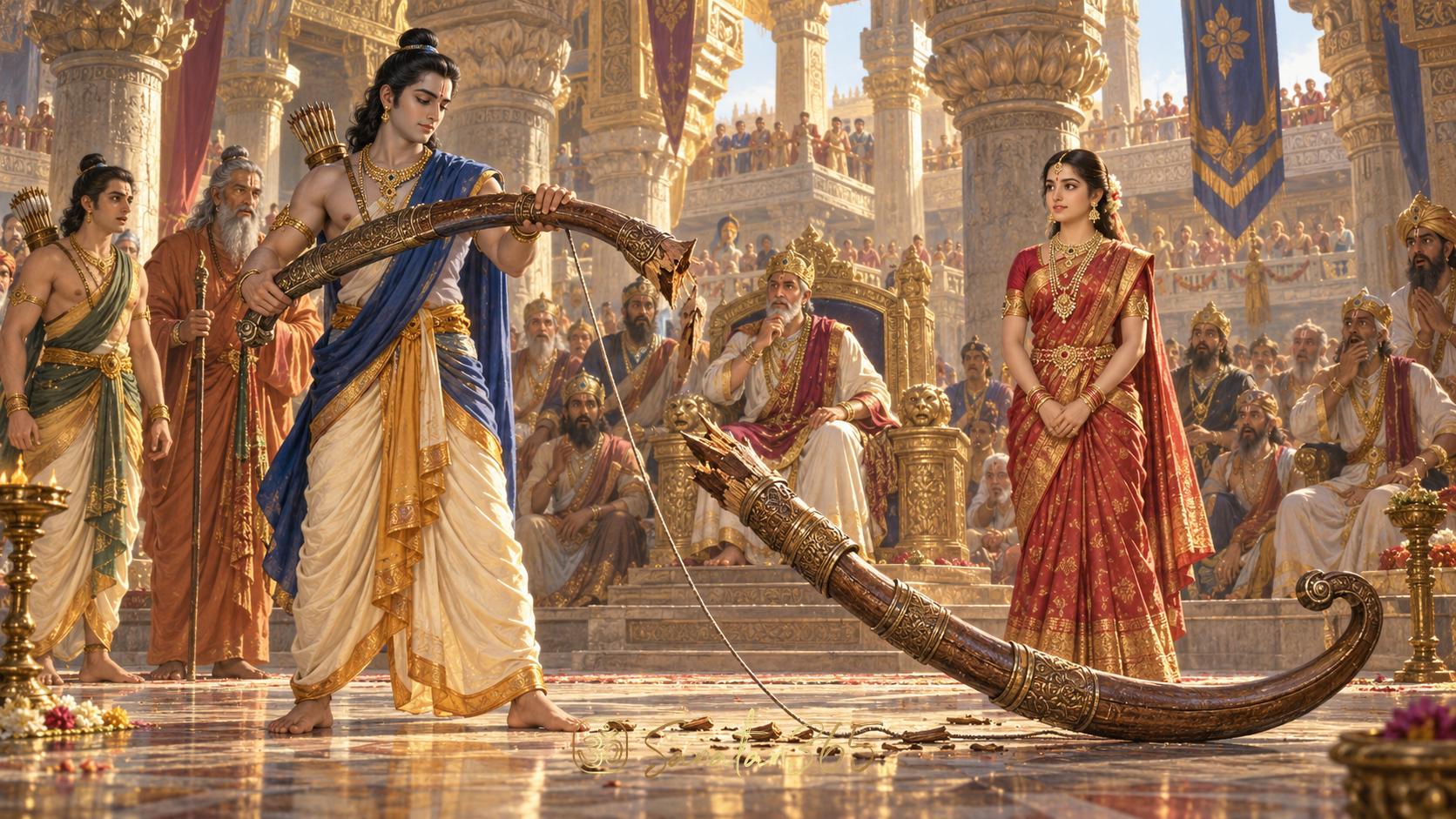 Stories
Sita Swayamvara in the Ramayana: Shiva's Bow and the Meaning of the Marriage
Read the Bala Kanda account of Rama, Sita, Janaka and Shiva's bow, and separate the text's sequence from later devotional retellings.
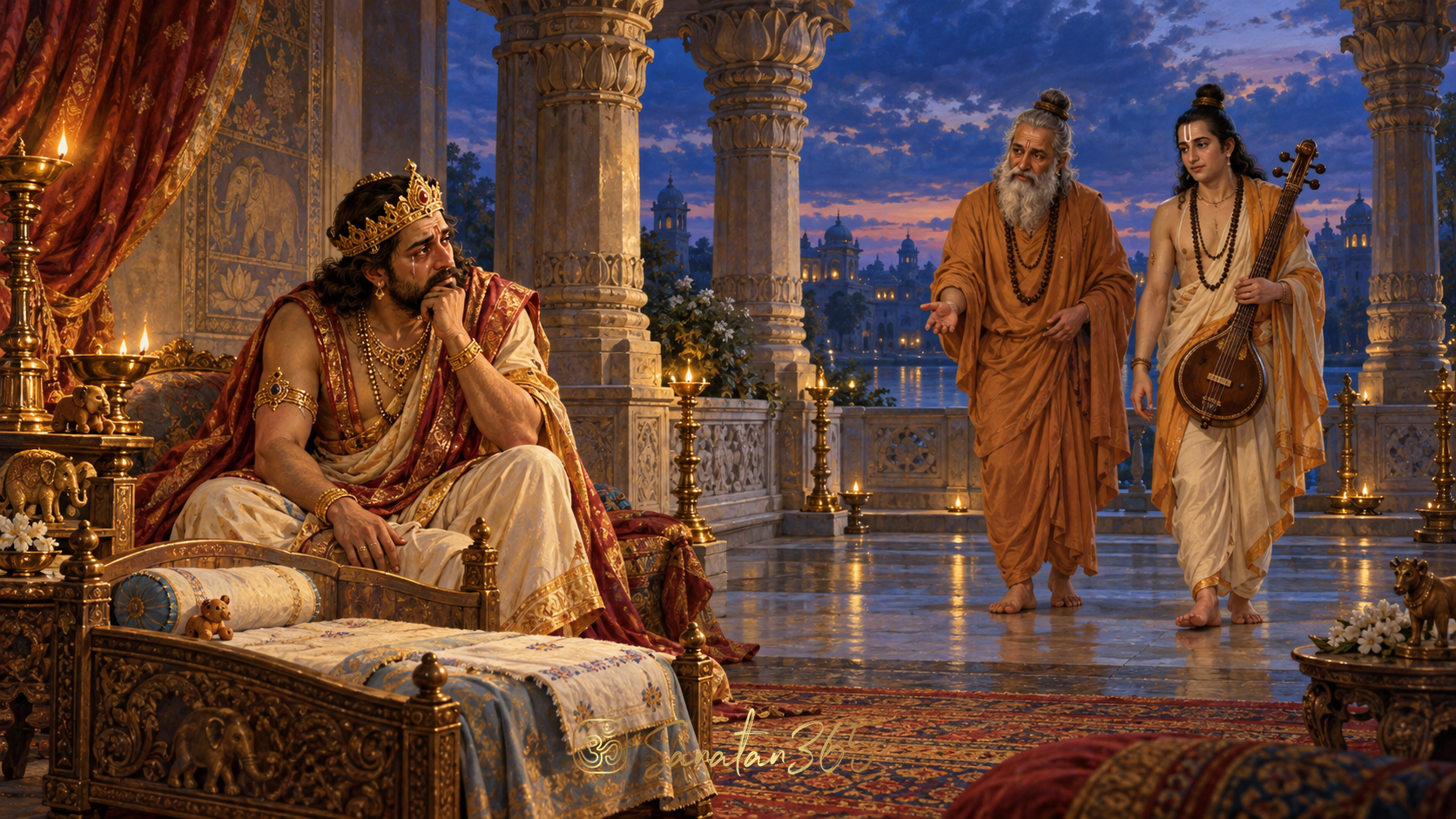 Stories
King Chitraketu Story: Grief, Wisdom, and Humility in the Bhagavata
The Bhagavata Purana tells how King Chitraketu met devastating loss, listened to Narada and Angira, and learned a difficult humility. Read…
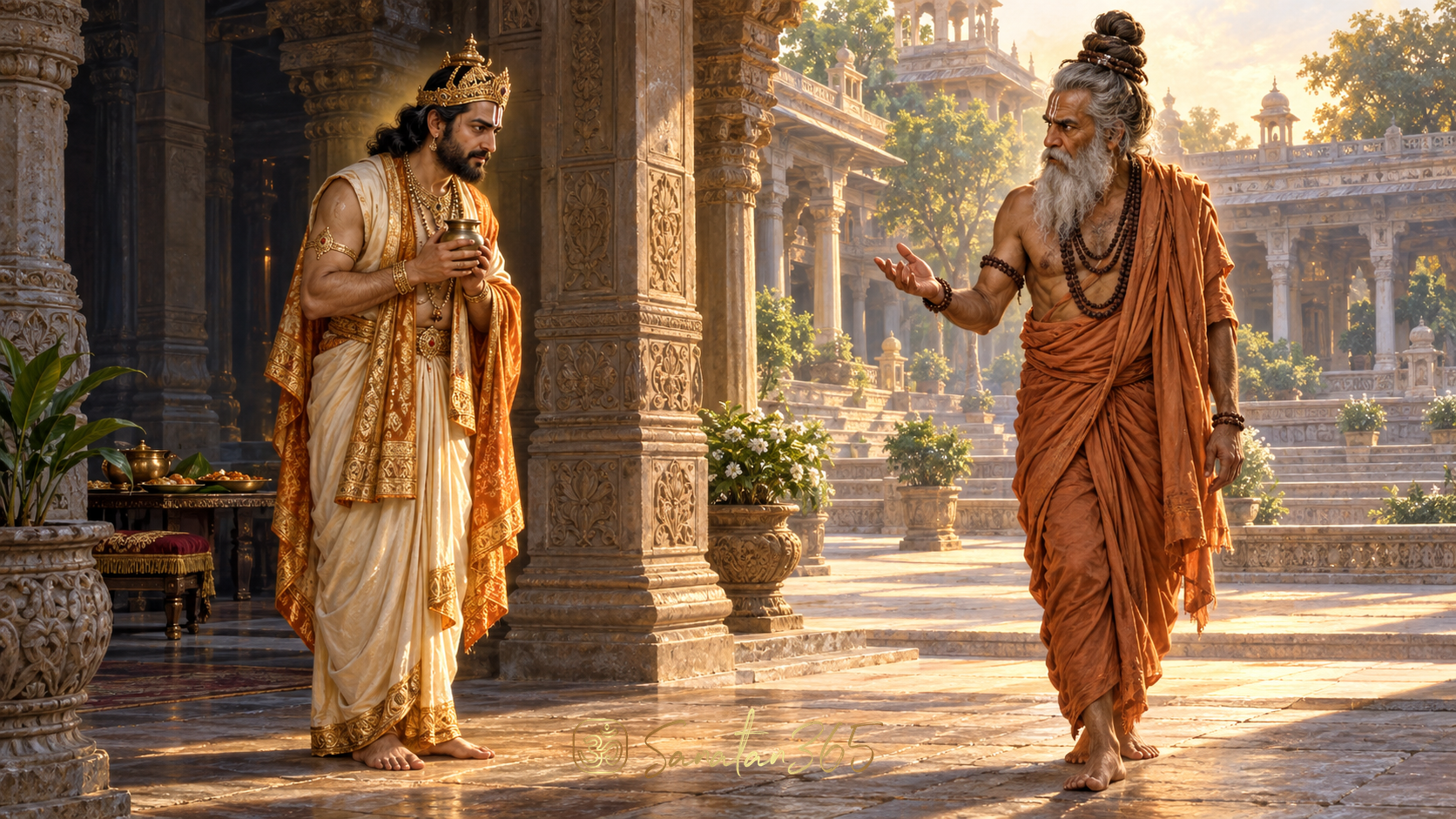 Stories
King Ambarisha and Durvasa: A Story of Devotion and Humility
The Bhagavata Purana story of King Ambarisha and Sage Durvasa explores a difficult fast, an angry visitor, and the restraint behind devotio…

