Modhera Sun Temple: Surya, the Stepwell, and Sacred Light
Explore Gujarat's Modhera Sun Temple through its Surya shrine, stepped reservoir, carved architecture, and the care needed to read a historic monument as sacred heritage.
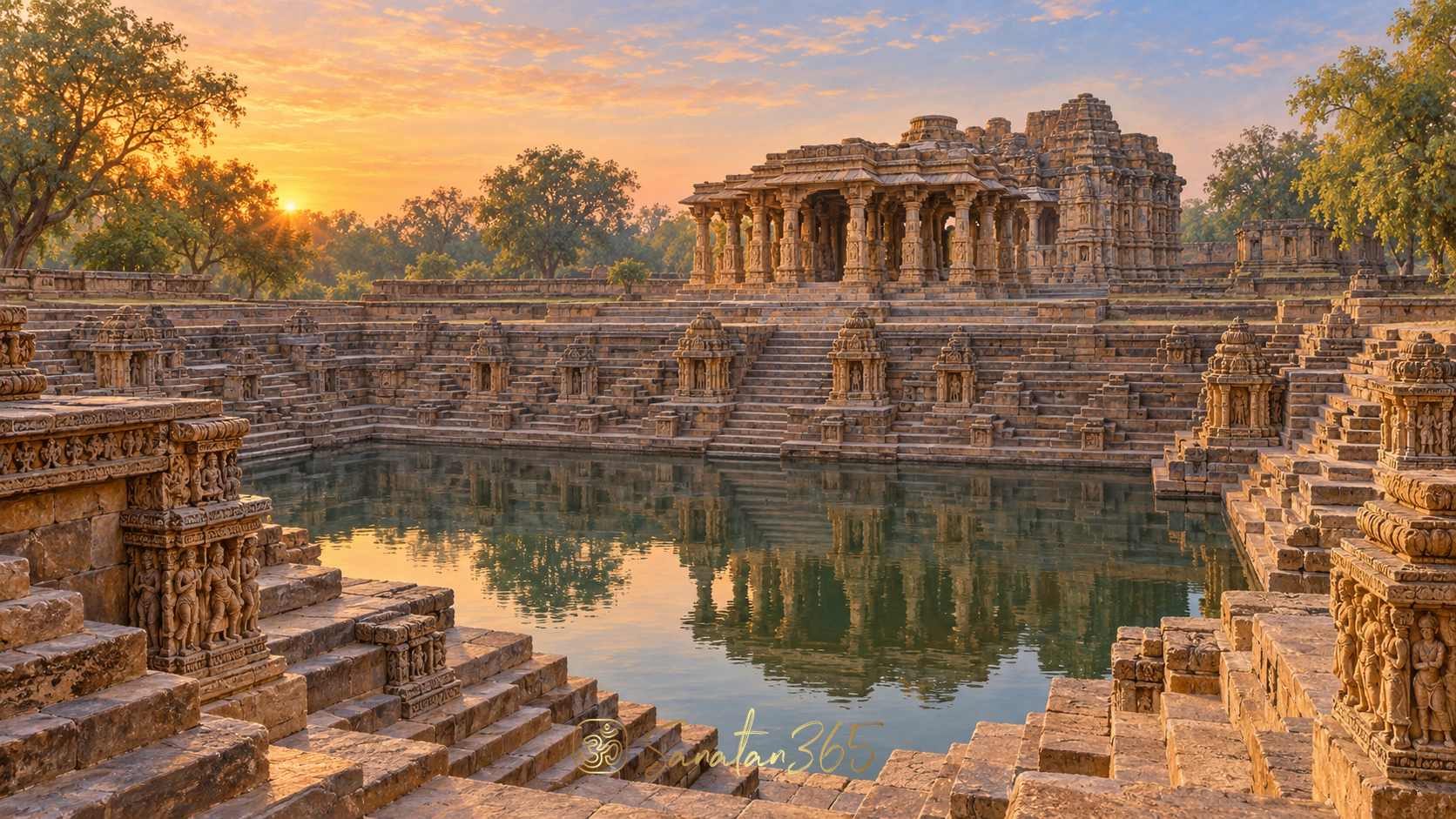
The first encounter with Modhera Sun Temple is not a towering image of the Sun. It is a descent: stone steps gather around a reservoir, drawing the eye toward carved halls beyond it.
Modhera Sun Temple is an eleventh-century Surya temple in Gujarat, valued for its stepped reservoir, richly sculpted assembly hall, and east-facing shrine. Its importance lies in the relationship among water, architecture, and light, as well as in the care with which a historic place of worship is preserved today. The site is a protected monument rather than an active temple with a surviving principal image. To understand it well, visitors should look at what its stones still show and distinguish that evidence from attractive but sometimes overstated stories about sunlight and ritual.
Why is Modhera Sun Temple important?
Modhera is a village in Gujarat's Mehsana district. The temple is dedicated to Surya (सूर्य, Sūrya, the Sun deity), whose visible light has long offered Hindu traditions a powerful language for life, time, and attentive worship. Gujarat Tourism dates the monument to 1026–27 CE during the reign of Bhima I of the Chaulukya dynasty. UNESCO's tentative-list account places it within the eleventh-century Māru-Gurjara architectural tradition of western India. These are historical attributions, not a claim that every surviving carving can be precisely dated to one year.
Three parts give the site its distinctive rhythm: a stepped water reservoir, an open assembly hall, and the enclosed hall and sanctuary beyond. UNESCO describes the Surya-kunda beneath the eastern face of the assembly hall. Gujarat Tourism likewise guides a visitor from the reservoir toward the halls. The sequence matters. One approaches the sanctuary through changing perspectives, from open water and sky to increasingly concentrated stonework. The experience is architectural, not just decorative.
A temple can be both a work of sacred imagination and a historic object whose use has changed. Gujarat Tourism notes that the main image of Surya no longer exists. The protected site should therefore not be described as if a priest still conducts daily worship before that image. Nor does the loss make it spiritually meaningless. The structure preserves evidence of an earlier community's devotion, skilled labour, and ways of organizing space around the Sun.
A useful comparison is Konark Sun Temple, another Surya monument with a different architectural conception. Konark's famous chariot imagery should not be projected onto Modhera. Here, the reservoir and processional movement through halls are central to the visitor's reading. Each place deserves its own history rather than a generic description of “sun temples.”
Key takeaway: Modhera's significance is the connected design of reservoir, halls, and Surya shrine, not a single photogenic façade.
How the Surya Kund prepares the approach
The Surya Kund is a kuṇḍa (कुण्ड, a built water reservoir), often called the Ram Kund in descriptions of the site. Its numerous descending steps make a complex geometric field. From above, the eye moves repeatedly between the waterline, small shrines, landings, and the temple beyond. The arrangement makes the reservoir more than an ornamental foreground.
Gujarat Tourism describes a rectangular kund with many small shrines, and identifies larger shrines associated with Ganesha and Vishnu, along with an image of dancing Shiva. UNESCO's tentative-list description emphasizes the reservoir's relationship to the assembly hall and the ceremonial gateways between them. Because parts of a historic complex survive unevenly, published descriptions can differ in how they count and label subsidiary shrines. A visitor need not settle every count to see the essential point: water and multiple sacred presences shaped the approach to Surya.
It is tempting to declare that every ancient visitor performed the same purification rite at the same step. The surviving architecture cannot establish such a universal practice. Water has clear ritual significance across Hindu traditions, but local practice is historically variable. Modhera's reservoir can be read as a setting where physical descent, reflection, and preparation were made visible in stone, without inventing an exact rite or telling contemporary visitors to enter the water.
The steps also change scale. Seen from the edge, the kund forms a patterned whole; seen from a lower landing, the same stone becomes a series of individual paths. That shift rewards slow looking. Notice how the temple is framed from different levels. Ask what the builders wanted a person to encounter before the main hall. A sacred place can teach through movement as much as through sculpture.
There is an ethical dimension to looking, too. Small shrines are not merely “details” for a camera. They point to a sacred landscape larger than the principal dedication. The presence of Ganesha, Vishnu, and Shiva imagery described by Gujarat Tourism is consistent with the many relationships within Hindu worship; it does not make Modhera a contest among deities. The Sun remains the temple's central dedication while other forms remain worthy of reverence.
Key takeaway: The kund organizes an encounter with water, stone, and multiple sacred images before the visitor reaches the Surya shrine.
What the carved Sabha Mandapa and shrine reveal
From the reservoir, the route leads toward the sabhā-maṇḍapa (सभामण्डप, assembly hall). Its pillars and carved surfaces invite a second kind of attention: close reading rather than a single panoramic view. Gujarat Tourism points visitors to representations of the twelve Ādityas (आदित्य, solar deities or forms associated in this context with the months). That detail links the Sun to a recurring cycle of time, yet the exact theological interpretation of each sculpture should be guided by reliable iconographic study rather than guesswork from a photograph.
Beyond the open hall lies the more enclosed gūḍha-maṇḍapa (गूढमण्डप, inner hall) and the garbhagṛha (गर्भगृह, sanctum). UNESCO presents the temple's parts as an ordered architectural ensemble. These Sanskrit-derived names describe different spatial roles; they are not interchangeable synonyms for “temple.” The assembly hall is a place of gathering and display. The enclosed hall mediates the approach. The sanctum is the focused inner space associated with the principal deity.
Carving at Modhera includes figures, vegetal motifs, and architectural ornament. UNESCO's description praises the profusion and workmanship of sculpture. A visitor can appreciate that skill without treating every motif as a secret code. When a guide assigns a precise meaning to a damaged figure, ask whether the identification appears in a reliable catalogue or is a plausible but unverified reading. Respect for a sacred monument includes honesty about what we do not know.
The stone also records the limits of preservation. The historic superstructure and principal image have not survived intact. A reconstruction drawing may help explain an architectural plan, but it is not the same as the monument presently visible. This distinction matters in captions, travel writing, and generated images. Showing a new, fully intact golden idol as if it stood at Modhera today would mislead readers. The remaining sanctuary is powerful enough without invented completion.
Māru-Gurjara architecture, as identified in UNESCO's account, belongs to a regional building tradition rather than to one monument alone. Modhera offers an unusually clear way to notice how sculptural abundance and spatial order can coexist. The building does not simply display images; it stages a progression from large, open forms toward a smaller and quieter center.
Key takeaway: Read Modhera as a sequence of distinct spaces and carefully observed carvings, while acknowledging what time has removed.
What is known about sunlight and the temple's orientation?
A Sun temple naturally raises a question: was Modhera designed so the rising Sun entered the shrine at a specific time? The answer needs two parts. The east-facing orientation is described in UNESCO's tentative-list statement, which says that equinox sunrise would shine through the assembly-hall doors toward the shrine. Gujarat Tourism also invokes the equinox in its visitor account. These published accounts support discussing intended solar orientation as part of the site's interpretation.
They do not, by themselves, prove every popular version of the story. Claims that a beam touches a particular surviving idol today are especially problematic: Gujarat Tourism says the principal image no longer exists. Nor should an evocative alignment claim be turned into a guaranteed annual viewing promise. Weather, the condition of the structure, sightlines, and the difference between a historical design and a contemporary observation all matter.
A careful description is more beautiful than an inflated one. Modhera faces the morning light; authoritative heritage accounts connect the design with an equinox alignment; the present monument must be seen as it survives. A visitor can observe how changing daylight reveals carvings without pretending to reenact an exact eleventh-century ceremony.
The relationship between light and sacred meaning also extends beyond one optical event. Surya's daily rising makes time visible. In the temple's design, water reflects the sky while stone gives the eye a route toward the shrine. That is an interpretation of the experience, not an archaeological measurement. Keeping interpretation and evidence distinct allows both to remain valuable.
Consider the difference between Modhera and the meaning of Surya Arghya, a living practice of offering water to the rising Sun. Both connect sunlight and reverence, but one is a protected historic monument and the other a practice carried out in varied settings today. Confusing them would flatten their distinct contexts.
Key takeaway: The east-facing design and reported equinox relationship are worth understanding, but precise modern beam-and-idol claims exceed the surviving evidence.
How to visit Modhera with respect
Begin with the reservoir, and allow enough time to move slowly toward the halls. Follow current Archaeological Survey of India and site instructions on access, photography, and protected surfaces. Do not assume that a heritage monument can be used in the same way as an active worship site. The absence of current worship before the lost principal image is part of the site's present reality, not a reason to treat it casually.
Look first at the whole plan, then at details. At the kund, notice the descending geometry and how the temple changes position in the frame. In the assembly hall, look for the relationships among pillars and figures rather than rushing to identify every image. At the inner hall, consider how enclosure changes the feel of the space. These are observations available to anyone, whether visiting as a devotee, student, or curious traveller.
If using a guide, ask which statements come from site signage or published heritage records and which are local tradition or interpretation. Local storytelling may carry memory and devotion, but it should be labelled as such when a claim is presented as history. The same discipline applies to the date of construction: the Gujarat Tourism account provides a specific early-eleventh-century attribution, while broader architectural descriptions speak of the Chaulukya period. The two are compatible, but neither requires pretending every phase is fully settled.
Practical plans should use the current official visitor information rather than an old blog's opening hours or ticket price. Gujarat Tourism's Modhera Sun Temple page is a useful starting point. In warm weather, plan for sun exposure and bring water; this is ordinary visitor care, not a ritual requirement. Keep voices moderate, protect the carved surfaces, and leave no offerings or objects where site rules do not permit them.
A respectful visit need not claim ownership of the site through a single interpretation. Modhera belongs to a living cultural memory and to a public heritage responsibility. Its dedication to Surya deserves reverence; its historic material deserves conservation; its incomplete state deserves truthfulness. These commitments reinforce rather than diminish one another.
Key takeaway: Slow observation, accurate language, and care for protected stone are the best ways to honour Modhera today.
The enduring impression of Modhera is a movement from reflective water through carved stone toward a sanctuary shaped for the Sun. The site asks for neither exaggerated miracles nor indifference. It asks for attention: to the builders' skill, to Surya's place in Hindu devotion, and to the difference between a living tradition and a surviving historical monument.
Single key takeaway: Modhera Sun Temple is best understood as a sacred architectural sequence where water, carving, and eastern light meet, interpreted with both reverence and historical care.
FAQ
Is Modhera Sun Temple still used for daily worship?
The monument is a protected historic site, and Gujarat Tourism notes that its principal Surya image no longer exists. Visitors should not assume daily worship before that image or conduct rituals contrary to site rules. Check current official guidance before a visit.
What is the Surya Kund at Modhera?
The Surya Kund is the stepped reservoir in front of the temple halls. Its descending geometry and subsidiary shrines make it central to the architectural approach. It is also called the Ram Kund in some descriptions.
Was Modhera built so sunlight reaches its sanctum?
UNESCO's tentative-list description identifies an east-facing design and an intended equinox sunrise path toward the shrine. That does not validate every modern claim about an exact beam striking an idol, especially because the principal image is no longer present.
Who built Modhera Sun Temple?
Gujarat Tourism attributes its construction to 1026–27 CE under Bhima I of the Chaulukya dynasty. Architectural accounts place the site in the eleventh-century Māru-Gurjara tradition. These attributions should be cited rather than reduced to legend.
How is Modhera different from Konark Sun Temple?
Both honour Surya, but they are distinct monuments in different regions and traditions. Modhera is especially noted for its Surya Kund and sequence of halls; Konark is famous for its monumental chariot conception. Their histories and surviving conditions should be explained separately.
About the author
Sanatan365 Editorial
Bringing Sanatan Dharma to modern seekers through authentic, scripture-grounded content.
Related in Temples
 Temples
Airavatesvara Temple Darasuram: Shiva, Stone, and Living Chola Art
Explore the Airavatesvara Temple at Darasuram as a living Shiva shrine, from its Chola stonework to the devotional rhythms that continue to…
 Temples
Virupaksha Temple Pattadakal: Shiva and Chalukya Art
A guide to Pattadakal's Virupaksha Temple: its Shiva dedication, Queen Lokamahadevi's patronage, intricate Chalukya architecture, and thoug…
 Temples
Jambukeswarar Temple: Water, Shiva, and Akilandeswari
Explore why Jambukeswarar Temple at Thiruvanaikaval is a sacred water-element Shiva shrine, and how to approach its living worship respectf…

