Nala Damayanti Story: Love, Loss, and the Discipline of Recovery
The Mahabharata's Nala and Damayanti story follows a royal couple through choice, gambling loss, exile, separation, hidden identities, and a hard-won reunion.
A king loses his realm at the dice board; a queen enters the forest, survives abandonment, and turns intelligence into a path home. The Nala Damayanti story is not simply an ancient romance. In the Mahabharata, it is a study of choice under pressure: love chooses freely, weakness carries consequences, skill can be rebuilt, and reunion becomes meaningful only after truth and accountability.
Known as the Nalopakhyana (नलोपाख्यान, Nalopākhyāna, “the episode of Nala”), the account appears in the Vana Parva, the Mahabharata’s Book of the Forest. Sage Brihadashva tells it to Yudhishthira after the Pandava king has lost his kingdom in a disastrous dice game. The parallel is deliberate. Nala’s fall tells Yudhishthira that catastrophe is real, but it need not be final.
Key takeaway: The story offers hope without denying consequence: recovery begins when suffering is met with discernment, learning, and responsible action.
What Is the Nala Damayanti Story in the Mahabharata?
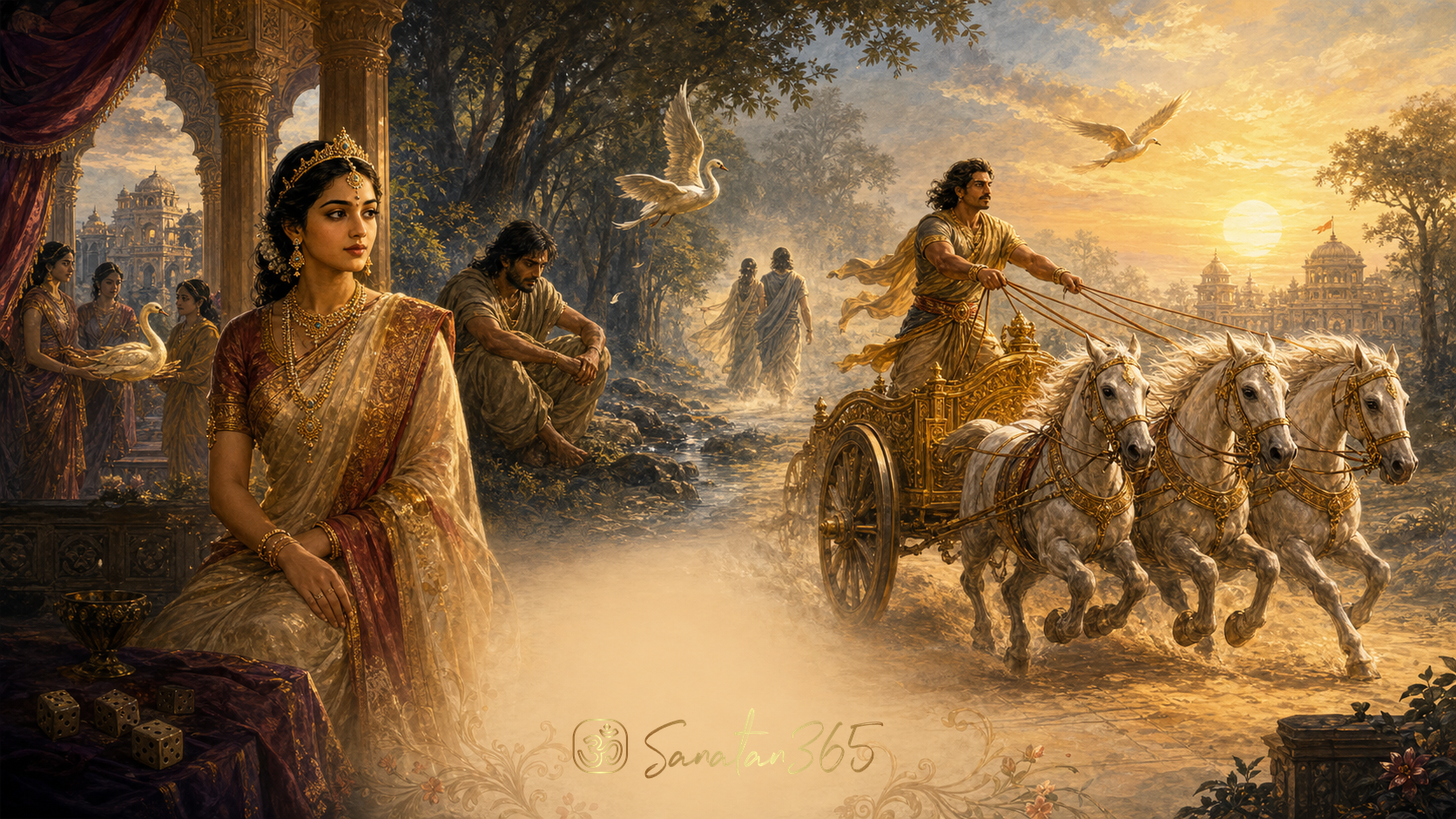
Nala is the admired king of Nishadha; Damayanti is the princess of Vidarbha. Before meeting, each hears of the other’s qualities. A golden swan carries messages between them, giving their love an almost luminous beginning. Yet the tale quickly makes clear that attraction is not enough. Damayanti must exercise judgment in public, under extraordinary pressure.
At her svayamvara (स्वयंवर, svayaṃvara, “self-choice”), Damayanti is to choose a husband from assembled suitors. Several devas also desire her and enlist Nala as their messenger. Nala faithfully delivers their proposal even though he loves her himself. Damayanti remains resolute: she will choose Nala.
The devas then take Nala’s appearance, forcing her to distinguish the human king from divine likenesses. She observes carefully. Traditional tellings describe the devas as untouched by ordinary bodily signs while Nala bears the marks of embodied life. Damayanti recognizes him and places the garland around his neck. Her choice is not impulsive; it joins love to close perception.
The couple marry and rule well, but Kali—here a hostile personified force, not Goddess Kali—holds resentment over Damayanti’s choice. After waiting for an opening, Kali influences Nala. Nala accepts a dice challenge from his brother Pushkara. The game consumes his wealth and kingdom. Despite appeals to stop, he continues until ruin sends Nala and Damayanti into exile.
That sequence echoes Yudhishthira’s own crisis. The Mahabharata does not tell him that fate makes responsibility irrelevant. It shows how an external influence and a human vulnerability can operate together. Nala is afflicted, but he also makes decisions whose effects fall upon others.
Key takeaway: Dharma (धर्म, dharma, “right order, duty, and sustaining conduct”) requires both awareness of powerful influences and honesty about one’s own choices.
Why Does the Nala Damayanti Story Begin with Free Choice?
Damayanti’s svayamvara establishes the moral center of the narrative. She is not merely the reward at the end of a contest. She listens, observes, decides, speaks, and acts. Even when confronted by beings who resemble Nala, she does not surrender her discernment.
This matters because later parts of the story test recognition in a different form. Nala will become unrecognizable, living under the name Bahuka. Damayanti will again have to read signs, compare evidence, and distinguish truth from appearance. The early court scene and the later reunion mirror one another: love must see clearly.
Nala also makes a morally serious choice before the marriage. Asked by the devas to carry their message, he keeps his word even though doing so may cost him the woman he loves. His integrity does not manipulate Damayanti’s answer. Their bond begins with truthfulness and consent, not possession.
The episode therefore resists a shallow reading of destiny. Providence surrounds the pair, but choice still matters. Damayanti chooses Nala. Nala chooses to honor his duty as messenger. Later, he chooses badly at dice and must acquire the knowledge needed to recover.
This is one reason the story has endured through Sanskrit poetry, miniature painting, and Kerala’s Nalacaritam performance tradition. Its drama is not built only on what happens to the characters. It is built on how they choose when appearances, desire, duty, and fear pull in different directions. Sahapedia’s study of the narrative traces this rich afterlife across the Mahabharata, Harsha’s Naishadhiyacarita, and Kathakali.
Key takeaway: The story treats love as an exercise of freedom guided by discernment, not as passive destiny.
How Do Dice, Exile, and Separation Change Nala and Damayanti?
The dice game is the tale’s great fracture. Nala’s kingdom is not lost in a single careless moment. Loss accumulates while he continues playing. That pattern makes the episode painfully recognizable: destructive habits often shrink judgment by degrees, while each new loss creates pressure to chase reversal.
The story should not be reduced to a modern clinical diagnosis, but its moral observation remains sharp. Secrecy, compulsion, wounded pride, and refusal to stop can transfer private vulnerability into family and public harm. A ruler’s decisions reach citizens; a spouse’s decisions reach the household. Position does not shield anyone from consequence.
In the forest, Nala and Damayanti face hunger, exhaustion, and despair. Nala eventually abandons Damayanti while she sleeps, convinced in his disturbed state that she may fare better without him. The act is presented within his affliction, but its pain is not erased. Damayanti awakens alone and must survive danger, uncertainty, and grief.
Her response reveals formidable agency. She seeks information, protects herself, reaches the court of Chedi, and later returns to Vidarbha. She does not simply wait in one place for rescue. She creates networks, questions travelers, sends Brahmins as messengers, and devises ways to locate the missing Nala.
Nala, meanwhile, encounters the serpent Karkotaka. After Nala rescues him from a fire, Karkotaka’s bite changes Nala’s appearance. Under the name Bahuka, Nala enters the service of King Rituparna as a charioteer and cook. The disguise protects him, but it also humbles him. A king who has lost control must serve, work, and learn.
The altered appearance can be read as more than concealment. Nala can no longer rely on royal beauty or status. His capacities must speak for him. His exceptional command of horses remains real; his cooking and service become part of his hidden life. Identity survives beneath changed fortune, but it needs disciplined expression.
For readers affected by gambling or another harmful pattern, the responsible modern lesson is concrete: love alone does not correct compulsion. Honest disclosure, firm limits, financial safeguards, and qualified professional support may be necessary. Spiritual reflection can accompany those steps; it should not replace them.
Key takeaway: Loss exposes character, but it also creates a demanding classroom in which humility, skill, and support can begin rebuilding a life.
What Do Nala and Damayanti Teach About Recovery?
Recovery in the Nala Damayanti story is not a magical rewind. Nala gains knowledge from Rituparna, whose mastery of numbers complements Nala’s mastery of horses. Their exchange is central: Nala shares equestrian knowledge and receives the science of dice. He does not overcome the instrument of his ruin through willpower alone; he learns how it works.
The distinction is crucial. A person harmed by a domain may need to understand that domain more clearly—not to return carelessly, but to stop being ruled by ignorance. Knowledge, however, is only one part of repair. Nala must also regain steadiness and confront what has happened.
Damayanti’s strategy helps bring him back. Hearing reports of a remarkably skilled charioteer in Rituparna’s court, she arranges news of a second svayamvara as a test and summons the king to Vidarbha with impossible speed. Bahuka’s driving skill makes the journey possible. Damayanti then gathers evidence: his conduct, knowledge, cooking, and emotional responses all matter.
Modern readers may feel discomfort at elements of the reunion, and the epic should not be flattened into a command that every abandoned partner must reconcile. Damayanti’s choices belong to her story; they do not erase another person’s boundaries. The deeper principle is that reunion requires recognition and truth. She questions. Nala explains. Trust is not treated as blindness.
Once restored to his true form and reunited with Damayanti, Nala later challenges Pushkara again. With new knowledge, he wins back the kingdom. Yet restoration is completed through restraint rather than vengeance: Nala does not define victory as annihilating his brother. Rule returns together with a changed understanding of power.
The tale thus offers a four-part pattern of recovery:
- Name the loss truthfully. A kingdom, trust, stability, and time have been damaged.
- Learn what weakness obscured. Nala acquires disciplined knowledge rather than relying on pride.
- Let skill serve responsibility. Charioteering, observation, communication, and patience become practical tools.
- Restore without becoming consumed by revenge. Regained power is tested by how it is used.
This pattern also explains why Brihadashva tells the story to Yudhishthira. Consolation is not merely “another king suffered too.” The teaching is that capability can be rebuilt. Brihadashva also gives Yudhishthira knowledge of dice, preparing him rather than simply soothing him.
Key takeaway: Durable recovery combines truthful accountability, practical learning, patient evidence, and the ethical use of restored power.
Why Does This Mahabharata Story Still Matter?
The Nalopakhyana understands that a person can be more than the worst period of his or her life without pretending that harm never occurred. Nala is neither permanently reduced to failure nor excused by destiny. Damayanti is neither a passive sufferer nor a flawless symbol placed beyond human feeling. Both act within uncertainty.
For families, the narrative opens valuable conversations without forcing a single moral:
- What distinguishes devotion from possessiveness?
- When does perseverance become harmful refusal to stop?
- How can a family protect itself while still holding compassion?
- What knowledge is needed before trust can be rebuilt?
- Does winning matter if victory reproduces cruelty?
The tale also honors multiple kinds of intelligence. Damayanti’s pattern recognition and communication are as decisive as Nala’s chariot mastery. Rituparna’s numerical knowledge matters. Messengers, hosts, and observers help connect separated worlds. Recovery is relational, even when one person must do the inner work.
Readers can pair this account with the Yaksha Prashna and Yudhishthira’s test of dharma, another forest teaching in which judgment matters under extreme pressure. The story of Matsya and what must be preserved offers a complementary reflection on safeguarding life and knowledge through crisis. For a practical view of action without fixation on results, see Nishkama Karma in daily life.
The story’s hope is disciplined rather than easy. Love endures, but love also investigates. Skill survives, but skill must be trained. Fortune returns, but power must be governed. The couple reaches reunion only after each has traveled through a different education in courage.
Key takeaway: Nala and Damayanti remain relevant because their story joins compassion with boundaries, hope with learning, and restoration with responsibility.
The Nala Damayanti story begins with a golden swan and a radiant act of choosing, then passes through dice, forest darkness, disguise, and doubt. Its conclusion does not restore innocence. It restores relationship and rule after knowledge has been earned. That is its single enduring lesson: a fall may change a life, but truthful learning can change what happens next.
FAQ
Where does the Nala Damayanti story appear?
It appears in the Vana Parva, or Book of the Forest, of the Mahabharata. The embedded narrative is commonly called the Nalopakhyana, meaning “the episode of Nala.”
Why is the story told to Yudhishthira?
Sage Brihadashva tells it after Yudhishthira loses his kingdom at dice. Nala’s parallel experience offers both hope and instruction: loss can be survived, but recovery requires knowledge, discipline, and better judgment.
How does Damayanti recognize Nala at the svayamvara?
When the devas assume Nala’s likeness, Damayanti observes signs distinguishing divine beings from an embodied human. Her recognition shows careful discernment rather than blind attraction.
Who is Bahuka in the Nala Damayanti story?
Bahuka is the name Nala uses after Karkotaka changes his appearance. In that form, he serves King Rituparna as an exceptionally skilled charioteer and cook while learning knowledge that later helps him recover.
What is the main lesson of Nala and Damayanti?
The story has several lessons, but its central movement is from loss to responsible restoration. Love needs discernment; harmful choices have consequences; and recovery requires accountability, practical learning, patient truth-seeking, and restraint.
About the author
Sanatan365 Editorial
Bringing Sanatan Dharma to modern seekers through authentic, scripture-grounded content.
Related in Stories
 Stories
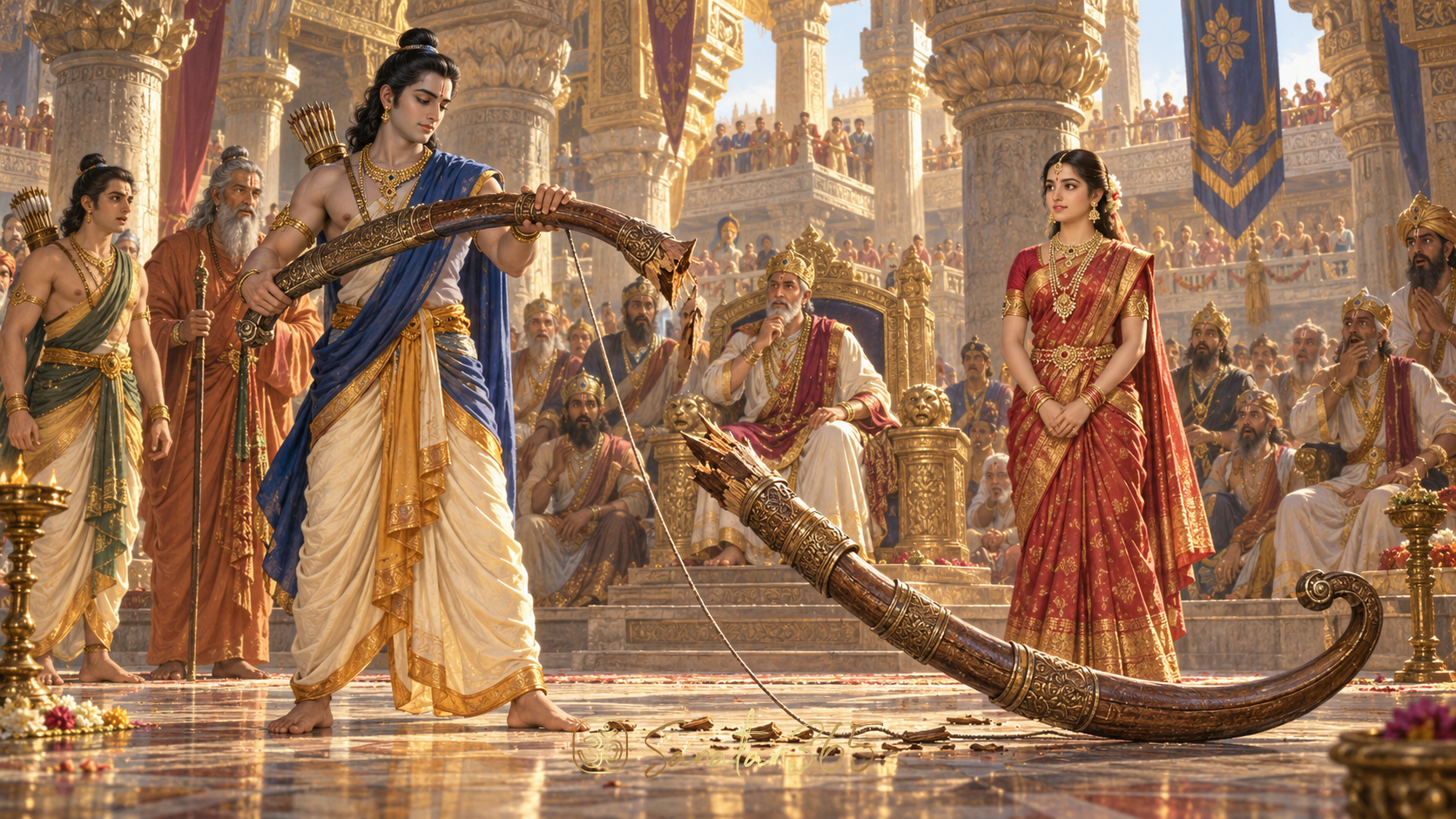
Sita Swayamvara in the Ramayana: Shiva's Bow and the Meaning of the Marriage
Read the Bala Kanda account of Rama, Sita, Janaka and Shiva's bow, and separate the text's sequence from later devotional retellings.
 Stories
King Chitraketu Story: Grief, Wisdom, and Humility in the Bhagavata
The Bhagavata Purana tells how King Chitraketu met devastating loss, listened to Narada and Angira, and learned a difficult humility. Read…
 Stories
King Ambarisha and Durvasa: A Story of Devotion and Humility
The Bhagavata Purana story of King Ambarisha and Sage Durvasa explores a difficult fast, an angry visitor, and the restraint behind devotio…