Pancha Maha Yajna Meaning: Five Daily Offerings in Hindu Life
Pancha Maha Yajna means the five great daily offerings of Hindu householder life: to knowledge, the Divine, ancestors, living beings, and guests.
A Hindu home was never meant to be a private island. It was imagined as a small center of gratitude, learning, worship, care, and hospitality.
Pancha Maha Yajna meaning begins with three words: pancha (पञ्च, five), maha (मह, great), and yajna (यज्ञ, sacred offering or sacrifice). The phrase refers to five daily offerings traditionally associated with Hindu householder life: Brahma Yajna for sacred knowledge, Deva Yajna for the Divine, Pitru Yajna for ancestors, Bhuta Yajna for living beings, and Manushya or Atithi Yajna for fellow humans and guests. The teaching is simple but demanding: every day, a person receives from many visible and invisible sources, so every day should include some act of return.
Key takeaway: Pancha Maha Yajna turns ordinary home life into daily gratitude toward knowledge, the Divine, ancestors, nature, and society.
What is the Pancha Maha Yajna meaning in Hindu life?
The Pancha Maha Yajna meaning is the fivefold discipline of giving back. In classical Hindu thought, especially in the grihastha (गृहस्थ, householder) stage of life, a person does not live only for personal comfort. The householder supports family, learning, ritual, guests, elders, animals, and the wider community. The five yajnas give that responsibility a daily rhythm.
The Taittiriya Aranyaka, associated with the Krishna Yajurveda, is one of the Vedic sources connected with Mahayajna material, recitation, ancestral rites, and Brahma Yajna, as summarized by the Government of India's Vedic Heritage Portal Vedic Heritage Portal. Later Dharma traditions also preserve the idea that household life carries duties beyond earning and consumption.
The word yajna is often translated as sacrifice, but that English word can sound narrow. Yajna does not only mean giving something up painfully. It means making an offering in a sacred relationship. Fire rituals are one form of yajna, but the deeper pattern is wider: receive with awareness, offer with humility, and keep life connected to dharma (धर्म, sustaining order and right conduct).
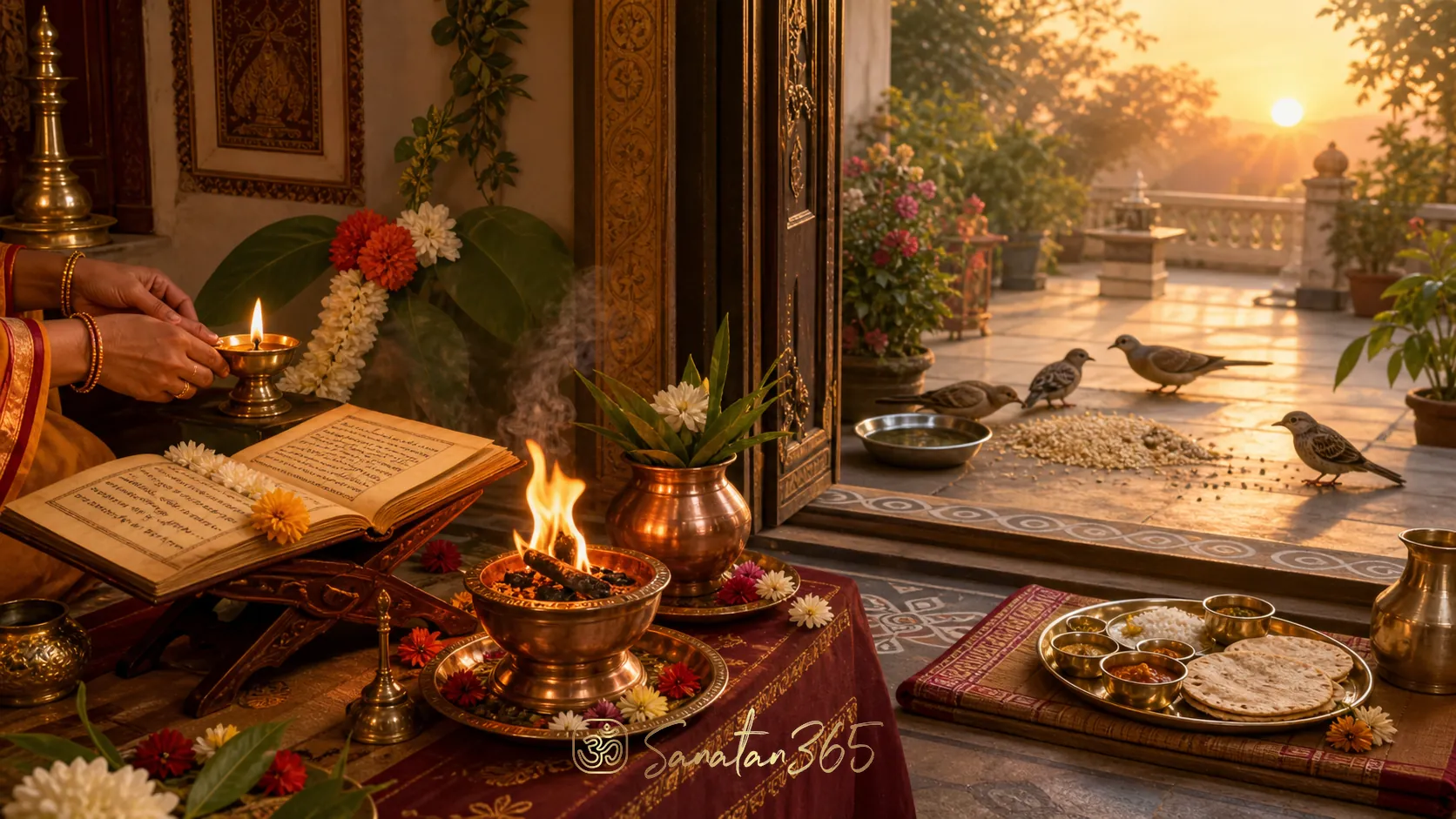
For a modern family, Pancha Maha Yajna need not always mean elaborate ritual. It can include reading a sacred verse, lighting a lamp, remembering ancestors, feeding birds, helping a guest, teaching a child, or serving someone without display. The spirit is continuity, not performance.
Key takeaway: The five yajnas teach that a Hindu household is spiritually complete only when it gives back in five directions.
What are the five daily yajnas?
Different texts and traditions may phrase the list slightly differently, but the familiar five are Brahma Yajna, Deva Yajna, Pitru Yajna, Bhuta Yajna, and Manushya Yajna, also called Atithi Yajna in many explanations. Each offering repairs one relationship.
- Brahma Yajna: offering to sacred knowledge, the Vedas, teachers, rishis, and learning.
- Deva Yajna: offering to the Divine through worship, lamp, mantra, homa, or gratitude.
- Pitru Yajna: offering to ancestors through remembrance, water offering, gratitude, and family duty.
- Bhuta Yajna: offering to living beings, animals, birds, plants, and the ecological world.
- Manushya or Atithi Yajna: offering to people, especially guests, seekers, strangers, and those in need.
Britannica describes yajna broadly as a Vedic ritual offering before sacred fire, while also noting that the tradition has evolved into symbolic offerings and continues in rites, temple ceremonies, and community practice Britannica. Pancha Maha Yajna shows that same movement from ritual center to daily ethical life.
The five are not random. They cover the whole field of indebtedness. A person receives language, stories, scriptures, and wisdom from teachers. One receives life and breath under the protection of the Divine. One receives a body, name, culture, and memory from ancestors. One depends on animals, trees, soil, water, and unseen beings. One survives through society, workers, neighbors, guests, friends, and strangers.
When these debts are ignored, life becomes self-enclosed. When they are remembered, even simple acts gain dignity.
Key takeaway: The five yajnas are a daily map of gratitude toward learning, divinity, lineage, ecology, and humanity.
Why is Brahma Yajna an offering to knowledge?
Brahma Yajna is the offering made through study, recitation, teaching, and reverence for sacred knowledge. Here, Brahma is often connected with Brahman, the Vedas, and the stream of wisdom carried by rishis and teachers. The offering is not only flowers or flame. It is attention.
A home performs Brahma Yajna when it keeps learning alive. Reading a passage from the Bhagavad Gita, teaching a child a shloka, listening to a responsible discourse, preserving a family story, learning Sanskrit pronunciation carefully, or reflecting on dharma before making a decision can all carry the spirit of Brahma Yajna.
This matters because knowledge decays when it is not used. A scripture closed forever becomes furniture. A mantra recited without attention becomes sound alone. A tradition inherited but never understood becomes fragile. Brahma Yajna asks each generation to become a living bridge rather than a storage box.
For diaspora families, this yajna can be especially powerful. A small weekly reading circle, a child asking grandparents about a festival, or parents learning the meaning of a prayer before teaching it can keep Sanatan Dharma rooted without turning it into pressure. The goal is not to make every child a scholar. The goal is to protect reverence for truth.
Hinduism Today has described Pancha Maha Yajna as a framework that can help children and youth see daily duties as meaningful relationships rather than as remote ritual obligations Hinduism Today. Brahma Yajna begins that process by honoring the guides who gave language to the soul.
Key takeaway: Brahma Yajna means learning is not consumed casually; it is received, practiced, protected, and passed forward.
How do Deva Yajna and Pitru Yajna sustain reverence?
Deva Yajna is the offering to the Divine. It may take the form of lighting a diya, doing puja (पूजा, worship), chanting a mantra, offering water, performing havan, or simply beginning the day with gratitude. In a fuller Vedic setting, Deva Yajna may involve fire offerings. In a daily household setting, the essential movement is reverent offering.
This yajna reminds the mind that human effort is not the whole story. Sunlight, rain, digestion, breath, intelligence, protection, and opportunity are not manufactured by ego alone. Deva Yajna trains the heart to see grace. Even a short lamp-lighting becomes powerful when done with bhava (भाव, sincere inner feeling).
Pitru Yajna is the offering to ancestors. Pitru (पितृ, ancestor or forefather) does not mean only names remembered in a family tree. It points to the entire lineage through which body, culture, language, duties, land, food habits, songs, and moral examples have arrived. Traditional forms include water offerings, shraddha rites, and remembrance. Everyday forms include gratitude, caring for elders, preserving family dharma, and not dishonoring the sacrifices that built one's life.
Pitru Yajna should not become fear-based. Its healthiest form is grateful continuity. A person may remember ancestors before a meal, teach children about grandparents, support aging parents with dignity, or perform annual rites according to family tradition. The offering says: "I did not begin with myself."
Together, Deva Yajna and Pitru Yajna correct spiritual loneliness. One looks upward toward the Divine. The other looks backward through lineage. Both make the present moment less arrogant.
For readers exploring related household practices, Havan Meaning: Why Hindus Offer Into Sacred Fire and Nitya Puja Meaning: Daily Worship as a Living Hindu Practice give deeper context on sacred fire and daily worship.
Key takeaway: Deva Yajna keeps the heart open to grace, while Pitru Yajna keeps the heart rooted in grateful lineage.
What do Bhuta Yajna and Manushya Yajna teach about service?
Bhuta Yajna is the offering to living beings. Bhuta (भूत, being or creature) can refer to animals, birds, insects, plants, and the wider field of life. Traditional households often expressed this by placing food for animals, caring for cows, feeding birds, or showing restraint toward the natural world.
The modern meaning is not difficult. Do not waste food casually. Keep water for birds in hot weather when locally appropriate. Feed animals responsibly without creating harm. Avoid cruelty. Plant and protect trees. Use resources with restraint. Notice that human comfort depends on non-human life.
Bhuta Yajna is especially relevant in urban life, where people can forget that milk, grain, cotton, air, water, soil, and medicine all come through networks of living beings. The offering may be small, but the vision is large: the world is not a warehouse for human appetite.
Manushya Yajna, often expressed as Atithi Yajna, is the offering to people. Atithi (अतिथि, guest) literally suggests one who arrives without a fixed date. In the old household ideal, the guest was not treated as an interruption but as a sacred opportunity. This does not require unsafe naivety. It means the home should not lose hospitality, generosity, and human warmth.
Today, Manushya Yajna may include feeding a guest, helping a neighbor, supporting a student, giving directions kindly, checking on someone elderly, donating with discretion, or making time for a person who cannot repay the favor. The related practice of Seva Meaning: Hindu Selfless Service in Daily Life shows how service becomes a daily form of worship.
Together, Bhuta Yajna and Manushya Yajna prevent spirituality from becoming private decoration. They ask whether worship has softened one's conduct toward beings and people.
Key takeaway: Bhuta Yajna expands compassion to all living beings, and Manushya Yajna turns hospitality and service into sacred duty.
How can modern families practice Pancha Maha Yajna simply?
The five yajnas can be practiced without anxiety. A family does not need to imitate every detail of another region, caste tradition, or lineage. It should honor its own parampara (परम्परा, lineage or transmitted tradition) where known, and apply the principle with sincerity where detailed practice is not available.
A simple daily pattern could look like this:
- Brahma Yajna: read one verse, teach one value, or study one paragraph of a sacred text.
- Deva Yajna: light a diya, chant a mantra, offer water, or sit in gratitude for one minute.
- Pitru Yajna: remember ancestors, call elders, preserve a family story, or perform family rites on the right days.
- Bhuta Yajna: feed birds or animals responsibly, water a plant, reduce waste, or avoid needless harm.
- Manushya Yajna: feed a guest, help someone, give quietly, or practice patient hospitality.
For busy households, the rhythm can be weekly at first. Monday may include study. Tuesday may include extra service. A weekend may include elder care or family storytelling. The aim is to make the five relationships visible again.
Children can learn the five as five questions:
- What did I learn or pass on today?
- How did I remember the Divine?
- Whom did I thank from my family line?
- Which living being did I treat kindly?
- Which person did I help or welcome?
The deeper practice is not counting points. It is changing identity. A person begins to see himself or herself not as an isolated consumer, but as a participant in a sacred network.
For a fuller view of household dharma, Grihastha Ashrama Meaning: Householder Dharma in Hindu Life explains why the householder stage is treated as a pillar of Hindu life.
Key takeaway: Modern Pancha Maha Yajna can be simple, but it should remain concrete enough to change daily behavior.
Why does Pancha Maha Yajna still matter?
Pancha Maha Yajna matters because modern life often trains the opposite habit: take knowledge without honoring teachers, use nature without restraint, inherit culture without gratitude, seek divine help without offering, and move through society without hospitality. The five yajnas quietly reverse that pattern.
They also protect Hindu ritual from becoming isolated from ethics. A lamp before the Divine should lead to gentler speech. Ancestor remembrance should lead to family responsibility. Sacred study should lead to humility. Feeding animals should lead to ecological care. Welcoming guests should lead to social warmth.
This is why Pancha Maha Yajna is not merely a list of old duties. It is a civilizational design for daily life. It tells the householder: your kitchen, doorway, prayer space, bookshelf, water vessel, and dining mat can all become places of offering.
The practice also corrects spiritual ego. A person may know many scriptures, but Brahma Yajna asks whether knowledge is honored and shared. A person may worship beautifully, but Deva Yajna asks whether the offering is sincere. A person may speak proudly of lineage, but Pitru Yajna asks whether elders and ancestors are remembered with duty. A person may love spiritual ideas, but Bhuta and Manushya Yajna ask whether beings and people are treated kindly.
Key takeaway: Pancha Maha Yajna keeps Hindu spirituality whole by joining worship, study, family duty, ecological care, and service.
FAQ
What is the simple Pancha Maha Yajna meaning?
Pancha Maha Yajna means the five great daily offerings in Hindu life. They are offerings to sacred knowledge, the Divine, ancestors, living beings, and fellow humans or guests.
What are the five Pancha Maha Yajnas?
The five are Brahma Yajna, Deva Yajna, Pitru Yajna, Bhuta Yajna, and Manushya Yajna or Atithi Yajna. They represent duties toward learning, worship, lineage, nature, and society.
Is Pancha Maha Yajna only for traditional households?
No. Traditional households may follow detailed inherited forms, but the principle can guide modern families too. Reading scripture, lighting a lamp, remembering ancestors, feeding beings, and helping guests all express the same spirit.
Does yajna always mean a fire ritual?
Not always. Yajna often refers to sacred fire offerings, but it also means a sacred act of offering. In Pancha Maha Yajna, study, hospitality, remembrance, and care for living beings can also become yajna.
How can children learn Pancha Maha Yajna?
Children can learn it through five daily questions: What did I learn, how did I remember the Divine, whom did I thank in my family, which living being did I treat kindly, and whom did I help?
The single key takeaway: Pancha Maha Yajna teaches that a Hindu home becomes sacred not by withdrawal from the world, but by offering something back to every relationship that sustains life.
About the author
Sanatan365 Editorial
Bringing Sanatan Dharma to modern seekers through authentic, scripture-grounded content.
Related in Rituals
 Rituals
Samavartana Meaning: Returning Home After Sacred Study
Samavartana marks the completion of traditional study through a ceremonial bath and return. Its lasting question is how learning becomes re…
 Rituals
Vidyarambham Meaning: First Letters, Learning, and Reverence
Explore Kerala’s ceremony of beginning letters, its Vijayadashami setting, rice-writing customs, and the meaning of a gentle first step int…
 Rituals
Ganga Aarti Meaning: Why Lamps Are Offered to the River
Why devotees offer light to the Ganga, what the public ceremony in Varanasi expresses, and how visitors can participate with care.