Tulsi Plant Meaning: Sacred Basil, Vishnu Devotion, and the Hindu Home
Tulsi plant meaning explained through sacred basil, Vishnu devotion, home worship, Tulsi Vrindavan, and daily care without superstition or overclaim.
A courtyard plant can become the spiritual center of a home.
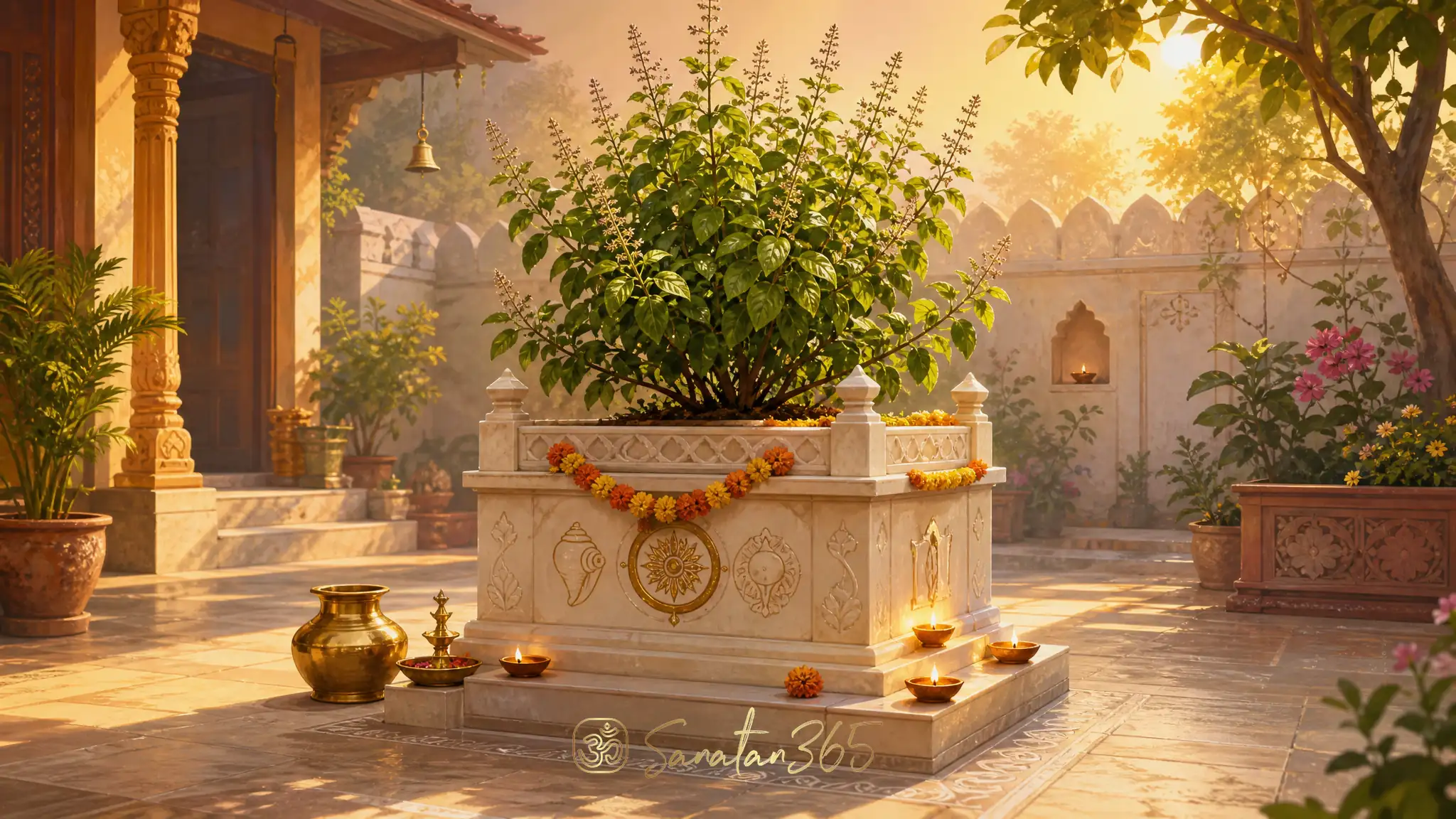
Tulsi plant meaning begins with sacred basil, Vishnu devotion, and the Hindu habit of turning daily care into worship. Tulsi (तुलसी, tulasī, sacred basil) is revered in many Hindu homes as a living symbol of purity, auspiciousness, and devotion to Vishnu and Lakshmi. The plant is not worshipped as decoration or superstition. It is honored as a daily reminder that the home itself can become a place of prayer, restraint, gratitude, and sacred rhythm.
What is Tulsi plant meaning in Hindu homes?
The Tulsi plant meaning in Hindu practice is layered. Botanically, holy basil is commonly identified as Ocimum tenuiflorum. Devotionally, Tulsi is remembered as sacred to Vishnu and closely associated with Lakshmi. Britannica describes holy basil as revered in Hinduism and connected with Lakshmi, the consort of Vishnu. Britannica's wider discussion of ceremonial plants also notes tulasi as sacred in Vaishnava worship, where plants can become ritual objects through sacred meaning.
This is why the plant often stands near the entrance, courtyard, balcony, or a small Tulsi Vrindavan (तुलसी वृन्दावन, tulasī vṛndāvana, a raised shrine-like planter). The placement is practical and symbolic. A living plant needs light and care, and a sacred plant invites the family to pause before the day becomes ordinary.
Tulsi worship is therefore not only about the plant. It is about relationship. The devotee waters, circles, offers light, recites a prayer, and remembers Vishnu. In many homes, this rhythm is led by mothers and grandmothers, but its meaning belongs to the whole family. Children learn that devotion is not only done in a temple. It can be done through a cup of water, a lamp, a leaf, a clean space, and a steady heart.
Key takeaway: Tulsi plant meaning is the transformation of daily plant care into Vishnu-centered remembrance inside the Hindu home.
Why is Tulsi sacred to Vishnu and Lakshmi?
Tulsi is especially loved in Vaishnava traditions because her leaves are offered to Vishnu and his forms, including Krishna and Vithoba. The plant is often understood as a manifestation or beloved form connected with Lakshmi and Vrinda. In living practice, Tulsi leaves are placed with devotion in Vishnu puja, on prasada, or near the home altar.
The theological point is subtle. Hindu worship does not treat sacred objects as magic objects by themselves. A flower, leaf, lamp, or water offering becomes meaningful through bhava (भाव, devotional feeling), mantra (मन्त्र, sacred sound formula), and the presence of the Divine invoked through tradition. This is why a Tulsi leaf offered with humility can feel more spiritually alive than an elaborate ritual performed without attention.
The Bhagavad Gita gives a useful devotional frame: Krishna says that whoever offers a leaf, flower, fruit, or water with devotion, that loving offering is accepted. Tulsi does not replace that teaching; it embodies it. A single leaf, offered reverently, becomes a lesson in simplicity.
Regional practices vary. In Maharashtra, Tulsi is deeply connected with Vithoba devotion. In North Indian homes, Tulsi may be linked with Vishnu, Krishna, or household vrata traditions. In South Indian and diaspora homes, the plant may be kept in a courtyard, balcony, or pot near the puja space. The shared meaning remains recognizable: a living sign of sacred presence in domestic life.
Key takeaway: Tulsi is sacred because it gathers Vishnu devotion, Lakshmi's auspiciousness, and the humility of simple offering into one living practice.
How is Tulsi worship done at home?
Home Tulsi worship can be simple. The point is not to imitate a large temple ritual. The point is to create a daily rhythm that is clean, reverent, and sustainable.
A gentle household practice may include:
- Cleaning the Tulsi area and keeping the planter respectful.
- Offering water in the morning with a calm mind.
- Lighting a small diya when appropriate and safe.
- Folding hands and remembering Vishnu, Lakshmi, or Krishna.
- Circumambulating the plant slowly, if that is part of family tradition.
- Offering a short mantra or prayer.
- Avoiding waste, harshness, and careless plucking.
Some families do pradakshina (प्रदक्षिणा, clockwise circumambulation) around Tulsi. For context on the ritual logic of sacred circling, see Pradakshina Meaning: Why Hindus Walk Clockwise Around the Sacred. Others simply water the plant and offer namaste. Both can be meaningful when done with shraddha (श्रद्धा, reverent trust).
Leaves are usually plucked carefully and only when needed for puja or offering. Many families avoid plucking on certain days or at night, according to local custom. These rules differ by region, and readers should honor their own family or sampradaya (सम्प्रदाय, spiritual tradition) guidance. The deeper principle is consistent: sacred care should not become casual consumption.
Tulsi worship also asks for ecological sensitivity. A living plant needs sunlight, soil, water, and protection from neglect. A person who worships Tulsi but does not care for the plant has missed the practice. The devotion is in the relationship.
Key takeaway: Tulsi worship is best kept simple, clean, and regular, with more attention to reverence than display.
What is a Tulsi Vrindavan and why does it matter?
A Tulsi Vrindavan is a raised pedestal, planter, or small shrine-like structure that houses the Tulsi plant. It is common in many traditional homes, especially where courtyards allow the plant to become visible in daily life. The word Vrindavan also recalls the sacred geography of Krishna devotion, where the natural world, devotion, and divine play are remembered together.
Architecturally, the Tulsi Vrindavan makes a statement: the home has a sacred center. Even if a household cannot visit a temple every day, the plant stands as a small mandir-like presence. It gathers morning water, evening light, festival decoration, family prayer, and seasonal memory.
This matters for diaspora homes too. A family in New Jersey, London, Dubai, Singapore, or Sydney may not have a courtyard. Tulsi may live in a balcony pot, sunny window, terrace planter, or indoor grow-light setup where climate requires it. The form changes, but the principle remains: give sacred practice a visible place in the home.
Tulsi Vrindavan also teaches children through repetition. A child may not understand Vaishnava theology immediately, but the child can understand that this plant is greeted every morning. Over years, that memory becomes cultural continuity. The home does not merely explain Sanatan Dharma. It shows it.
Key takeaway: Tulsi Vrindavan turns a plant into a visible anchor of daily devotion, family memory, and sacred domestic space.
How does Tulsi connect ritual, ecology, and self-discipline?
Tulsi worship is powerful because it refuses to separate spirituality from care. The plant must be watered, protected from heat or cold, kept in healthy soil, and treated gently. This makes the ritual concrete. Devotion becomes visible in whether the plant is actually cared for.
There is a useful discipline here for modern life. Many people want spiritual depth but struggle with consistency. Tulsi gives a small daily act: water, pause, remember. The act is modest enough to continue and sacred enough to matter.
This discipline also protects the mind from superstition. Tulsi should not be reduced to a guarantee of luck, health, wealth, or instant problem-solving. Traditional Hindu culture values sacred plants, but responsible writing should avoid medical or magical claims. The devotional meaning is already deep without exaggeration.
Ecologically, Tulsi also invites respect for plant life. Hindu traditions often see rivers, mountains, trees, animals, and plants as spiritually meaningful. That does not mean every ecological claim needs to be inflated. It means the seeker learns humility before life. A plant is not an object to dominate. It is a living presence entrusted to care.
For householders, this can become a practice of restraint:
- Water enough, not carelessly.
- Pluck only what is needed.
- Keep the area clean without harshness.
- Teach children reverence without fear.
- Let the ritual make the home calmer, not more anxious.
Key takeaway: Tulsi practice joins devotion with care, making spirituality visible through daily discipline and ecological respect.
How can beginners honor Tulsi without confusion?
Beginners often worry about doing Tulsi worship incorrectly. A calmer approach is better. Start with reverence, cleanliness, and humility. Learn family customs gradually. When in doubt, ask an elder, priest, or trusted teacher rather than inventing rules from random online fragments.
A beginner can begin with this simple rhythm:
- Keep the plant in a clean, light-filled place.
- Offer water in the morning.
- Say a short prayer to Vishnu, Lakshmi, or Krishna.
- Avoid plucking leaves casually.
- Learn one family mantra or stotra over time.
- Let the practice create steadiness, not fear.
If a plant dies, the response should be respectful, not panicked. Plants are living beings affected by weather, soil, water, and care. Dispose of the plant reverently according to local custom, learn what went wrong practically, and begin again if possible. Devotion matures through care and patience.
It also helps to distinguish between sacred respect and anxiety. Sacred respect says, "This plant is honored, so I will be mindful." Anxiety says, "If I make one mistake, something terrible will happen." The first is dharmic. The second needs gentleness and correction.
Readers who already keep a puja routine may connect Tulsi worship with Aarti Meaning: Why Hindus Offer Light in Worship or a daily morning practice like Brahma Muhurta Meaning: A Gentle Hindu Morning Practice Before Sunrise. Those who are just beginning can keep it simple. A steady namaste offered daily is better than a complicated ritual abandoned after three days.
Key takeaway: beginners can honor Tulsi through clean care, simple prayer, gradual learning, and freedom from fear.
FAQ
What is Tulsi plant meaning in simple words?
Tulsi plant meaning is sacred basil honored in Hindu homes as a living symbol of purity, devotion, and Vishnu-Lakshmi worship. It turns daily plant care into a simple practice of remembrance.
Why do Hindus keep a Tulsi plant at home?
Many Hindus keep Tulsi at home because the plant is sacred in Vaishnava worship and is associated with Vishnu, Krishna, Lakshmi, and household auspiciousness. It also creates a daily rhythm of prayer and care.
Can Tulsi leaves be offered in puja?
Yes. Tulsi leaves are traditionally offered in Vishnu and Krishna worship. Families usually pluck leaves respectfully, avoid casual use, and follow their own regional or family rules about timing.
What is a Tulsi Vrindavan?
A Tulsi Vrindavan is a raised planter or small shrine-like structure that houses the sacred Tulsi plant. It often stands in a courtyard, entrance area, balcony, terrace, or another clean devotional place in the home.
Is Tulsi worship only for Vaishnavas?
Tulsi is especially central in Vaishnava traditions, but many Hindu families across regions honor the plant at home. The exact practice varies, so household and sampradaya customs should be respected.
Conclusion
Tulsi plant meaning is not limited to a sacred herb, a household custom, or a ritual object. It is a daily relationship between life and devotion. The plant asks for care, and the act of care becomes prayer.
Key takeaway: Tulsi makes the Hindu home remember Vishnu, Lakshmi, discipline, ecology, and humility through one living sacred presence.
About the author
Sanatan365 Editorial
Bringing Sanatan Dharma to modern seekers through authentic, scripture-grounded content.
Related in Rituals
 Rituals
Ganga Aarti Meaning: Why Lamps Are Offered to the River
Why devotees offer light to the Ganga, what the public ceremony in Varanasi expresses, and how visitors can participate with care.
 Rituals
Chandan Offering in Hindu Puja: The Meaning of Gandha
Why devotees offer sandalwood paste in Hindu worship, what gandha signifies, how the custom varies, and how to practise with care.
 Rituals
Deepa Dana Meaning: Why Devotees Offer Lamps
Deepa Dana is the devotional offering or giving of a lamp. Learn how it differs from aarti, what shared light signifies, and how to observe…

