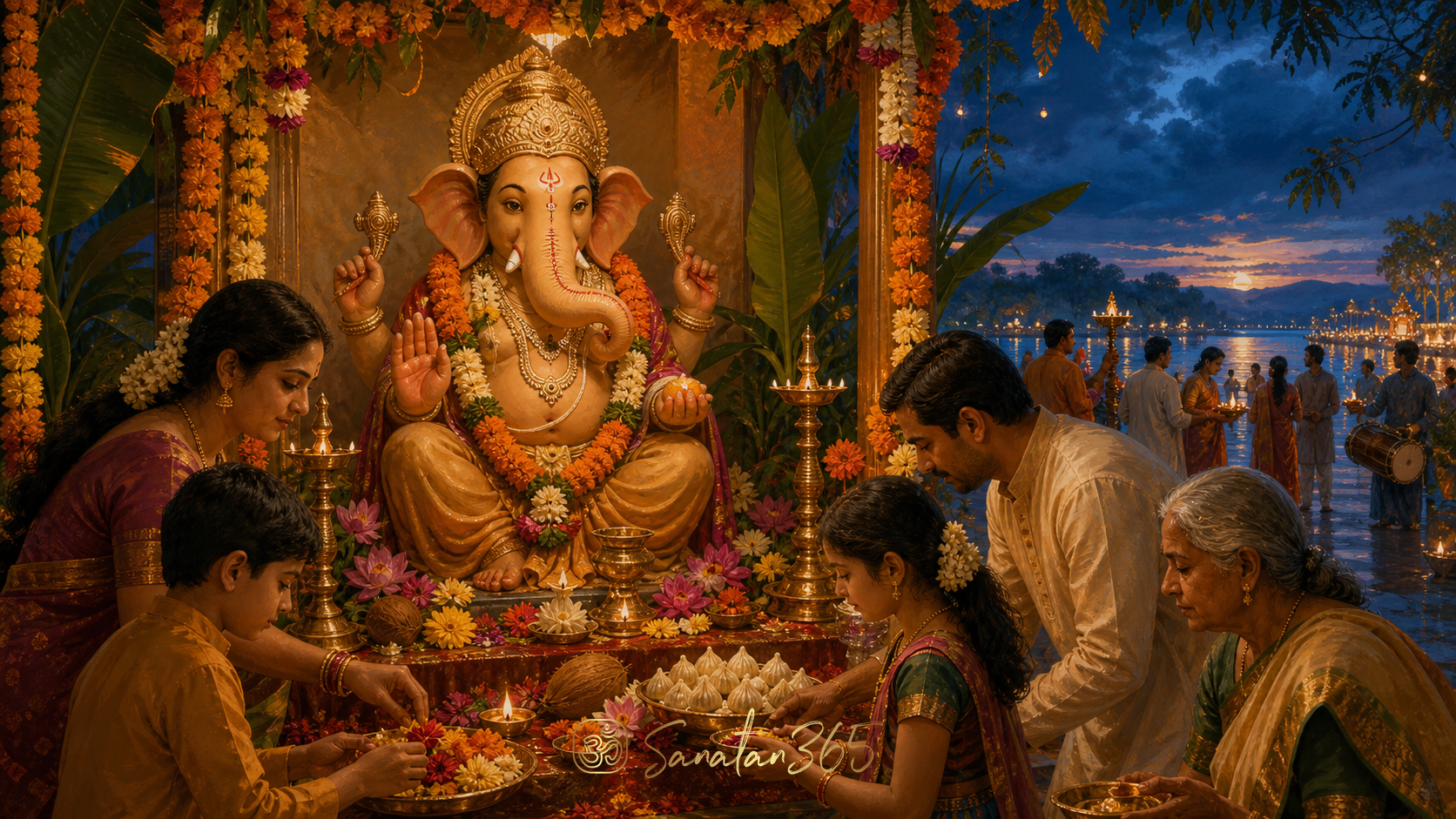
Ganesh Chaturthi 2026: Date, Puja, Meaning, and Visarjan
Ganesh Chaturthi 2026 falls on 14 September. Learn the festival's meaning, a respectful home puja, regional traditions, and responsible visarjan.
A festival about removing obstacles begins by asking a quieter question: what within us needs to become orderly, patient, and wise?
Ganesh Chaturthi 2026 falls on Monday, 14 September 2026. Also called Vinayaka Chaturthi, it honours Lord Ganesha through puja (पूजा, reverent worship), hospitality, music, food offerings, community gathering, and visarjan (विसर्जन, ceremonial immersion or respectful release) of a temporary clay murti (मूर्ति, sacred image or embodied form). The observance is not simply a request for difficulties to disappear. It is an invitation to begin well: with humility, clear intention, intelligent effort, and reverence for the Divine presence that guides every worthy undertaking.
When Is Ganesh Chaturthi 2026?
Ganesh Chaturthi is observed on Bhadrapada Shukla Chaturthi, the fourth lunar day of the bright fortnight in the month of Bhadrapada. In 2026, the main festival day is Monday, 14 September. The date is independently listed by Drik Panchang and Timeanddate's India calendar.
Puja timing is location-sensitive because the tithi (तिथि, lunar day) and local sunrise differ by city. A family in Mumbai, Bengaluru, London, or New York should therefore consult a trusted local panchanga (पञ्चाङ्ग, Hindu almanac) rather than copy a muhurta (मुहूर्त, chosen ritual time) from another location. Drik Panchang lists the 2026 festival on 14 September and the principal visarjan on 25 September, while also providing city-specific timings.
The public festival may extend across ten days, while household installations may be shorter according to family and community custom; Britannica describes the observance and its culminating immersion. Some homes welcome a small clay murti briefly, while large community mandaps (मण्डप, temporary worship pavilions) may continue until Ananta Chaturdashi (अनन्त चतुर्दशी, the fourteenth lunar day that commonly concludes the public festival). No duration is inherently more devotional than another. The heart of the festival is attentive worship, not scale.
Families should also distinguish Ganesh Chaturthi from monthly Vinayaka Chaturthi and Sankashti Chaturthi vratas (व्रत, sacred vows or disciplined observances). All honour Lord Ganesha, but their calendar setting and customary observances differ.
Key takeaway: Ganesh Chaturthi 2026 is on 14 September, but puja timings and the duration of worship should follow a reliable local panchanga and family tradition.
Why Is Lord Ganesha Worshipped at the Beginning?
Lord Ganesha is traditionally honoured before a new undertaking. Encyclopaedia Britannica describes him as the Hindu deity of beginnings who is worshipped before major enterprises and associated with learning and writing.Ganesha's familiar iconography holds together qualities that a good beginning requires: a broad intelligence, careful listening, disciplined desire, and the strength to act without arrogance.
The Sanskrit title Vighnaharta (विघ्नहर्ता, remover of obstacles) is sometimes misunderstood as a promise that devotion will erase every inconvenience. Hindu worship offers a deeper reading. Some obstacles must be removed; others must be understood; still others reveal that a plan needs correction. Lord Ganesha represents the discernment to tell the difference.
His elephant head evokes intelligence and attentive strength. His large ears suggest listening before reacting. His broken tusk is linked in devotional interpretation with sacrifice, purpose, and the willingness to use what one has in service of knowledge. His small vehicle, Mushika (मूषक, mouse), shows how restless desire can be directed rather than denied. Readers who want a fuller iconographic explanation can explore why Ganesha is worshipped first and why Mushika is his vahana (वाहन, sacred vehicle).
Ganesh Chaturthi brings these ideas into the home and public square. A temporary murti is welcomed with dignity, served as an honoured Divine guest, and later released. The pattern teaches both loving presence and non-possessiveness: devotion can be wholehearted without turning sacred form into an object of ownership.
Key takeaway: Worshipping Lord Ganesha at the beginning means seeking clear judgment and disciplined effort, not expecting a life without difficulty.
How Can Families Perform a Simple Ganesh Chaturthi Puja at Home?
Household customs vary, and families with an established sampradaya (सम्प्रदाय, living spiritual tradition) should follow their own elders or priest. A simple home observance can still be reverent without imitating every step of a temple ritual. The Hindu American Foundation's overview describes the customary welcome of a clay Ganesha murti, formal invocation, offerings, and worship while making clear that observances appear in homes and community spaces.
1. Prepare the space with care
Clean a calm area and place the clay murti on a secure raised surface. Keep a cloth, flowers, a lamp, water, fruit, and food offering nearby. A prepared puja thali can help gather the items without turning worship into a checklist.
Choose a natural-clay murti when possible, especially if immersion is planned. Avoid decorations that shed plastic, glitter, synthetic foam, or toxic colour into water. Keep flames stable and away from fabric, children, and crowded edges.
2. Begin with sankalpa and welcome
Sit quietly, settle the breath, and state a sankalpa (संकल्प, sacred intention). It may be as simple as welcoming Lord Ganesha with gratitude and asking for wisdom to begin or complete one honest responsibility.
After lighting the lamp, devotees may offer water, flowers, durva (दूर्वा, sacred grass traditionally offered to Lord Ganesha), fragrance, and respectful words of welcome according to family custom. Formal prana pratishtha (प्राणप्रतिष्ठा, ritual invocation of sacred presence) is a specialist rite in many traditions; households should not feel pressured to reproduce priest-led procedures from an online clip. A sincere, simple puja guided by one's tradition is enough.
3. Offer prayer, food, and attention
Common recitations include Om Gam Ganapataye Namah (a traditional salutation to Lord Ganesha using his seed syllable), the Ganesha Atharvashirsha (a Sanskrit hymn honouring Ganesha as the Supreme) in traditions where it is learned correctly, personal prayers, or a familiar aarti (आरती, worship offered with a circling flame and devotional song). Families may sing Sukhkarta Dukhharta, especially in Marathi devotional settings.
Modak, a filled sweet dumpling widely associated with Lord Ganesha, is one familiar offering, but naivedya (नैवेद्य, food offered to the Divine before it is received as prasada, प्रसाद, blessed food) differs by region and household. Fruit, coconut, cooked food, or a family preparation may be offered. Food should be prepared hygienically and shared without waste. The offering is an act of hospitality, not a demand for a reward.
4. Let the puja shape conduct
The worship becomes more meaningful when linked to action. A family might begin a delayed task, repair a misunderstanding, help a student organise a study plan, reduce festival waste, or share food with care. Children can participate by arranging flowers, learning one symbol, drawing a reusable decoration, or naming one obstacle they will meet with patience.
Key takeaway: A respectful home puja needs cleanliness, sincere intention, simple offerings, safe practice, and conduct that carries Lord Ganesha's wisdom beyond the altar.
How Do Ganesh Chaturthi Traditions Vary Across India?
Ganesh Chaturthi is pan-Indian, yet its textures are strongly regional. Variation is not inconsistency; it is one way a living tradition belongs to many communities. Britannica's festival overview documents home and public worship, clay images, processions, immersion, and the festival's especially prominent public form in Maharashtra, while the Hindu American Foundation explains how homes and community stages welcome and worship Lord Ganesha.
- Maharashtra: Public mandaps, aarti, cultural programmes, and processions are especially prominent. The Hindu's account of Maharashtrian festival food shows how offerings vary by geography and community rather than following one fixed menu.
- Across India: Britannica documents Ganesh Chaturthi observance across western, central, southern, and eastern India. Homes, temples, and community groups give the festival distinct local languages, foods, music, and rhythms while sharing devotion to Lord Ganesha.
- Outside India: The Hindu American Foundation's festival introduction describes both household and community-stage worship for a global audience. Diaspora communities should adapt practical arrangements to local law, approved immersion facilities, and shared public space while preserving the festival's devotional meaning.
No family needs to borrow every visible custom from social media. A Marathi aarti, Tamil food tradition, Goan household arrangement, or Telugu puja sequence belongs within a particular cultural memory. Learning across regions can deepen respect, but respectful learning names the source rather than flattening everything into one supposedly universal procedure.
The public form of the festival also creates responsibilities. Loud celebration should not disregard infants, elders, animals, hospitals, or local noise rules. Food distribution should preserve hygiene and dignity. Crowds require safe routes, clear exits, and care for volunteers. Devotion is not diminished by responsible planning; it is expressed through it.
Key takeaway: Regional diversity enriches Ganesh Chaturthi, and the most authentic observance is one that honours family tradition, local community, and the wellbeing of others.
What Does Visarjan Mean and How Can It Be Responsible?
Visarjan brings the temporary installation to a close. Devotees offer a final aarti, express gratitude, and accompany Lord Ganesha with the prayer, “Ganpati Bappa Morya, pudhchya varshi lavkar ya” in Marathi communities: may the beloved Lord return again next year.
The gesture holds a profound teaching. Sacred presence was welcomed into a form made from earth; the form returns to the elements, while devotion remains in the heart and in conduct. The farewell is joyful and tender because impermanence does not cancel love.
Responsible immersion protects the very creation through which worship is offered. India's Central Pollution Control Board recommends natural-clay idols rather than plaster of Paris or baked clay, eco-friendly colours, removal of decorative materials before immersion, and designated immersion arrangements.The revised national guidelines place duties on idol makers, organisers, local authorities, and the public.
Practical options include:
- Choose an unpainted or naturally coloured clay murti.
- Remove cloth, plastic, flowers, metal, and non-biodegradable decoration before immersion.
- Use a municipal or community immersion tank where local authorities provide one.
- For a small home murti, use a suitable household container only when local custom and material safety allow; let the clay dissolve, then return the clean clay respectfully to soil rather than pouring contaminated water into a drain.
- Never enter unsafe water, overcrowded edges, or restricted zones. Follow local police, civic, and environmental instructions.
- Compost clean flowers where facilities exist and dispose of other materials through the correct waste stream.
An “eco-friendly” label should be verified rather than assumed. Paint, varnish, adhesive, glitter, and internal supports matter as much as the base material. When a family uses a permanent metal or stone murti for daily worship, it should follow its own tradition and should not immerse that permanent sacred form merely to copy a public custom.
Key takeaway: Visarjan teaches grateful release; responsible visarjan extends that gratitude to rivers, lakes, coasts, workers, animals, and future worshippers.
What Can the Festival Teach Beyond the Ten Days?
Ganesh Chaturthi begins with arrival and ends with release, but its real measure lies between festivals.
Lord Ganesha's wisdom can become a daily discipline:
- Pause before beginning. A clear intention prevents energy from scattering.
- Listen for the real obstacle. The difficulty may be fear, poor planning, pride, missing knowledge, or an external condition that genuinely needs help.
- Take the next honest step. Prayer and effort support each other.
- Share what is received. Prasada, time, knowledge, and attention become meaningful through responsible distribution.
- Release without neglect. Completion includes cleaning the space, thanking helpers, accounting for waste, and learning from what happened.
This is why the festival can be both exuberant and inward. Drums, flowers, aarti, modak, and procession celebrate Divine nearness. Silence before the murti asks whether the devotee is becoming more attentive, responsible, and generous.
Key takeaway: The lasting blessing of Ganesh Chaturthi is the capacity to begin with wisdom, work with steadiness, and release results without losing gratitude.
FAQ
What is the date of Ganesh Chaturthi 2026?
Ganesh Chaturthi 2026 is on Monday, 14 September. Local puja timing varies by city, so devotees should consult a trusted location-specific panchanga.
How long is Ganesh Chaturthi celebrated?
The public festival commonly continues until Ananta Chaturdashi, but household observances may last one and a half, three, five, seven, or ten days according to family and regional custom. A shorter observance is not less devotional.
What is commonly offered to Lord Ganesha?
Common offerings include flowers, durva grass, fruit, coconut, modak or another household sweet, incense, lamp, water, and sincere prayer. The exact offering varies by tradition and region.
Can Ganesh Chaturthi puja be simple at home?
Yes. A clean space, respectfully placed clay murti or household sacred image, lamp, flowers, simple naivedya, prayer, aarti, and thoughtful conduct can form a meaningful home observance. Families should follow their own elders or priest for formal rites.
What is the most responsible way to perform Ganesh visarjan?
Use a natural-clay murti with eco-friendly colour, remove non-biodegradable decorations, and follow designated local immersion arrangements. Small household immersions should only use safe materials and methods permitted by local rules and family tradition.
About the author
Sanatan365 Editorial
Bringing Sanatan Dharma to modern seekers through authentic, scripture-grounded content.
Related in Festivals
 Festivals
Dussehra 2026: Date, Vijayadashami Meaning, and Living Traditions
Understand the 2026 Dussehra date, the meanings of Rama and Durga’s victories, regional celebrations, and a thoughtful way to observe Vijay…
 Festivals
Garba Meaning: The Lamp at the Heart of Navratri
Garba is a Gujarati devotional dance associated with Navratri. Its central lamp, shared circular rhythm and reverence for Goddess Amba expl…
 Festivals
Golu Meaning: Navratri Dolls, Living Stories, and Hospitality
Understand Navratri Golu through its handmade dolls, regional names, family stories and welcoming home visits, with thoughtful preparation…

