Yantra Meaning: Sacred Geometry in Hindu Worship and Meditation
A clear guide to yantra meaning, sacred geometry, mantra, mandala, home worship, and how these visual forms help focus Hindu devotional practice.
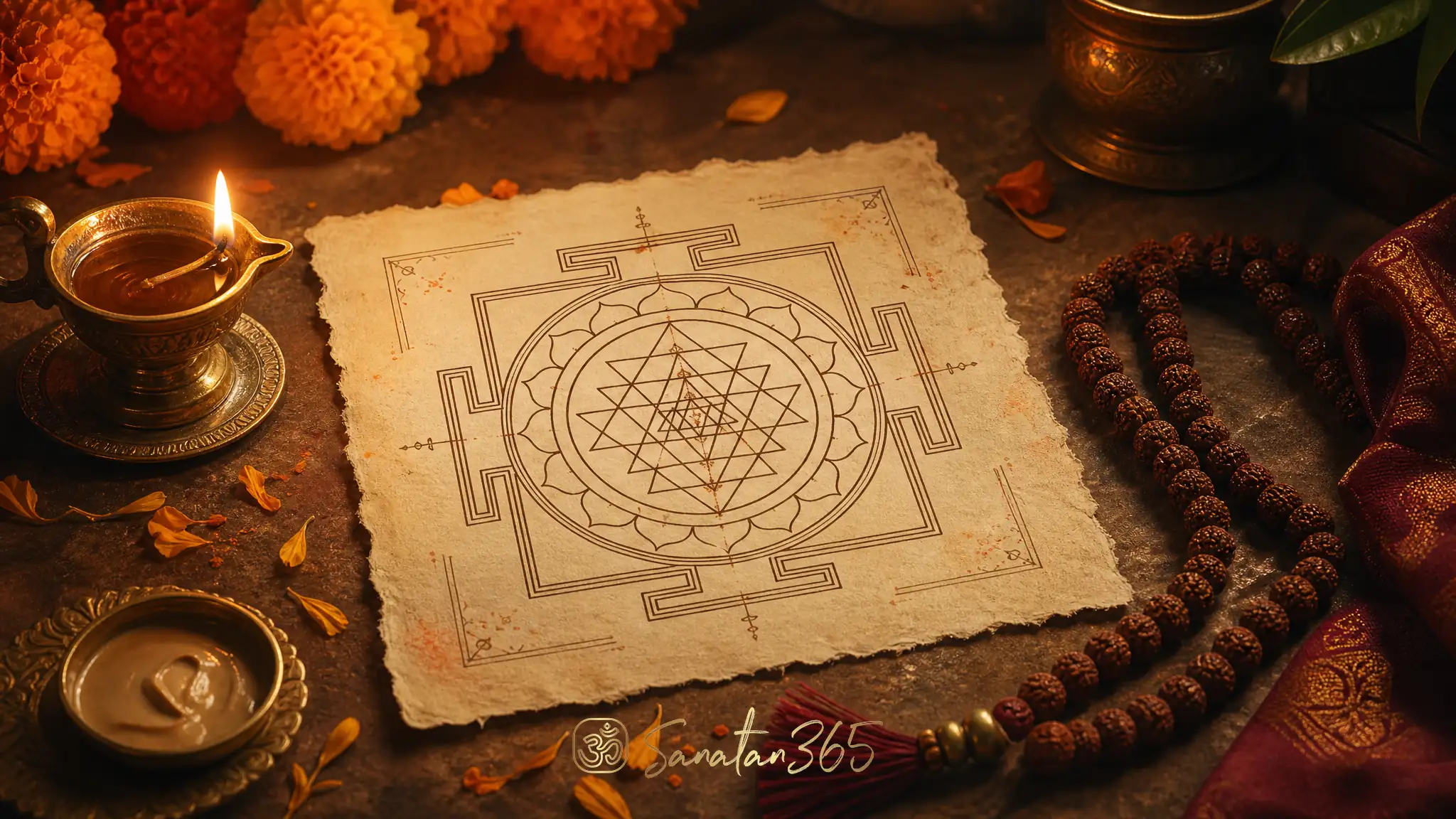
A yantra can look simple at first: lines, triangles, lotus petals, squares, and a central point.
Yantra meaning begins with sacred focus. A yantra (यन्त्र, yantra, instrument or support) is a ritual diagram used in Hindu worship, meditation, and contemplative practice to gather attention around a divine principle. It is not ordinary decoration. In Hindu traditions, especially Tantric and temple-linked practice, a yantra can function as a visual aid for puja (पूजा, worship), dhyana (ध्यान, meditation), and mantra (मन्त्र, sacred sound) by giving the mind a precise sacred form to return to.
This is why yantras matter: they translate devotion into geometry. The eye rests on form, the mind rests on meaning, and the heart remembers the Divine.
What Is Yantra Meaning in Hindu Worship?
At its simplest, yantra meaning is "instrument." The Sanskrit root is commonly understood in the sense of holding, supporting, restraining, or directing. In devotional use, that idea becomes practical: the yantra holds the mind in a chosen sacred pattern.
Britannica defines a yantra as a linear diagram used as a ritual support in Tantric Hinduism and related traditions. Encyclopedia.com similarly describes yantra as a geometrical design used in Hindu liturgy and meditation, especially in Tantric contexts. These definitions are useful because they keep the word grounded. A yantra is not merely "mystical art." It is a disciplined visual form used in a sacred setting.
Three ideas sit inside the word:
- A yantra is an instrument of focus.
- A yantra is a sacred diagram, not random ornament.
- A yantra normally belongs with mantra, puja, and inner attention.
This matters because Hindu worship often works through embodied supports. A devotee may use a murti (मूर्ति, sacred image), a flame, a mantra, a mala, a river, a temple, or a yantra. None of these limits the Divine to a physical object. They provide a form through which attention, reverence, and surrender become steady.
The Hindu American Foundation's puja guide explains that a murti or image can serve as a medium for worship by invoking the idea and attributes of the Divine in the devotee's mind. A yantra works in a related but more geometric way: it does not always show a recognizable figure, but it gives the mind a sacred structure. For a related ritual lens, see Tilak Meaning.
Key takeaway: Yantra meaning is best understood as a sacred instrument that concentrates attention during worship and meditation.
Why Does Sacred Geometry Matter in a Yantra?
Hindu sacred geometry is not about clever design. It is about spiritual order made visible.
Many yantras use repeated shapes: triangles, circles, lotus petals, squares, gates, and the central bindu (बिन्दु, point). The exact meaning varies by tradition and deity, so it is better not to reduce every yantra to one universal code. Still, certain patterns are widely understood.
The bindu often marks the center. It can invite the eye inward, from outer complexity toward a point of stillness. Triangles may suggest movement, energy, ascent, descent, or the meeting of complementary principles, depending on the yantra and tradition. Lotus petals often evoke unfolding, purity, and devotional expansion. Outer squares can suggest a sacred boundary, like a ritual enclosure.
Britannica's discussion of Hinduism notes yantra and mandala as ritual diagrams and supports for worship. The point is not that geometry is worshipped as geometry. The diagram becomes spiritually meaningful when it is received within a living tradition of mantra, devotion, discipline, and reverence.
This is also why careless use of yantras can feel thin. A yantra printed on a cushion or poster may look attractive, but its deeper role is not aesthetic consumption. In Hindu practice, geometry becomes sacred through intention, correct use, and respect.
A helpful way to read a yantra is from outside to inside:
- The outer form marks a sacred space.
- The repeated shapes guide attention through layers.
- The center gathers the mind.
- The associated mantra gives the form a sound-body.
- The devotee's bhava (भाव, devotional feeling) gives the practice life.
Key takeaway: Sacred geometry in a yantra is a visual discipline that turns space, line, and center into a support for inner focus.
How Are Yantra, Mantra, and Mandala Connected?
Yantra, mantra, and mandala are related but not identical.
A mantra is sacred sound. A yantra is sacred visual form. A mandala (मण्डल, circle or sacred enclosure) is a wider term for a ritual or contemplative diagram, often arranged as a symbolic cosmos. In some contexts, yantra and mandala overlap; in others, a yantra is more compact, deity-linked, and line-based.
Encyclopedia.com describes the yantra as a visual equivalent of mantra in certain ritual settings. That phrase helps explain why yantra practice should not be treated as separate from sound. A mantra can steady the ear and breath; a yantra can steady the eye and mind. Together they create a stronger field of attention.
For example, a practitioner may sit before a yantra, light a diya (दीया, sacred lamp), chant a mantra, and bring the gaze gently toward the bindu. The ritual is not about forcing supernatural results. It is about aligning body, speech, sight, and intention. For the role of light in puja, see Aarti Meaning.
The distinction can be remembered simply:
- Mantra gives sacred sound.
- Yantra gives sacred form.
- Mandala gives sacred space.
- Puja gives sacred offering.
- Dhyana gives sustained inner attention.
This integration is one reason Hindu ritual is so rich. It does not treat devotion as only belief or only emotion. It gives the seeker many doors: image, sound, scent, touch, flame, offering, silence, movement, and sacred geometry.
Key takeaway: A yantra is most powerful in context, where sacred form, sacred sound, and devotional intention support one another.
What Is Sri Yantra Meaning?
The Sri Yantra, also called Sri Chakra (श्रीचक्र, auspicious wheel), is one of the most recognized yantras in Hindu tradition. It is especially associated with Sri Vidya, a Shakta tradition centered on the Divine Mother as Tripura Sundari or Lalita.
Its pattern of interlocking triangles, lotus circles, outer enclosure, and central bindu has made it famous far beyond its traditional settings. That fame brings both opportunity and risk. Many people encounter the Sri Yantra through art, jewelry, wall prints, or online images before they understand its devotional background.
A careful explanation should begin with humility: Sri Yantra is not just "good luck geometry." In its traditional context, it belongs to disciplined worship, mantra, initiation lineages, and reverence for Devi. Some householders may keep a Sri Yantra respectfully as part of home worship, while deeper forms of Sri Vidya practice are guided by teachers and tradition.
For a beginner, the most useful lesson from Sri Yantra is not technical decoding. It is the principle of sacred concentration. The form invites the mind from multiplicity toward the center. It suggests that outer life, inner life, and divine presence are not separate compartments but a layered sacred order.
This is why casual claims should be avoided. A Sri Yantra is not a guaranteed wealth machine, a quick-fix charm, or a replacement for sincere effort. It is a revered symbol and ritual support. In Hindu practice, blessings are received with humility, not controlled like a transaction.
Key takeaway: Sri Yantra meaning should be approached with reverence, especially because its traditional depth is much greater than its modern decorative popularity.
How Can a Yantra Be Used Respectfully at Home?
Many families use sacred symbols at home with simple devotion. The same spirit can apply to a yantra when it is treated respectfully.
A gentle home approach can include:
- Choose a clean place on a home altar or puja shelf.
- Keep the yantra upright or flat according to family tradition.
- Light a diya if safe.
- Offer flowers, water, or quiet pranam (प्रणाम, reverent bow).
- Chant a known mantra with sincerity.
- Sit quietly for a few minutes, letting the gaze soften.
- End with gratitude rather than demand.
This is not a substitute for lineage-specific instruction. If a yantra is tied to a specific deity, mantra, or Tantric practice, it is wise to learn from a trusted teacher, priest, family elder, or sampradaya (सम्प्रदाय, tradition). Not every internet instruction is reliable. Sacred practice deserves care.
For ordinary home devotion, simplicity is enough. The Hindu American Foundation's puja instructions note that worship can be elaborate or simple, even as simple as lighting a lamp and offering prayer. That principle is useful here. A respectful yantra practice need not become complicated to be meaningful.
What should be avoided?
- Do not place a yantra on the floor casually.
- Do not use it as a coaster, fashion prop, or party decor.
- Do not make fear-based claims about what will happen if a ritual is imperfect.
- Do not promise guaranteed money, marriage, health, or success.
- Do not mix random mantras and yantras from the internet without understanding.
Respect is the first rule. If the practice increases steadiness, humility, gratitude, and dharmic conduct, it is moving in the right direction.
Key takeaway: Home yantra practice should be clean, simple, reverent, and free from fear or transactional promises.
What Does Yantra Meditation Teach the Modern Seeker?
Yantra meditation teaches that attention can be trained without aggression.
Modern life often scatters the eye. Screens, notifications, and constant visual noise pull the mind outward. A yantra reverses that movement. The eyes rest on a sacred form. The breath slows. The mind returns again and again to the center.
This does not make yantra practice a mental health treatment. It is a spiritual discipline. For stress, anxiety, depression, or crisis, people should seek appropriate professional care and trusted human support. But as a devotional practice, yantra meditation can help a seeker cultivate steadiness, reverence, and a cleaner inner rhythm.
A simple contemplative method:
- Sit comfortably before the yantra.
- Let the spine be steady but not tense.
- Offer a short prayer.
- Look at the outer shape for a few breaths.
- Move attention gradually toward the center.
- Chant the associated mantra softly, if known.
- Close the eyes and notice the after-image or inner stillness.
- End with gratitude.
The method is less important than the quality of presence. A yantra is not a tool for domination. It is a support for devotion, restraint, clarity, and surrender. For another visual concentration practice, see Trataka Meaning.
This is the deeper gift of yantra meaning. It reminds the seeker that sacred life is not only found in emotion or philosophy. It can also be found in a line drawn carefully, a point held steadily, a lamp lit quietly, and a mind gathered with love.
Key takeaway: Yantra meditation trains sacred attention by giving the eyes and mind a disciplined devotional center.
FAQ
What is the meaning of yantra in Hinduism?
Yantra meaning in Hinduism refers to a sacred instrument or diagram used as a support for worship, meditation, and concentration. It often combines geometry, mantra, and devotional intention.
Is a yantra the same as a mandala?
Not exactly. A mandala is a sacred enclosure or diagram, often cosmological in form. A yantra is usually a more specific ritual diagram or instrument of focus. The two can overlap in Hindu practice.
Can anyone keep a yantra at home?
Many devotees keep yantras at home respectfully, especially on a clean puja altar. For deity-specific or lineage-specific yantras, guidance from a trusted priest, teacher, family elder, or tradition is recommended.
Is Sri Yantra only for wealth?
No. Sri Yantra is a revered sacred diagram associated with Sri Vidya and Devi worship. Some people connect it with prosperity, but reducing it to a wealth object misses its deeper devotional and contemplative meaning.
How should beginners approach yantra meditation?
Beginners can approach gently: sit before a clean yantra, offer a prayer, soften the gaze, chant a known mantra if appropriate, and close with gratitude. Avoid fear-based or guarantee-based claims.
Yantra meaning is the meeting of sacred form and sacred attention: a visual instrument that helps worship become focused, reverent, and inwardly steady.
About the author
Sanatan365 Editorial
Bringing Sanatan Dharma to modern seekers through authentic, scripture-grounded content.
Related in Rituals
 Rituals
Tambula Meaning: Why Betel Leaves Are Offered After Food in Puja
Understand tambula, the betel-leaf and areca-nut offering in puja: its place after food, its distinct materials and the care owed to differ…
 Rituals
Vastra Offering Meaning: Why Clothing Is Offered in Puja
The offering of cloth turns ordinary care into sacred hospitality. Understand vastra in Hindu worship without confusing expense with devoti…
 Rituals
Madhuparka Meaning: Sweetness and Sacred Hospitality
Read madhuparka as a ceremonial honey mixture of welcome, exploring textual recipes, guest reception and its distinction from panchamrita.

