Rameswaram Temple Meaning: Ramanathaswamy, Rama, and Shiva's Southern Jyotirlinga
Understand the spiritual meaning of Rameswaram Temple, its link with Lord Rama, Ramanathaswamy Jyotirlinga, Char Dham, and the 22 sacred theerthams.
A Shiva temple where Rama is remembered at every step changes the way pilgrimage feels.
Rameswaram temple meaning begins with Ramanathaswamy, a name understood as "the Lord of Rama." The temple in Rameswaram, Tamil Nadu, is revered as a Shiva kshetra (क्षेत्र, sacred field), a Jyotirlinga (ज्योतिर्लिङ्ग, radiant linga of Shiva), and one of the four Char Dham pilgrimage sites. Its meaning is not only historical or architectural. It teaches that devotion can bow across forms: Rama, an avatar of Vishnu, worships Shiva before the great crossing to Lanka, and the devotee learns humility before action.
That single image gives Rameswaram its force. The hero of the Ramayana does not stand apart from worship. He pauses, consecrates, seeks grace, and moves forward with responsibility.
What Is the Rameswaram Temple Meaning?
The primary Rameswaram temple meaning is the union of bhakti (भक्ति, loving devotion), prayaschitta (प्रायश्चित्त, atonement or purification), and dharma (धर्म, righteous order). The official Tamil Nadu Hindu Religious and Charitable Endowments page describes Arulmigu Ramanathaswamy Temple as located on Rameswaram island near the Agni Theertham shore, spread across roughly 15 acres, and connected with Ramayana tradition Tamil Nadu HR&CE.
In the temple's living story, Lord Rama arrives with Sita and Lakshmana after the war with Ravana. Tradition says he worships Shiva here to purify the burden of battle and to honor the divine before returning to Ayodhya. This is why Ramanathaswamy is not only a temple name. It is theology in one word: Shiva as the Lord honored by Rama.
For a seeker, this matters because Hindu practice rarely reduces divinity to a single narrow doorway. Rameswaram holds Vaishnava memory, Shaiva worship, Tamil temple culture, ocean pilgrimage, and pan-Indian yatra in one place. It shows that spiritual maturity is not competition between forms of the Divine, but reverence moving through many forms.
Key takeaway: Rameswaram is sacred because it presents devotion as humility before action, not pride after victory.
Why Is Ramanathaswamy Temple a Jyotirlinga?
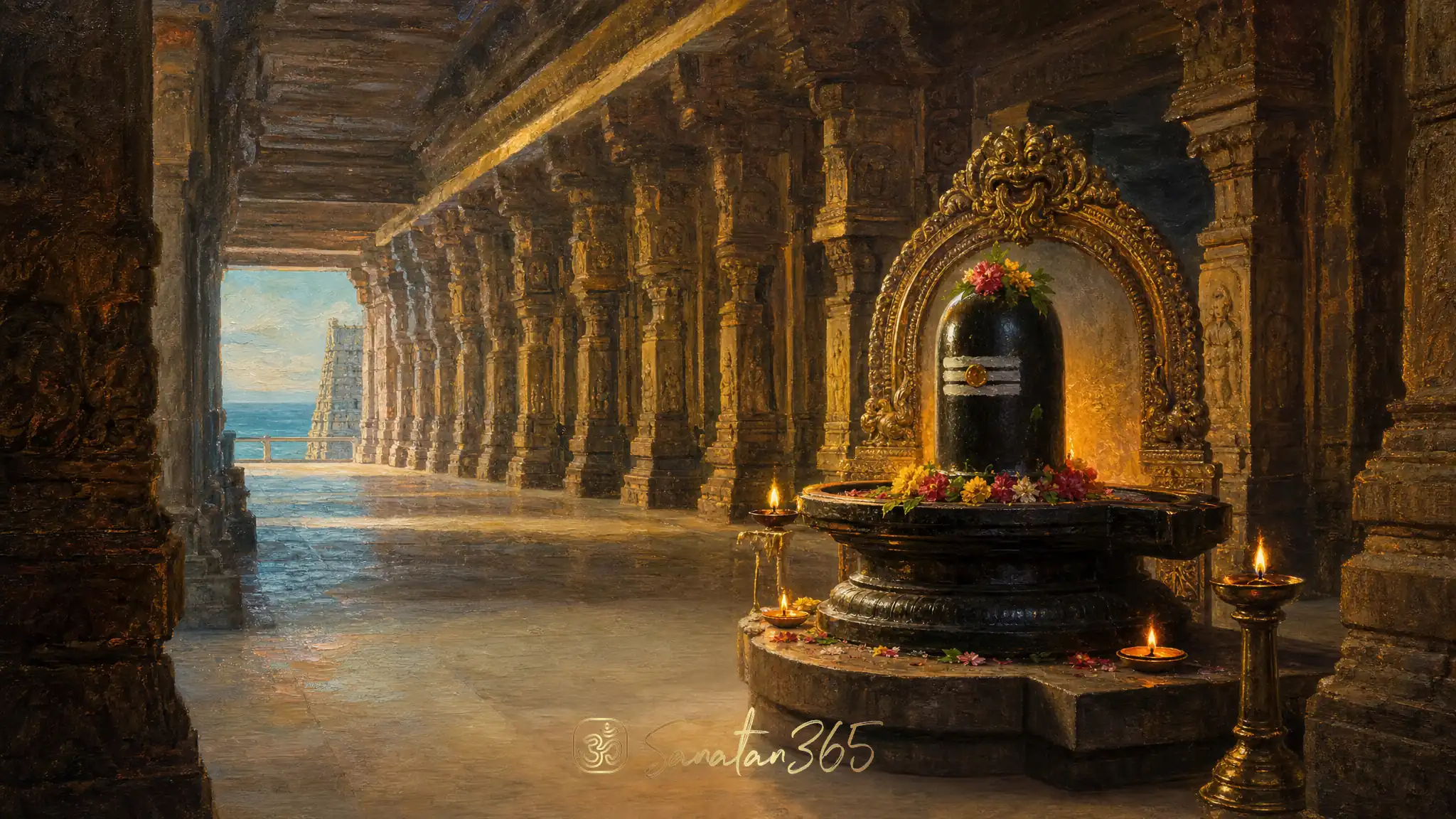
Ramanathaswamy Temple is honored as one of the twelve Jyotirlinga shrines of Lord Shiva. A Jyotirlinga is traditionally understood as Shiva manifesting as jyoti (ज्योति, light) through the linga (लिङ्ग, sacred mark or symbol). In practical devotional language, a Jyotirlinga is not treated as a statue of a distant deity. It is approached as a concentrated presence of Shiva.
This is why the temple's Shiva worship carries both intimacy and vastness. The devotee may arrive with a personal prayer, but the symbol points beyond personality toward the limitless. The linga does not narrate every detail of form. It asks the mind to become still before presence.
Rameswaram's Jyotirlinga meaning is distinctive because it is tied to Rama's worship. In many Shiva temples, the devotee approaches Shiva directly. Here, the devotee also remembers that Rama himself approached Shiva. The lesson is subtle: even the righteous person does not become self-sufficient. Dharma still bows.
This pattern has a powerful daily application:
- Before major work, pause.
- Before victory, seek clarity.
- After conflict, purify the mind.
- When burdened by duty, return to worship.
That is the inner Jyotirlinga lesson of Rameswaram. The light is not only in the sanctum. It is also in the conscience that refuses to become hard after struggle.
Key takeaway: Ramanathaswamy Jyotirlinga teaches that strength becomes sacred when it is joined with humility.
How Does Rameswaram Connect Rama and Shiva?
The connection between Rama and Shiva is the heart of Rameswaram. According to the temple tradition preserved by Tamil Nadu HR&CE, Rama is said to have installed and worshipped a Shiva linga here after being advised by Sage Agastya. The same account says Hanuman was sent to bring a linga from Kailasa, and when he was delayed, Sita formed a linga from sand for the auspicious worship Tamil Nadu HR&CE.
This story is often loved because it is devotional, but it is also philosophically rich. Rama does not become less Rama by worshipping Shiva. Shiva does not become less Shiva by being worshipped through Rama's devotion. The story refuses the anxiety that one form of worship must cancel another.
In Hindu homes, this has a living echo. A family may keep Rama, Shiva, Krishna, Durga, Ganesha, Hanuman, and family deities in the same puja space. The point is not confusion. It is relational spirituality. Different forms help different moods of the heart approach the same sacred reality.
Rameswaram also softens the boundary between heroic action and tender devotion. Rama's life is often read through duty, kingship, exile, courage, and moral complexity. At Rameswaram, the emphasis shifts to surrender. The warrior becomes worshipper. The king becomes servant. The story says that even dharmic action should not make the heart arrogant.
This is why the temple is meaningful for modern readers who carry heavy responsibilities. It says: do what must be done, but do not let action become ego. Let worship cleanse the residue of stress, conflict, and pride.
Key takeaway: Rameswaram's Rama-Shiva connection is a lesson in unity, humility, and non-sectarian devotion.
Why Is Rameswaram Part of Char Dham?
Rameswaram is one of the four Char Dham sites: Badrinath in the north, Dwarka in the west, Puri in the east, and Rameswaram in the south. A Char Dham yatra (यात्रा, sacred journey) turns India itself into a mandala of devotion, with sacred geography spread across the four directions. Rameswaram holds the southern point of that map.
Britannica notes that Rameswaram's temple stands on a traditional site associated with Rama's crossing toward Lanka and describes it as one of the most venerated Hindu shrines Britannica. The Char Dham frame gives that reverence a wider geography. The pilgrim is not only visiting one shrine, but entering a civilizational rhythm of movement, memory, and surrender.
This also explains why Rameswaram is deeply associated with completion. Many pilgrimage traditions speak of the relationship between Kashi in the north and Rameswaram in the south. The exact practice varies by lineage and family tradition, but the symbolic pattern is clear: Shiva is approached through multiple sacred landscapes, and the pilgrim's heart is widened by travel.
There is another layer. Badrinath, Dwarka, and Puri are strongly associated with Vishnu traditions, while Rameswaram is a Shiva shrine. The Char Dham map itself therefore honors plurality. It does not ask the devotee to choose one sacred direction and forget the rest. It asks the devotee to move, bow, learn, and return transformed.
For readers interested in the wider pilgrimage pattern, the earlier guide Char Dham Yatra Meaning: Four Sacred Directions of Hindu Pilgrimage explains how the four-direction yatra becomes a discipline of body, memory, and surrender.
Key takeaway: Rameswaram's place in Char Dham turns a local temple visit into part of a pan-Indian sacred map.
What Is the Meaning of the 22 Theerthams?
One of Rameswaram's most distinctive practices is bathing in the sacred theerthams (तीर्थ, crossing place or holy water source). The temple's official page refers to 22 punya theerthams inside the temple and gives current access timings for devotees Tamil Nadu HR&CE. The word tirtha originally means a ford or crossing. In spiritual use, it becomes any place where crossing from ordinary awareness to sacred awareness feels possible.
The 22 theerthams are often approached as purification before darshan (दर्शन, sacred seeing). The outer act is water poured over the body. The inner act is readiness. A devotee does not rush to see the deity as a consumer rushing to an attraction. The devotee prepares the body, cools the mind, and enters the temple with reverence.
This is the difference between tourism and pilgrimage. Tourism asks, "What can I see?" Pilgrimage asks, "How should I become before I see?"
The theertham practice also belongs to a wider Hindu pattern in which water carries memory. Rivers, temple tanks, wells, and ocean confluences are not treated as decoration. They are reminders that life is received, cleansed, and renewed. Rameswaram intensifies this because the temple stands close to the sea, and Agni Theertham itself is part of the pilgrimage imagination.
It is important to approach these practices respectfully and practically. Temple timings, access rules, and local procedures can change. Devotees should check official temple guidance before visiting and follow the instructions of temple staff.
Key takeaway: The 22 theerthams teach that darshan begins before the sanctum, with purification, patience, and readiness.
What Does the Temple Architecture Teach?
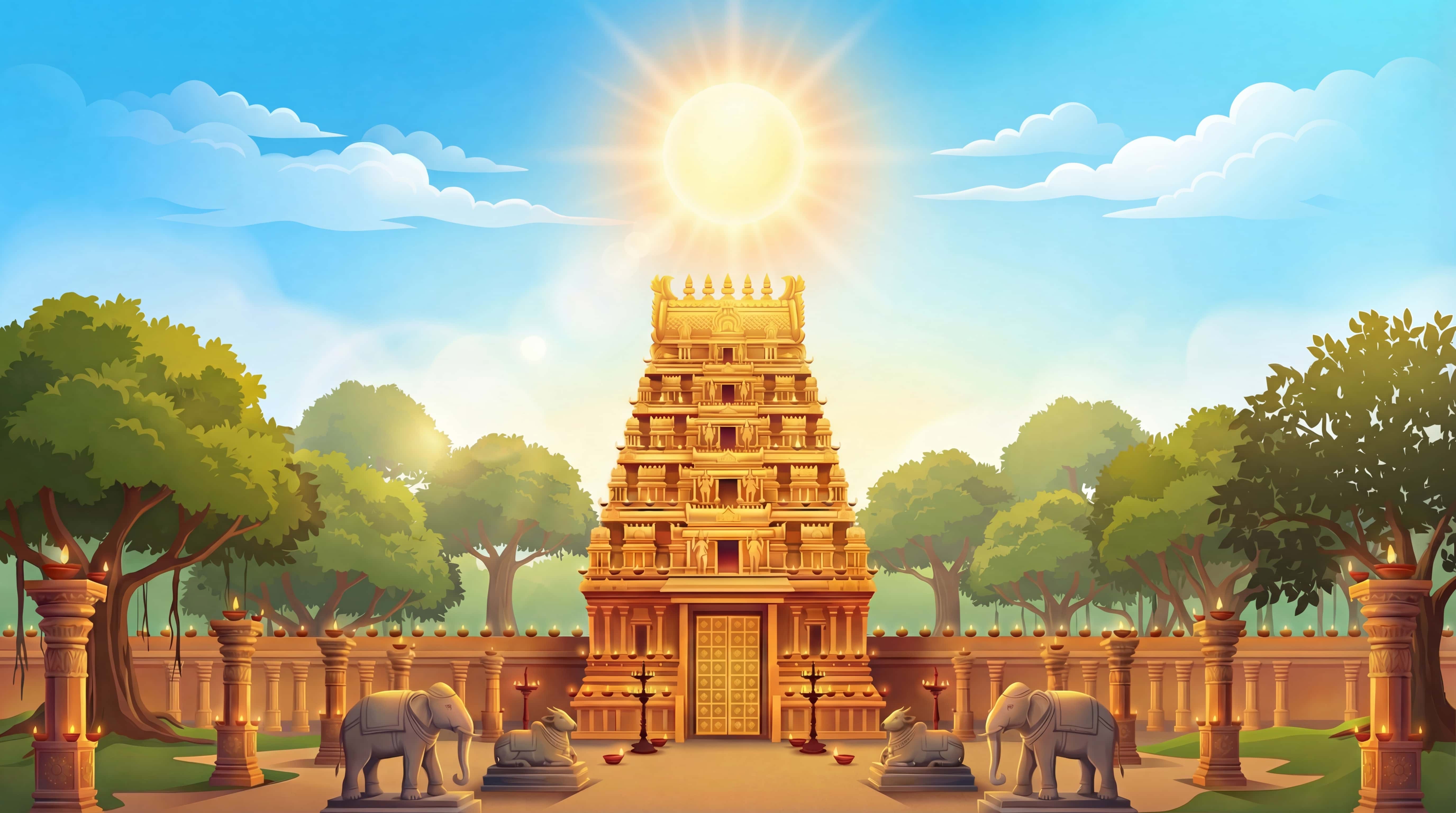
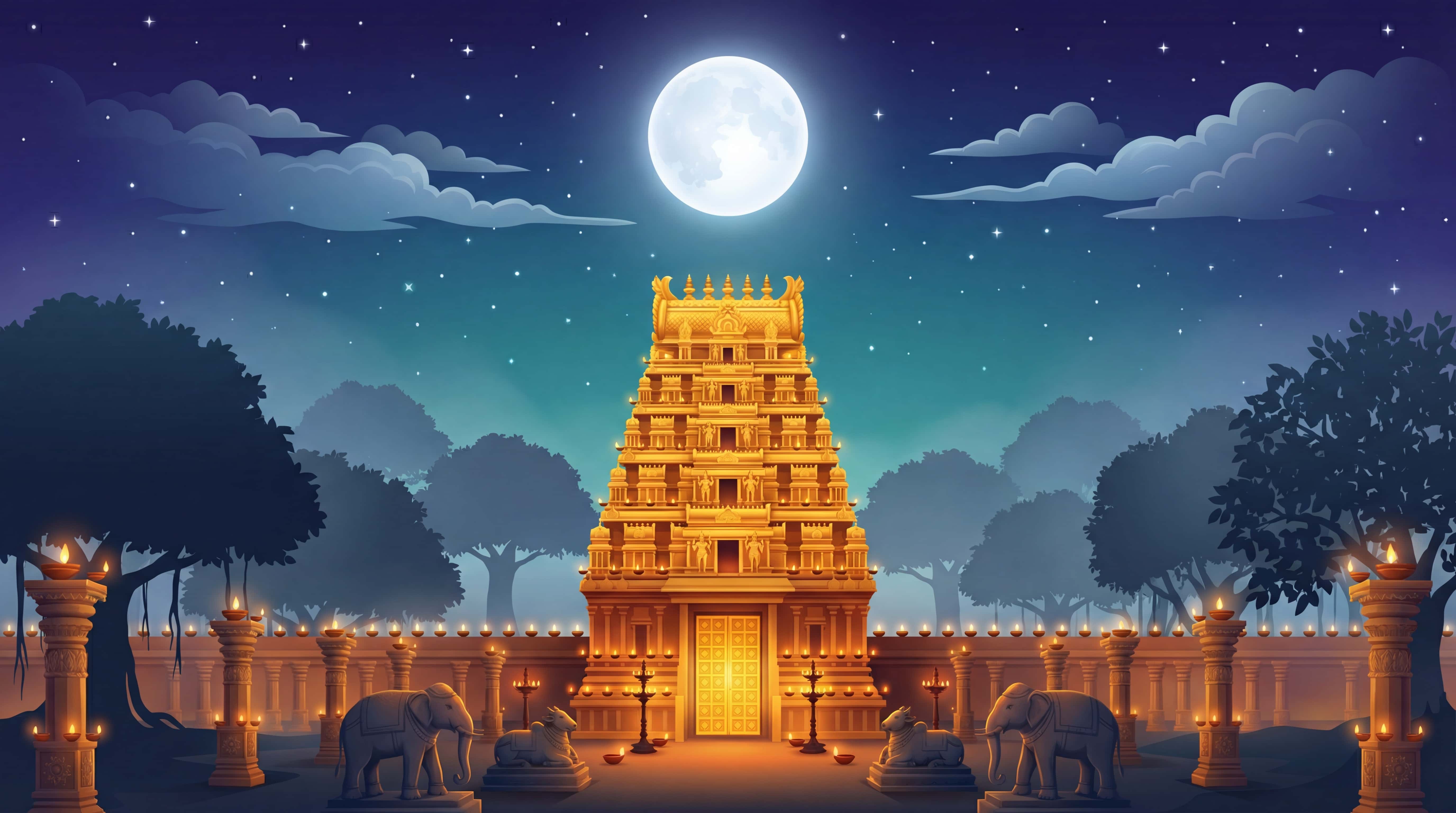
Rameswaram is also famous for its vast stone corridors, gopurams, and Tamil temple architecture. Incredible India describes Sri Ramanathaswamy Temple as a revered Shiva shrine and one of the twelve Jyotirlinga sites, highlighting its architectural grandeur and pilgrimage importance Incredible India. Britannica describes the temple as quadrangular and gives approximate dimensions of about 1,000 feet by 650 feet Britannica.
Architecture in a Hindu temple is rarely only visual. It shapes the mind. A long corridor slows the body. Repeated pillars quiet the eyes. Gateways mark transition. Stone absorbs heat, sound, footfall, chant, and silence. By the time the pilgrim reaches the inner sanctum, the body has already been trained to move differently.
This is one reason temple architecture can work on people even before they understand theology. The space teaches through walking. The sequence of entrance, water, corridor, shrine, and darshan turns movement into sadhana (साधना, disciplined spiritual practice).
Rameswaram's corridors also carry a social meaning. Countless people have walked them: Tamil families, North Indian yatris, diaspora visitors, elderly pilgrims, children on first temple journeys, renunciants, priests, and local devotees. A temple like this is not merely a monument. It is a living archive of footsteps.
When read this way, the corridor becomes a metaphor. The devotee may not reach clarity instantly. One walks pillar by pillar. One repeats the name. One lets the body learn what the mind resists: patience, direction, rhythm.
For another view of Shiva temple symbolism, see Somnath Jyotirlinga Meaning: Shiva’s Light on the Western Shore, where the western sea-facing Jyotirlinga carries a different but related devotional mood.
Key takeaway: Rameswaram's architecture teaches through slow movement, repetition, and the discipline of approaching the sacred.
How Can a Modern Devotee Understand Rameswaram From Home?
Not everyone can travel to Rameswaram. Age, distance, cost, work, health, and family responsibilities may make pilgrimage difficult. Hindu tradition understands this. A physical yatra has great power, but remembrance, nama japa (नाम जप, repetition of the divine name), reading, and home worship also carry value when done with sincerity.
A modern devotee can reflect on Rameswaram through five simple practices:
- Read the Rama-Shiva story before beginning a difficult duty.
- Chant "Om Namah Shivaya" with the feeling of surrender.
- Offer water to a Shiva linga or sacred symbol at home.
- Practice a brief pause before important decisions.
- Study the Char Dham map as a symbol of India's sacred geography.
The point is not to replace pilgrimage. The point is to let the temple's teaching enter daily life. If Rameswaram means humility before action, then a small morning pause can become a personal Rameswaram. If Rameswaram means purification after conflict, then honest prayer after a hard day can become a theertham of the heart.
Readers who want a broader home-practice frame may also find Nitya Puja Meaning: Daily Worship as a Living Hindu Practice useful, especially for understanding how daily worship becomes steady rather than occasional.
Key takeaway: Rameswaram can shape daily life through humility, mantra, water offering, and reflective action.
FAQ
What is the main Rameswaram temple meaning?
The main Rameswaram temple meaning is devotion joined with humility. Lord Rama's worship of Shiva at Ramanathaswamy Temple teaches that even righteous action should be purified through reverence, surrender, and prayer.
Why is Ramanathaswamy Temple important?
Ramanathaswamy Temple is important because it is revered as a Shiva Jyotirlinga, a major temple connected with the Ramayana, and the southern site in the Char Dham pilgrimage. It also has distinctive theertham and corridor traditions.
Is Rameswaram a Shiva temple or a Rama temple?
Rameswaram's Ramanathaswamy Temple is a Shiva temple, with Lord Shiva worshipped as Ramanathaswamy. Its sacred story is deeply connected with Lord Rama, who is traditionally remembered as worshipping Shiva there.
What are the 22 theerthams in Rameswaram?
The 22 theerthams are sacred water sources inside Ramanathaswamy Temple. Devotees traditionally bathe in them as a purification practice before darshan, following temple procedures and local guidance.
Why is Rameswaram part of Char Dham?
Rameswaram is part of Char Dham because it forms the southern sacred point in the four-direction pilgrimage circuit with Badrinath, Dwarka, and Puri. It brings Shiva worship into a pan-Indian yatra pattern.
Rameswaram Temple ultimately teaches that the deepest strength still bows. Rama worships Shiva, water prepares the pilgrim, corridors slow the body, and the Jyotirlinga points beyond pride toward light. The single key takeaway: before crossing any ocean of duty, pause at the inner shrine and make action sacred.
About the author
Sanatan365 Editorial
Bringing Sanatan Dharma to modern seekers through authentic, scripture-grounded content.
Related in Temples
 Temples
Chidambaram Nataraja Temple: Where Shiva Dances as Space
Explore the meaning of Chidambaram Nataraja Temple, its vision of Shiva as cosmic dancer, the Akasha element, sacred architecture, and resp…
 Temples
Kedarnath Temple Meaning: Shiva, the Himalayas, and Sacred Endurance
Explore Kedarnath Temple's meaning as a Himalayan Jyotirlinga, a Panch Kedar shrine, and a pilgrimage that turns effort, humility, and dars…
 Temples
Meenakshi Amman Temple Meaning: Madurai's Sacred City of the Goddess
Explore the meaning of Madurai's Meenakshi Amman Temple through Goddess Meenakshi, Sundareswarar, Dravidian architecture, sacred marriage,…