Upanayana Meaning: Sacred Thread, Study, and Inner Discipline
A clear guide to Upanayana, the Hindu sacred thread ceremony, its link with Gayatri mantra, guru, learning, and disciplined spiritual life.
What looks like a thread across the shoulder is actually a vow about attention.
Upanayana meaning begins with the Sanskrit idea of being led near: upa (उप, near) and nayana (नयन, leading). In Hindu practice, Upanayana is a samskara (संस्कार, sacred life-cycle rite) that traditionally initiates a student into disciplined learning, Gayatri mantra, and a life shaped by the guru's guidance. The sacred thread ceremony is not only about wearing janeu (जनेऊ, sacred thread); it is about accepting responsibility for study, conduct, and daily remembrance.
For many families, Upanayana is one of the most emotional Hindu rites because it places learning at the center of spiritual life. A child stands between home and discipline, between family affection and a new relationship with teacher, mantra, and duty. The ceremony has many regional forms across India and the diaspora, but its heart remains the same: the student is invited to take knowledge seriously.
What Is Upanayana Meaning in Hindu Tradition?
Upanayana meaning is often translated as "sacred thread ceremony," but that phrase describes only the most visible part of the rite. More fully, Upanayana is the initiation that brings a young student near the guru for sacred learning. The Pluralism Project describes it as a rite of rebirth into the world of the Vedas, marked by instruction, sacred garments, the thread, and the Gayatri mantra (Pluralism Project).
The ceremony belongs to the wider family of samskaras, the rites that sanctify major transitions in Hindu life. A samskara is not just a social event. It refines the person by placing an ordinary transition inside sacred memory. Birth, naming, first feeding, education, marriage, and later life are all treated as moments where dharma (धर्म, righteous order and duty) can be consciously renewed.
In older settings, Upanayana often signaled the beginning of brahmacharya (ब्रह्मचर्य, the disciplined student stage of life). The student might leave home to study with a guru, learn recitation, serve the teacher, and cultivate restraint. In many modern families, the child does not literally leave home. The meaning still survives when the family treats the ceremony as a turning point: learning is no longer casual, and prayer is no longer only inherited by observation.
The sacred thread, called janeu in many North Indian homes and by other names such as jandhyam, poonul, or munja in other regions, becomes a reminder worn on the body. It says: remember what you have received, and live in a way worthy of it.
Key takeaway: Upanayana meaning is not limited to thread-wearing; it is an initiation into disciplined learning, mantra, and responsibility.
Why Is the Sacred Thread Ceremony Connected to Gayatri Mantra?
The sacred thread ceremony is deeply connected to Gayatri mantra because Upanayana often includes the first formal instruction in this mantra. Gayatri is addressed to Savitr, the solar divine source of illumination, and asks that the inner intelligence be guided toward clarity. Many traditions treat this instruction as the spiritual heart of the rite.
In the ceremony, the student receives not only an object but a practice. The thread can be seen by everyone, but the mantra must be carried inwardly through repetition, reverence, and understanding. This is why Upanayana is sometimes described as a second birth. The first birth is biological. The second is into learning, discipline, and sacred responsibility.
The Hindu American Foundation explains Upanayana as a rite in which a child is accepted by a guru and enters sacred study, receiving the thread and instruction in Brahman or Gayatri mantra according to family tradition (HAF). The exact ritual language, age, sequence, and regional customs vary, but the educational meaning remains central.
Families often ask what the thread itself represents. Different lineages explain it through different symbolic layers:
- Commitment to study, self-restraint, and daily remembrance.
- Gratitude toward guru, parents, ancestors, and sacred knowledge.
- Readiness to perform prescribed prayers and rituals within one's tradition.
- A visible reminder that learning should refine conduct, not inflate pride.
This last point matters. A sacred object becomes spiritually meaningful only when it shapes behavior. If the thread is worn without humility, discipline, or respect for others, the outer form has lost its inner purpose.
Upanayana also connects naturally with Sandhya Vandana, the daily twilight prayer associated with Gayatri in many lineages. For some families, the ceremony begins a lifelong relationship with sunrise, noon, and sunset remembrance. For others, it is at least an invitation to understand why Hindu time treats thresholds as sacred.
Key takeaway: The thread is visible, but Gayatri mantra is the inner practice that gives Upanayana its spiritual depth.
What Happens During Upanayana?
There is no single universal script for Upanayana because Hindu practice is lived through region, sampradaya (सम्प्रदाय, lineage or tradition), family custom, and local priestly instruction. A ceremony in Mithila may look different from one in Tamil Nadu, Maharashtra, Karnataka, Gujarat, Bengal, or a diaspora temple in New Jersey. The names also vary: janeu, janoi, jandhyam, poonul, munja, and other local terms may be used.
Still, many Upanayana ceremonies share a broad pattern:
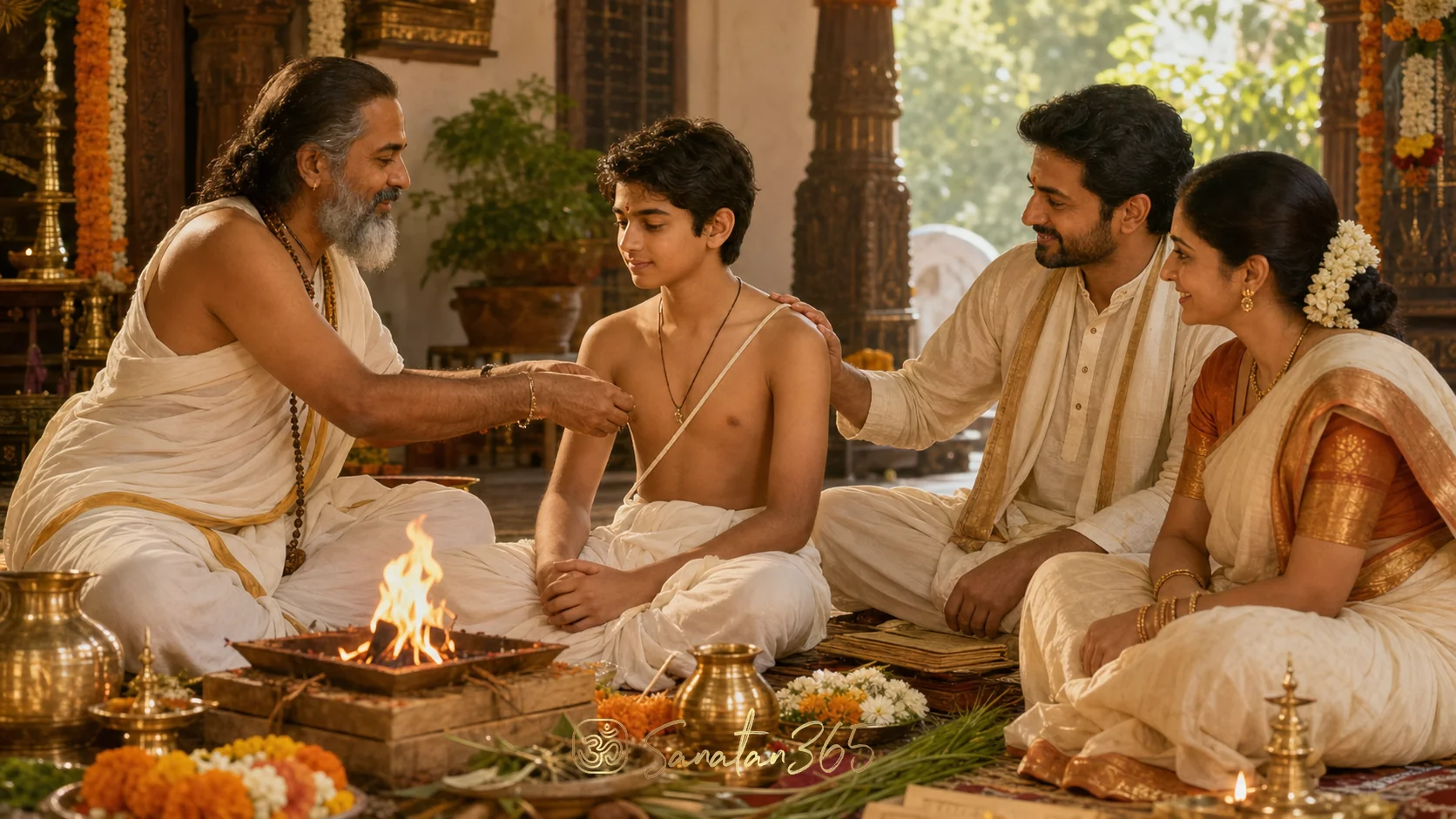
- The family prepares the child through bathing, new clothing, blessings, and puja.
- The parents and guru or priest invoke auspiciousness through mantras and offerings.
- A sacred fire may be kindled, making Agni (अग्नि, sacred fire) a witness to the vow.
- The student receives the yajñopavita (यज्ञोपवीत, sacred thread worn over the shoulder).
- The Gayatri mantra or related instruction is given according to family tradition.
- The student symbolically asks for bhiksha (भिक्षा, alms), remembering humility and dependence on the community.
- Blessings, gifts, food, and family celebration complete the transition.
Some rites include head-shaving or symbolic cutting of hair, special garments, standing on a stone to represent firmness, offerings to ancestors, and formal instruction in daily duties. The Pluralism Project's account of an Upanayana at a Sri Venkateswara temple in New Jersey shows how immigrant Hindu families preserve the rite while adapting its practical setting to contemporary life (Pluralism Project).
This adaptability is important. Hindu rituals are not museum pieces. They carry continuity through living families. When a ceremony is performed in a village home, a city apartment, a temple hall, or a diaspora community center, the outer setting changes. The inner message remains: learning is sacred, and the student must approach it with humility.
Families preparing for Upanayana should consult their own guru, priest, elders, and lineage practice rather than treating internet summaries as ritual manuals. A blog can explain meaning, but a samskara should be guided by people who know the family's tradition and can answer practical questions with care.
Key takeaway: Upanayana has many regional forms, but most versions join family blessing, guru instruction, sacred thread, mantra, and a vow of disciplined learning.
Is Upanayana Only About Caste or Gender?
Any honest explanation of Upanayana must speak carefully here. Historically, many communities restricted the rite to boys from certain varnas, and modern practice still reflects those inherited customs in many families. At the same time, sources also note older and renewed examples of girls receiving Upanayana, and contemporary Hindu communities differ in how they understand eligibility, lineage, and access.
Sanatan365's public content avoids exclusionary claims because spiritual dignity is not measured by birth, gender, nationality, or background. The Atman (आत्मन्, inner Self) is not reduced to social identity. A family may still follow its own sampradaya rules for a specific samskara, but the deeper value of disciplined learning, prayer, humility, and reverence for knowledge can guide every seeker.
This distinction helps prevent two mistakes.
The first mistake is flattening the tradition by pretending there were never boundaries around the rite. That would be historically careless. The second mistake is treating the outer boundary as the whole meaning of the ritual. That would miss the spiritual center of Upanayana: drawing near to wisdom.
For modern families, the most respectful approach is neither argument nor casual reinvention. It is inquiry. Ask:
- What does our lineage teach about Upanayana?
- What daily practice is the student expected to maintain afterward?
- Who will actually guide the child after the ceremony?
- How can the family explain the rite without pride, shame, or exclusion?
- How can siblings and relatives participate meaningfully, even if roles differ by tradition?
When handled with humility, Upanayana can teach children that sacred learning is not a performance. It is a discipline supported by family, teacher, and community.
Key takeaway: Upanayana has inherited social forms, but its deeper lesson of disciplined learning and reverence for knowledge can be understood without exclusionary language.
How Can Families Understand Upanayana Today?
A modern Hindu family may live far from ancestral villages, speak multiple languages at home, and practice in a mixed setting of temple visits, online learning, elders' memory, and children's school schedules. Upanayana still has meaning in such a life if it is not reduced to photography, clothing, and a checklist.
The simplest way to understand Upanayana today is as the ceremony that asks: who will guide this child's inner life?
Parents cannot outsource that question entirely to a priest for one day. The ritual opens a door. The family must help the student walk through it through steady habits:
- Learning the meaning of the Gayatri mantra with proper guidance.
- Practicing age-appropriate prayer at dawn, dusk, or another steady time.
- Respecting teachers, books, elders, and sacred spaces.
- Learning pronunciation slowly instead of rushing through mantras.
- Connecting ritual life with conduct: truthfulness, restraint, gratitude, and service.
This is where Upanayana links with other daily practices. A child who has seen Nitya Puja at home understands that worship is not limited to major ceremonies. A teenager who learns Mauna can see why speech discipline matters after receiving a mantra. A family that already honors Gayatri through twilight prayer can use Upanayana as a natural deepening, not a sudden obligation.
The rite also benefits from gentle explanation. Children should not be told only "do this because it is tradition." They can be told: this thread reminds you to learn with humility; this mantra is a prayer for clear intelligence; this guru relationship means knowledge is received with gratitude; this family gathering tells you that your inner growth matters to everyone.
For diaspora families, regional names can become bridges rather than confusion. A child may hear janeu from grandparents, poonul from Tamil relatives, jandhyam from Telugu or Kannada circles, and sacred thread ceremony from school friends. Explaining these as related local expressions helps the child feel continuity rather than fragmentation.
Key takeaway: Upanayana remains meaningful today when families support the ceremony with daily practice, clear explanation, and living guidance.
What Should Be Remembered After the Ceremony?
The most important part of Upanayana begins after the guests leave.
A samskara plants a seed, but the seed needs repetition. If the student never learns the meaning of the mantra, never asks questions, never practices, and never receives patient guidance, the ceremony becomes a memory rather than a formation. If the family treats the rite as the start of a long relationship with learning, it becomes powerful.
Three reminders help keep the ceremony alive.
First, humility is greater than display. The sacred thread should never become a badge of superiority. It is closer to a quiet burden of responsibility.
Second, discipline should be compassionate. A child who is forced without understanding may resist the practice. A child who is guided with meaning, patience, and consistency is more likely to respect it.
Third, knowledge must become conduct. The real fruit of sacred learning is seen in speech, study, kindness, steadiness, and reverence. Upanayana points toward that life.
This is why the ceremony continues to move families. It says that education is sacred, not merely useful. It says that a child is not only being prepared for exams, career, and status, but for dharma. It says that mantra is not superstition, but disciplined remembrance. It says that the family, guru, and community have a role in protecting the student's attention.
Conclusion
Upanayana meaning is the sacred act of drawing a student near to knowledge, guru, mantra, and disciplined life. The thread matters because it remembers the vow; the vow matters because it shapes the person.
Key takeaway: The sacred thread ceremony is most powerful when it becomes a lifelong practice of humility, learning, and inner clarity.
FAQ
What is the simple Upanayana meaning?
Upanayana means being led near the guru for sacred learning. In Hindu practice, it is a samskara that often includes receiving the sacred thread and formal instruction in Gayatri mantra.
Is Upanayana the same as the sacred thread ceremony?
The sacred thread ceremony is the common English name for Upanayana, but it is not the whole meaning. The thread is one visible sign of a larger initiation into study, discipline, mantra, and responsibility.
What is janeu in Upanayana?
Janeu is a common Hindi name for the yajñopavita, the sacred thread worn over the shoulder after Upanayana in many traditions. Other regions use names such as jandhyam, poonul, janoi, or munja.
Why is Gayatri mantra important in Upanayana?
Gayatri mantra is important because many Upanayana traditions treat it as the central instruction given to the student. It is a prayer for illuminated intelligence and daily spiritual discipline.
Can every family perform Upanayana in the same way?
No. Upanayana varies by region, lineage, family custom, and priestly guidance. Families should learn the meaning broadly, then follow their own sampradaya and trusted elders for the actual rite.
About the author
Sanatan365 Editorial
Bringing Sanatan Dharma to modern seekers through authentic, scripture-grounded content.
Related in Rituals
 Rituals
Deepa Dana Meaning: Why Devotees Offer Lamps
Deepa Dana is the devotional offering or giving of a lamp. Learn how it differs from aarti, what shared light signifies, and how to observe…
 Rituals
Kanya Puja Meaning: Honouring the Divine Feminine During Navratri
Kanya Puja honours young girls as living symbols of Devi during Navratri. Learn its meaning, timing, regional forms, offerings, and a respe…
 Rituals
Archana Puja Meaning: Names, Flowers, and Personal Temple Worship
Archana Puja is focused Hindu worship through sacred names, mantra, and offerings, often performed on behalf of a devotee or family.