Yoga Nidra Meaning: Conscious Rest in Hindu Practice
Yoga Nidra meaning explained through yogic sleep, awareness, sankalpa, pratyahara, Mandukya Upanishad insight, and gentle practice without medical overclaim.
Rest is not always unconsciousness.
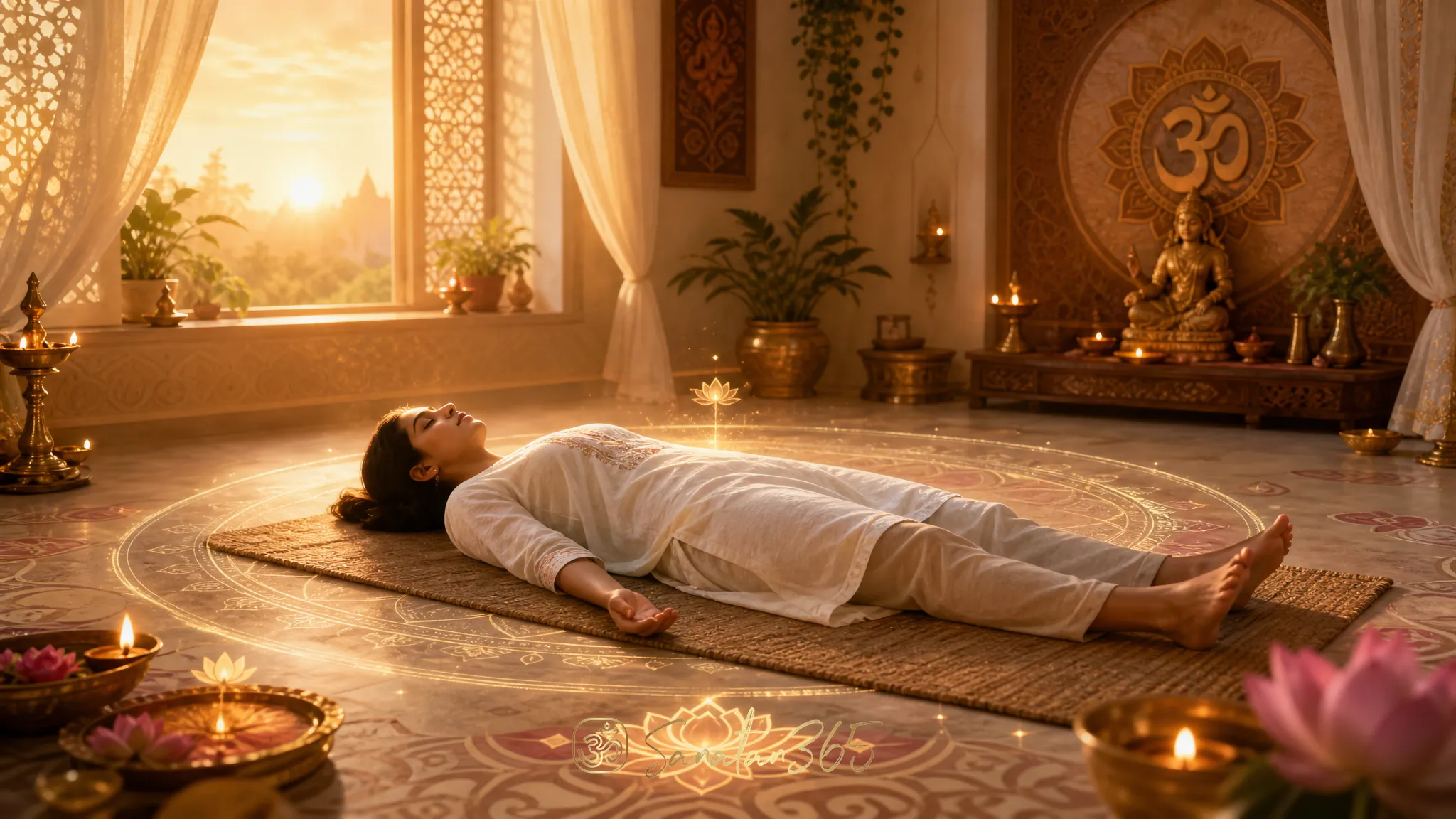
Yoga Nidra meaning begins with yoga nidrā (योग निद्रा, yogic sleep), a guided practice of conscious rest in which the body becomes deeply still while awareness remains gently present. In Hindu practice, it is not merely a sleep trick or relaxation hack. It sits near pratyahara (प्रत्याहार, withdrawal of the senses), sankalpa (संकल्प, sacred resolve), and the older Indian reflection on waking, dream, deep sleep, and the awareness that silently witnesses them.
What is Yoga Nidra meaning in simple terms?
The Yoga Nidra meaning most beginners need is simple: it is a practice of resting the body while training awareness to remain awake, steady, and receptive. A person usually lies in shavasana (शवासन, corpse pose), listens to guidance, relaxes the body part by part, watches the breath, and holds a quiet intention.
This is why Yoga Nidra is often translated as "yogic sleep." The phrase can be misleading if it makes the practice sound like ordinary sleep. Sleep Foundation explains that yoga nidra is commonly described as yogic sleep, yet it involves maintaining awareness while the body enters a sleep-like state. A peer-reviewed review in Sleep and Vigilance, available through the U.S. National Library of Medicine, also describes Yoga Nidra as a state in which awareness is preserved while the body is deeply relaxed (PMC review).
In Hindu vocabulary, nidra (निद्रा, sleep) is not treated as nothingness. Patanjali's Yoga Sutra 1.10 classifies sleep as a vritti (वृत्ति, movement or modification of the mind), not as a meaningless blank. That single insight is powerful: even sleep has a trace, a pattern, a subtle mental condition.
Yoga Nidra works with that borderland. It asks the seeker to stop forcing, stop performing, and stop gripping the senses, while remaining inwardly alert.
Key takeaway: Yoga Nidra is conscious rest, not ordinary sleep; it trains relaxed awareness rather than dullness.
How is Yoga Nidra connected with Hindu ideas of consciousness?
Yoga Nidra becomes richer when seen beside the Hindu study of consciousness. The Mandukya Upanishad famously reflects on waking, dreaming, deep sleep, and turiya (तुरीय, the fourth), the awareness beyond the usual three states. For a deeper introduction to that text, see Mandukya Upanishad Meaning: Om, Turiya, and the Four States of Consciousness.
Yoga Nidra should not be carelessly equated with turiya or treated as a shortcut to realization. That would be an overclaim. But it can help modern seekers notice something the Upanishadic tradition takes seriously: human experience is not limited to active thinking.
In waking life, attention runs outward through tasks, screens, conversations, and duties. In dream, the mind creates its own inner theatre. In deep sleep, ordinary cognition is absent, yet on waking one says, "I slept." The tradition asks: what makes these states knowable? What is constant while states change?
Yoga Nidra gives a practical taste of that inquiry. The practitioner is not solving a philosophy puzzle. The practitioner is lying down, listening, breathing, and noticing that awareness can remain soft even when the body is quiet and the senses are withdrawn.
This is why the practice should be approached with humility. It is not a replacement for scripture study, guru-guided sadhana (साधना, disciplined spiritual practice), meditation, devotion, or ethical life. It is a doorway into steadiness.
Key takeaway: Yoga Nidra can make the Hindu map of waking, dream, sleep, and awareness feel practical without reducing Upanishadic wisdom to a relaxation technique.
What happens during a Yoga Nidra practice?
Most Yoga Nidra sessions follow a clear rhythm. Different teachers and lineages vary, but the common structure is easy to recognize.
- The body settles in shavasana with the spine comfortable and the breath natural.
- A sankalpa is remembered. This is not a random wish, but a concise inner resolve aligned with dharma.
- Awareness rotates through the body, often from one limb or point to another.
- The breath is observed without strain.
- Opposite sensations may be noticed, such as heaviness and lightness or warmth and coolness.
- Images, symbols, or spacious silence may be introduced.
- The sankalpa returns.
- The practitioner slowly comes back to waking awareness.
The rotation of awareness is especially important. It gives the mind a gentle path. Instead of fighting distraction, the practitioner lets attention move in an ordered way. This resembles pratyahara because the senses are not being chased outward. They are being gathered inward.
The sankalpa also matters. In many modern spaces, intention becomes a self-improvement slogan. In a Hindu frame, sankalpa is more serious. It is a sacred resolve made in the presence of conscience. A good sankalpa is short, truthful, and dharmic: "I act with steadiness," "I speak with kindness," or "I return to my practice."
Yoga Nidra is usually guided because the mind can easily slip into ordinary sleep. Guidance creates a thread. The practitioner follows that thread without force.
Key takeaway: Yoga Nidra uses body awareness, breath, sankalpa, and guided inward attention to create conscious rest.
Is Yoga Nidra the same as meditation or sleep?
Yoga Nidra overlaps with meditation, but it is not identical to every meditation method. Dhyana (ध्यान, meditation or steady contemplation) often emphasizes seated awareness, one-pointedness, or sustained contemplation. Yoga Nidra is commonly practiced lying down and moves through a guided sequence. For more on Hindu meditation, see Dhyana Meaning: Hindu Meditation as Steady Awareness, Not Empty Escape.
Yoga Nidra also overlaps with sleep, but it is not ordinary sleep. The body may feel heavy. Breath may slow. The practitioner may drift near the edge of dreaming. Yet the instruction is to keep a trace of awareness alive.
A simple comparison helps:
- Ordinary sleep: awareness of the practice is usually lost.
- Daydreaming: the mind wanders without a stable thread.
- Seated meditation: awareness is cultivated in an upright posture.
- Yoga Nidra: the body rests deeply while guided awareness remains present.
This distinction protects the practice from confusion. If someone falls asleep, there is no need for guilt. The body may have needed rest. But the aim of Yoga Nidra is not simply to nap. The aim is to practice relaxed witnessing.
It also protects Yoga Nidra from exaggerated claims. Some online descriptions make it sound like a guaranteed cure, a replacement for sleep, or a fast spiritual achievement. Responsible Hindu wellness writing should avoid that. Yoga Nidra can be a helpful spiritual and relaxation practice, but it is not medical treatment, and it should not replace professional care for sleep disorders, trauma, anxiety, depression, or any health condition.
Key takeaway: Yoga Nidra is near sleep and near meditation, but its special character is guided conscious rest.
How can beginners practice Yoga Nidra safely and reverently?
Beginners do not need complexity. They need a clean setting, a calm guide, and realistic expectations.
A simple beginning practice may look like this:
- Choose a quiet time when you are not responsible for driving, cooking, or supervising anything urgent.
- Lie down comfortably on a mat or firm surface.
- Keep the body warm enough so rest does not become discomfort.
- Set one dharmic sankalpa in a short sentence.
- Follow a trusted teacher's guided practice for 15 to 30 minutes.
- Return slowly before standing.
- Sit quietly for a minute before re-entering activity.
Morning or evening both work. Some seekers connect Yoga Nidra with a broader morning rhythm such as Brahma Muhurta Meaning: A Gentle Hindu Morning Practice Before Sunrise. Others use it after work to transition from worldly duties into a quieter evening. Diaspora families may practice in apartments, dorm rooms, or small home puja spaces. The room does not need to look perfect. It needs to support attention.
The most important safety rule is simple: do not use Yoga Nidra while driving, operating tools, or doing anything that requires alert action. If the practice brings up distressing memories or intense emotions, stop and seek support from a qualified professional or trusted guide. Spiritual practice should deepen steadiness, not force someone through overwhelm.
It also helps to keep the practice sattvic (सात्त्विक, clear, balanced, harmonious). Avoid sensational scripts, fear-based imagery, occult promises, or aggressive breath control. A good Yoga Nidra session leaves the seeker quieter, clearer, and more grounded.
Key takeaway: beginners should keep Yoga Nidra simple, guided, safe, and rooted in dharmic intention rather than performance.
What is the deeper value of Yoga Nidra for modern seekers?
Modern life rewards constant activation. Messages, deadlines, family duties, and digital noise keep the nervous system and attention pulled outward. Yoga Nidra offers a counter-practice: lie down, stop competing, and remain aware.
Its deeper value is not laziness. It is restoration with consciousness. In Hindu life, rest is not opposed to sadhana when it serves clarity. A tired mind becomes reactive. A scattered mind becomes careless. A body never allowed to soften may struggle to sit for japa, study, seva, or meditation.
Yoga Nidra can therefore support a spiritual household in modest but meaningful ways:
- It teaches children and adults that stillness is normal.
- It gives working professionals a bridge from stress to prayer.
- It helps elders practice inwardness even when seated meditation is uncomfortable.
- It gives families a non-sectarian entry into yogic discipline without reducing it to exercise.
- It reminds seekers that awareness is subtler than constant thinking.
There is a cultural point here too. Yoga is often seen globally through posture. Yoga Nidra reminds readers that yoga also includes withdrawal, awareness, resolve, inner ethics, and refined rest. The body matters, but yoga is not only the body.
For Hindu families, this can be a quiet act of preservation. A child who learns Yoga Nidra may later ask what sankalpa means. That may open a conversation about dharma. A parent who practices conscious rest may become less reactive. That may change the emotional climate of the home.
Key takeaway: Yoga Nidra helps modern seekers recover attention, humility, and rest without separating wellness from dharma.
FAQ
What is Yoga Nidra meaning in one sentence?
Yoga Nidra meaning is yogic sleep or conscious rest, a guided Hindu-rooted practice in which the body relaxes deeply while awareness remains gently present.
Is Yoga Nidra a Hindu practice?
Yoga Nidra is rooted in Indian yogic and Hindu thought, especially ideas around nidra, pratyahara, sankalpa, and states of consciousness. Modern teachers present it in many settings, but its deeper vocabulary comes from the yogic tradition.
Can Yoga Nidra replace sleep?
No. Yoga Nidra should not be treated as a replacement for normal sleep. It can support rest and awareness, but sleep is necessary, and ongoing sleep problems should be discussed with a qualified health professional.
What is a good sankalpa for Yoga Nidra?
A good sankalpa is short, positive, truthful, and aligned with dharma. Examples include "I act with steadiness," "I speak with kindness," or "I return to my practice."
How long should beginners practice Yoga Nidra?
Beginners can start with 15 to 30 minutes under a trusted guide. Short, regular practice is usually better than a long session attempted with strain.
Conclusion
Yoga Nidra meaning is richer than "sleep meditation." It is a disciplined form of conscious rest that honors the body, gathers the senses inward, and points the seeker toward a subtler awareness beneath ordinary activity.
Key takeaway: Yoga Nidra is most valuable when practiced as relaxed awareness in the service of dharma, not as a shortcut, cure, or performance.
About the author
Sanatan365 Editorial
Bringing Sanatan Dharma to modern seekers through authentic, scripture-grounded content.
Related in Wellness
 Wellness
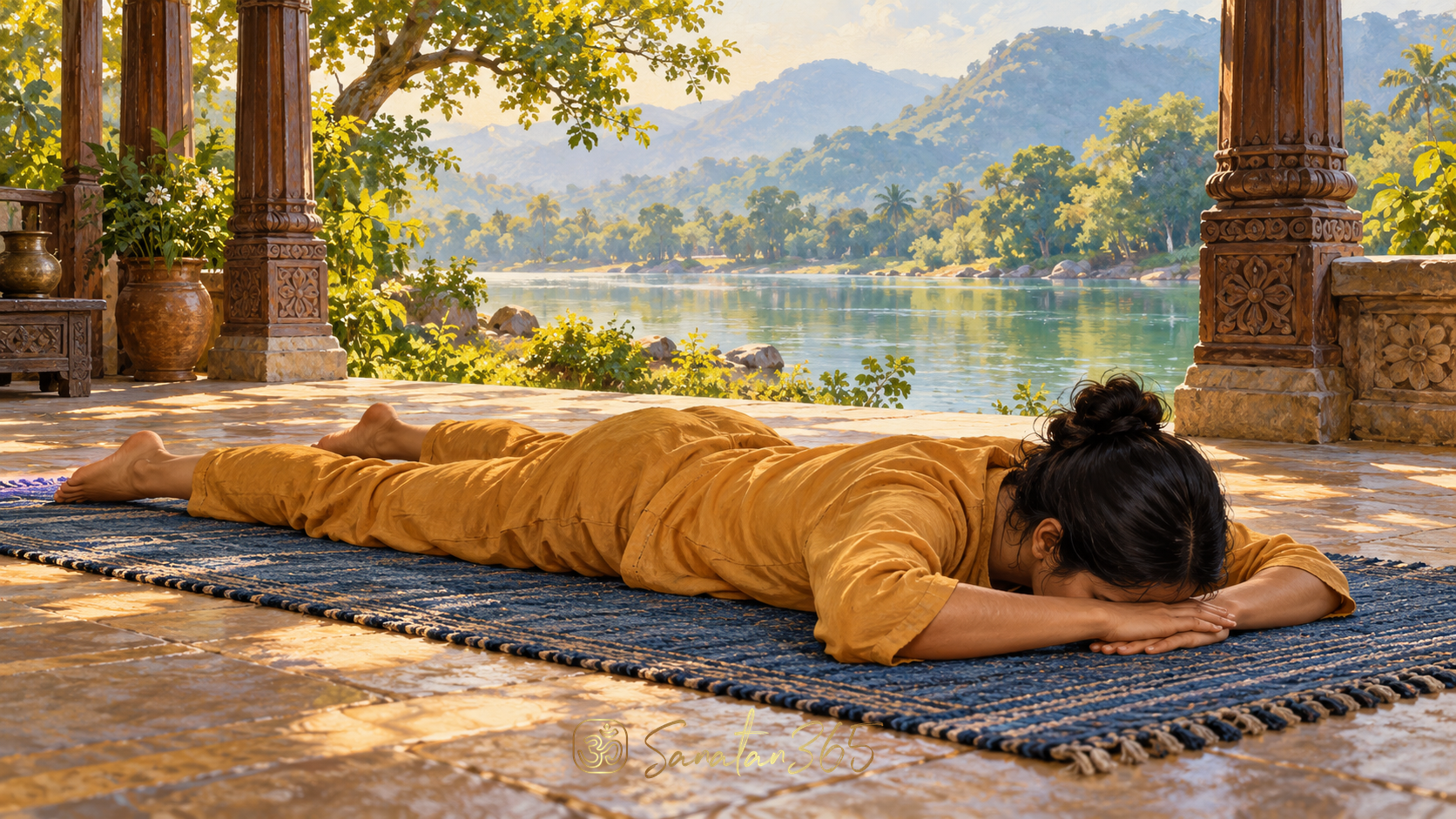
Makarasana Meaning: Crocodile Pose and the Value of Prone Rest
Learn the simple forehead-supported form of Makarasana, how it differs from Cobra and Shavasana (Corpse Pose), and why a resting posture ne…
 Wellness
Vajrasana Meaning: The Thunderbolt Pose as a Supported Seat
Explore Vajrasana as a kneeling yoga seat, its thunderbolt name, practical supports, changing historical usage, and a respectful alternativ…
 Wellness
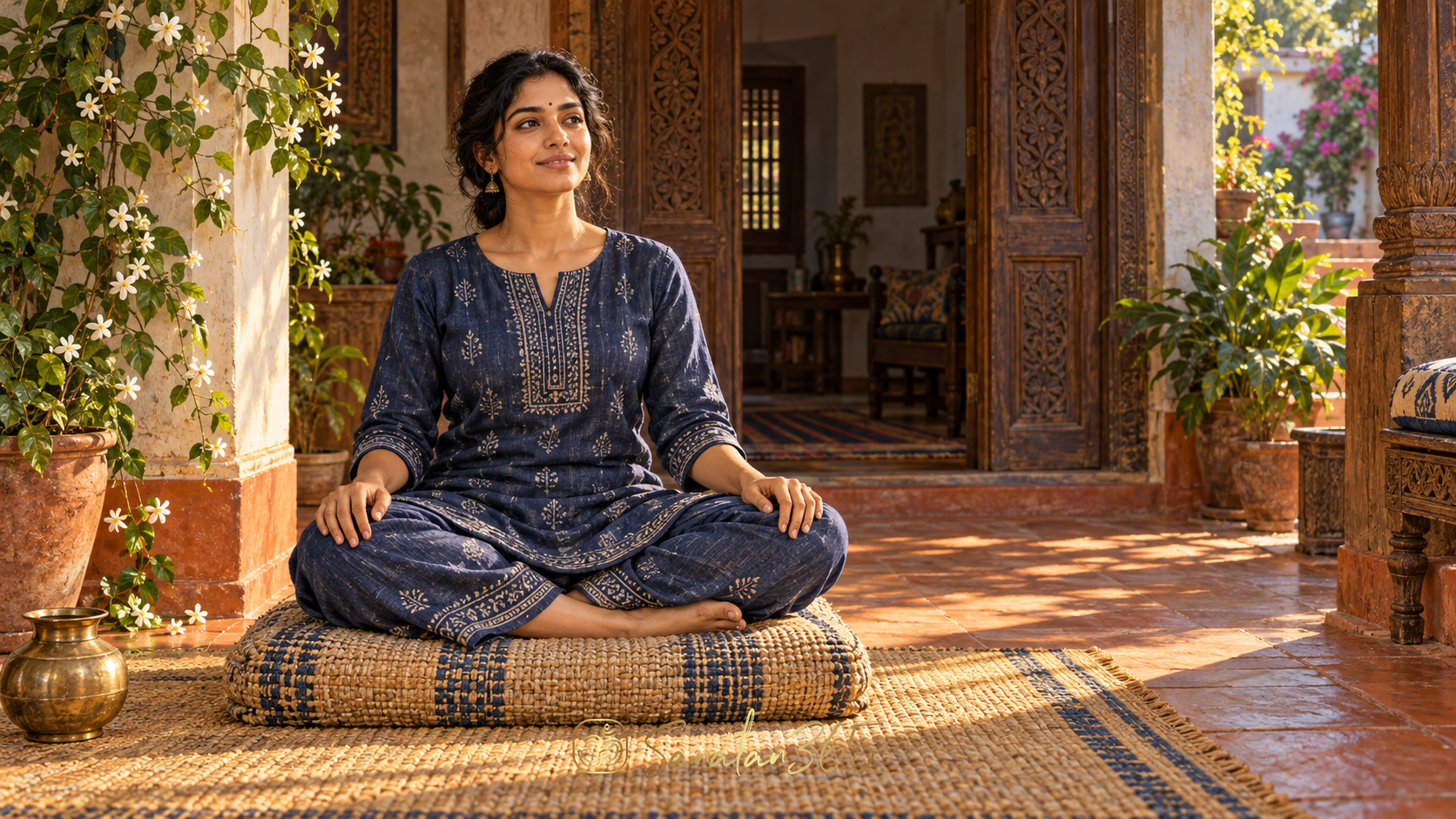
Sukhasana Meaning: Finding Ease in a Supported Seat
Sukhasana is a simple cross-legged yoga seat, not a test of flexibility. Learn its meaning, practical supports and the value of choosing st…

